UAE non-compete clause rules allow a maximum restriction period of 2 years under Article 10 of Federal Decree-Law No. 33 of 2021. If you’ve seen an older guide mention 6 months, that figure does not come from the current law, and this article explains what applies now.
Whether you’re an employee checking if a clause in your contract is enforceable, or an employer drafting one, this guide covers the UAE non-compete clause rules: legal basis, duration, exemptions, and how enforcement works in practice.
UAE Non-Compete Clause Rules at a Glance
Rule
Answer
Maximum duration
2 years
Governing law
Article 10, Federal Decree-Law No. 33 of 2021
Employers must prove damage?
Yes
Geographic limit required?
Yes
Injunction available?
Mainland: No. DIFC and ADGM: Yes
Claim limitation period
1 year from discovery
Are Non-Compete Clauses Legal in the UAE?
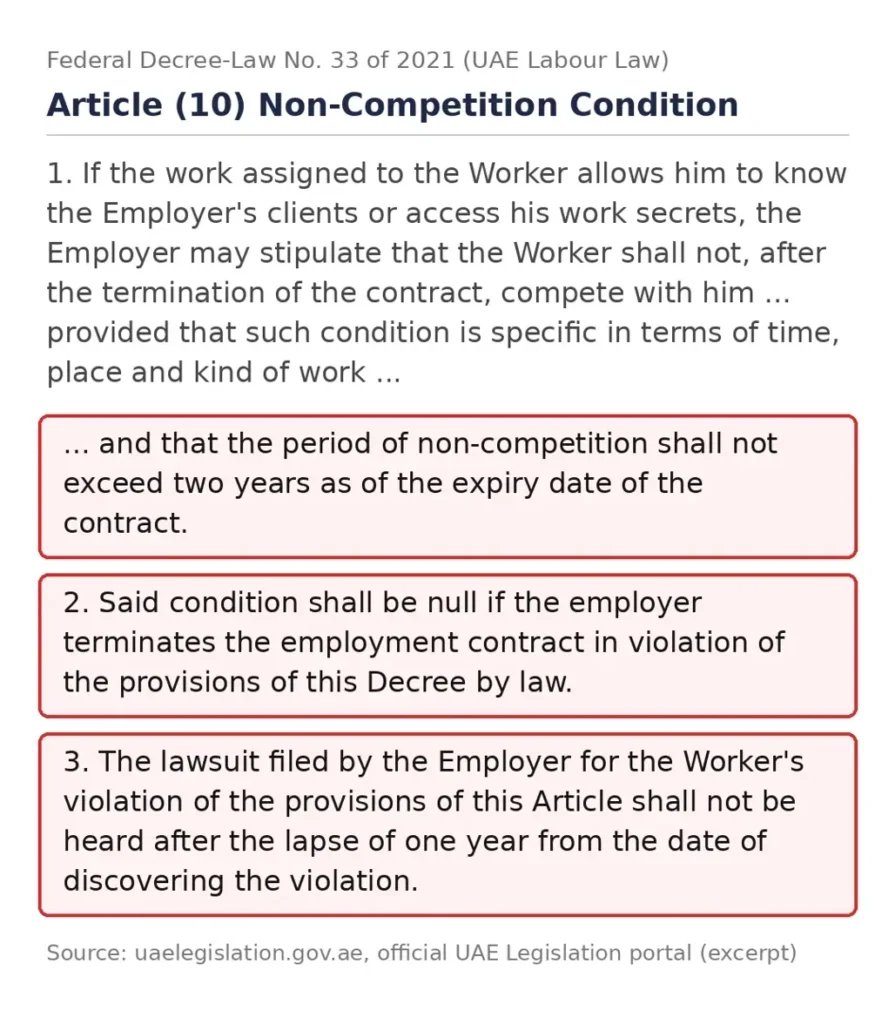
Yes. Non-compete clauses are legal and enforceable under Article 10 of Federal Decree-Law No. 33 of 2021, provided the restriction is limited in time, place, and scope, and protects a genuine business interest rather than simply blocking competition.
What Is a Non-Compete Clause Under UAE Law?
A non-compete clause is a contractual provision restricting a former employee from working for a competitor or starting a competing business for a defined period, within a defined geographic area, after employment ends.
Non-Compete vs Non-Solicitation vs Non-Disclosure
These three terms get confused often, but they’re distinct:
Non-compete: restricts working for or starting a competing business
Non-solicitation: restricts approaching the former employer’s clients or staff
Non-disclosure: restricts sharing confidential information or trade secrets
What Is the Legal Basis for Non-Compete Clauses in the UAE?
The maximum is 2 years from the date the contract ends. This is a hard legal ceiling, though courts still assess whether a shorter period would have been reasonable for the specific role and industry.
Why You Might Still See 6 Months Mentioned Online
No UAE law has set a 6-month maximum. Article 127 of the old 1980 Labour Law, repealed when Federal Decree-Law No. 33 of 2021 came into force on 2 February 2022, set no fixed period at all; it only required the restriction to be limited in time, place and nature of work, and the employee to be at least 21 when signing. The 6-month figure is usually a mix-up with the 6-month labour ban that applied under the old rules. If a guide cites a 6-month non-compete maximum, it is not based on the law.
When Is a Non-Compete Clause Enforceable in the UAE?
A non-competition clause is only valid in the first place if the employee’s role gave them genuine access to the employer’s clients or confidential business information. Without that threshold condition, the clause has no legal basis to begin with.
Beyond that, three conditions generally need to be met together:
A valid agreement, signed by both parties, compliant with the law
Genuine harm to a legitimate business interest, not simply a wish to block competition
Reasonableness, the time period, geographic scope, and nature of restricted work must be clearly defined and proportionate
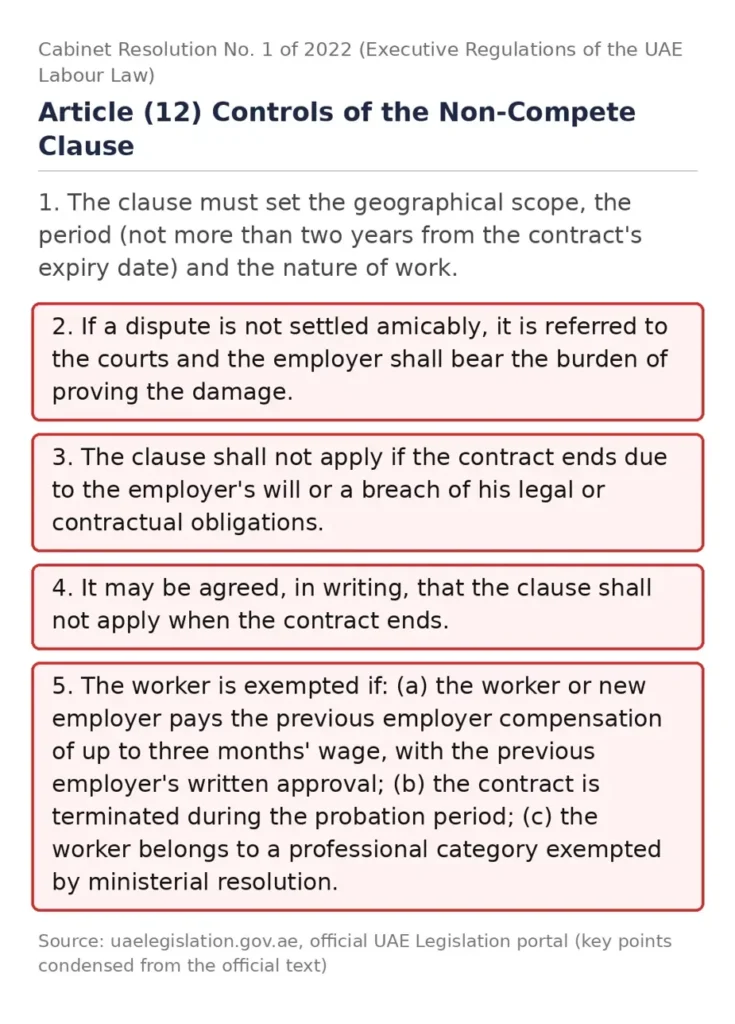
The burden of proof sits with the employer throughout. It’s not enough to show a clause was breached, the employer must prove actual, substantial damage resulted from it.
A Practical Example
A non-compete barring an IT engineer from working at “any other IT company” is too broad and unlikely to hold up. A clause restricting work on a specific project or with defined competitors, tied to real confidential information the employee had access to, is far more likely to be enforced.
Another Scenario Worth Considering
Ahmed worked as a cashier at a retail store in Dubai. His contract included a clause prohibiting him from working for any retail business for 2 years after leaving. Since his role never involved access to confidential information, pricing strategy, or major client relationships, this restriction would likely be difficult for his former employer to justify in court, regardless of how the clause was worded.
Common Myths About UAE Non-Compete Clauses
Myth: Every employee must follow a non-compete clause if it’s in their contract. Reality: Only employees whose role gave them genuine access to clients or confidential information can be bound by one in the first place.
Myth: Any breach automatically stops you from working. Reality: Employers still have to prove genuine business harm before a court will enforce the restriction.
Myth: A clause lasting the full 2 years is automatically enforceable. Reality: Courts still test whether that duration was actually reasonable for the specific role and industry.
When Are Employees Exempt from a UAE Non-Compete Clause?
The contract was ended by the employer’s decision, or the employer breached its legal or contractual obligations
The employee was terminated during their probationary period (see our notice period rules for how probation termination works)
Both parties agree in writing to waive the restriction
The new employer, or the employee, pays up to 3 months’ compensation to the former employer, with the former employer’s written consent
The employee belongs to a professional category exempted by a ministerial resolution, based on UAE labour market needs
How Is a Non-Compete Clause Actually Enforced?
Civil claim for damages: a liquidated damages clause makes this more straightforward than proving loss from scratch, though the penalty can’t be set so high that it effectively forces the employee to stay, and the employee can rebut the claim by proving no actual loss occurred
MOHRE work permit action: under Ministerial Resolution 297 of 2016, MOHRE can withhold or withdraw a work permit for the restriction’s duration, following a final court judgment. You can check your work permit status online
No injunction onshore: unlike DIFC and ADGM, mainland UAE courts don’t offer an effective injunction mechanism to immediately stop a former employee from working for a competitor
What Enforcement Actually Looks Like in Practice
The process is straightforward to describe, but slow in reality:
The employer files a complaint with MOHRE first
MOHRE attempts an amicable resolution between both parties
If that fails, the case proceeds to court
By the time a court actually considers the claim, the employee has often already been working at the competitor for months
This practical reality shapes how much real protection a non-competition clause offers, beyond just the legal text.
Recent Procedural Changes Worth Knowing
Federal Decree-Law No. 9 of 2024 didn’t amend Article 10 itself, but it changed how enforcement works in practice:
No separate court order is needed for these smaller disputes, speeding up resolution
How Long Do You Have to File a Claim?
Article 10 itself sets a specific limitation period:
An employer’s claim for an employee’s violation of the non-compete provision will not be heard if more than 1 year has passed since discovering the violation
The period starts from the date the employer discovers the violation, not from the date the employee left
It’s distinct from a separate, general 2 year labour dispute limitation period, introduced by Federal Decree-Law No. 9 of 2024, which applies to labour claims broadly rather than non-compete violations specifically
What Happens If a Non-Compete Clause Is Too Broad?
Courts may “blue pencil” an unenforceable clause, editing out the unreasonable parts while keeping the rest enforceable, rather than voiding it entirely. However, this isn’t guaranteed:
Onshore UAE courts are generally seen as less willing to do this than DIFC and ADGM courts
Some describe onshore courts as less likely to redraft and more likely to invalidate an overly broad clause in full
Don’t assume a defective clause will simply be trimmed down to something workable
Does DIFC or ADGM Follow Different Rules?
Yes, significantly. The Dubai International Financial Centre and Abu Dhabi Global Market apply common law principles rather than the federal Labour Law.
Both allow courts to grant injunctive relief, stopping a former employee immediately, a real enforcement advantage mainland UAE doesn’t offer
Enforcement of a DIFC or ADGM injunction outside the free zone itself still requires coordination with onshore courts
Can a Non-Compete Clause Be Added After the Contract Starts?
Yes. Even if the original employment contract didn’t include one, a non-compete clause can be introduced through a mutual termination agreement. The employee’s consent is generally required, and courts tend to accept this if properly documented, though an employee isn’t obligated to agree to a new restriction that wasn’t part of their original terms. If you’re reviewing your own contract for clauses like this, our guide on checking your UAE labour contract covers what else to look for.
Employer Checklist: Before Relying on a Non-Compete Clause
Does the employee’s role give them access to confidential information or major clients?
Is the duration reasonable for this specific role and industry, not just within the 2-year maximum?
Is the geographic scope limited to where the business actually operates?
Can actual financial loss be proven if the clause is breached?
Employee Checklist: Before Signing
Read exactly which industries or activities are restricted
Check the duration specified in the clause
Check the geographic area it applies to
Ask whether the clause can be waived under the exemptions above
Updates Section
Last verified: October 2026. Reflects Article 10 of Federal Decree-Law No. 33 of 2021, Article 12 of Cabinet Resolution No. 1 of 2022, and procedural enforcement changes introduced by Federal Decree-Law No. 9 of 2024.
Conclusion
The legal maximum for a UAE non-compete clause is 2 years; the 6-month figure some guides cite has no basis in the law. Enforcement onshore works through damages claims and MOHRE work permit action, not the injunctions available in DIFC or ADGM, so the practical protection a clause offers is often slower and weaker than the contract wording suggests.
If you believe a former employer or employee has breached the terms of a non-compete clause, or you’re dealing with a related employment dispute, our guide on filing a MOHRE complaint covers that first step.
If you’re unsure whether a clause in your own contract is enforceable, don’t assume it’s automatically valid just because it’s written into your agreement. Under UAE law, enforceability depends on the employee’s role, the wording of the restriction, and whether the employer can prove a genuine business interest was harmed. Confirm your specific situation with a qualified UAE employment lawyer before assuming any single figure or exemption applies to you.
Frequently Asked Questions
Are non-compete clauses legal in the UAE?
Yes. They’re legal and enforceable under Article 10 of Federal Decree-Law No. 33 of 2021, provided the restriction is limited in time, place, and scope, and the employee’s role gave them genuine access to clients or confidential information.
What is the maximum length of a non-compete clause in the UAE?
2 years from the date the employment contract ends, under Article 10 of Federal Decree-Law No. 33 of 2021.
How long does an employer have to file a non-compete claim?
1 year from discovering the violation, a limitation period set specifically within Article 10 itself.
Is a 6-month non-compete clause the standard in the UAE?
No. No UAE law has set a 6-month maximum; the old 1980 Labour Law set no fixed period, and the current law allows up to 2 years.
Can an employee get out of a non-compete clause in the UAE?
Yes, if the employer ended the contract or breached its obligations, if termination happened during probation, through mutual written waiver, by paying up to 3 months’ wage as compensation to the former employer, or if the employee’s profession is exempted by ministerial resolution.
Can a UAE employer get an injunction to stop a former employee from working for a competitor?
Not onshore. Mainland UAE courts don’t offer an effective injunction mechanism, enforcement happens through damages claims and MOHRE work permit action instead. DIFC and ADGM, applying common law, do allow injunctive relief.
Do DIFC and ADGM follow the same non-compete rules as mainland UAE?
No. Both apply their own common law frameworks, DIFC under Employment Law No. 2 of 2019, and ADGM under its Employment Regulations 2024, with different enforceability tests than onshore Labour Law.
Can a company withhold a new work permit over a non-compete violation?
Yes, under Ministerial Resolution 297 of 2016, MOHRE can withhold or withdraw a work permit for the restriction’s duration, following a final court judgment confirming the violation.
Anees is a UAE-based content creator, writer, and SEO professional with over 12 years of experience. Since 2014, he has published research-backed guides on UAE visas, labour laws, jobs, traffic fines, and government services, all verified against official sources. He is certified in SEO by HubSpot Academy and Digital Marketing by Google Digital Garage.
12+ Years ExperienceHubSpot Academy — SEOGoogle Digital Garage
Disclaimer: This information is for general guidance only, based on publicly available UAE laws and regulations. It does not constitute legal advice. Always verify with official UAE government sources or a qualified legal professional.





Your email will not be published. Comments are reviewed before appearing.