UAE maternity leave rules entitle private sector employees to 60 calendar days, 45 at full pay and 15 at half pay, under Article 30 of Federal Decree-Law No. 33 of 2021. If you’ve read that you need a year of service before you qualify, that rule comes from the old 1980 law and no longer applies.
This is a complete breakdown of maternity leave in UAE labour law: duration, pay, extensions, parental leave, and how government sector and free zone rules differ.
What Is Maternity Leave in the UAE?
Maternity leave meaning, in the UAE context, is a legally mandated period of paid and partly paid time off for female employees before and after childbirth, protecting both income and job security during this time. It is not a discretionary company benefit, it’s a statutory right under UAE maternity leave law that every private sector employer must honour.
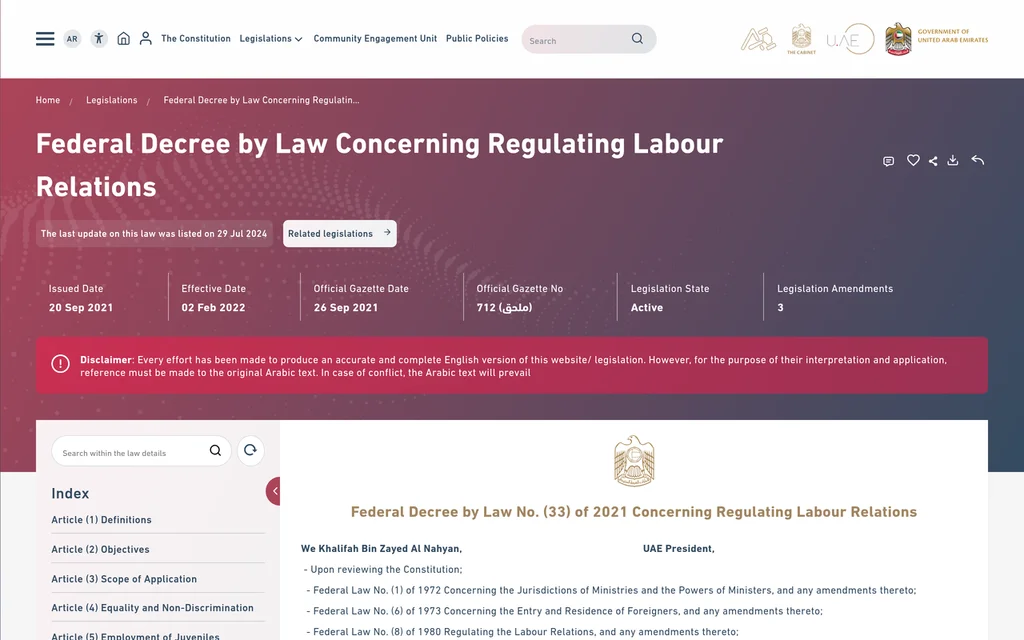
Screenshot: Federal Decree-Law No. 33 of 2021 on Regulating Labour Relations on the official uaelegislation.gov.ae website (captured October 2026).
How Long Is Maternity Leave in the UAE?
Maternity leave in UAE is 60 calendar days for private sector employees, split into 45 days at full pay followed by 15 days at half pay. Leave can begin as early as the last day of the month before the month the baby is expected.
Is Maternity Leave Counted in Calendar Days or Working Days?
Calendar days, for the private sector under federal law. This means weekends and public holidays within the leave period count toward the 60 days. This differs from DIFC and ADGM, covered further below, where leave is counted in working days instead.
How the 60 Day Entitlement Came About
The current structure isn’t the original rule:
Under the older Federal Law No. 8 of 1980, maternity leave was 45 days
This was extended when Federal Decree-Law No. 33 of 2021 came into effect on 2 February 2022
The current entitlement, 60 days, has applied since that date
If you come across older content citing a 45-day standard, it reflects the pre-2022 law and is no longer accurate.
Do You Need a Minimum Service Period to Qualify?
Many people still believe one year of service is needed.
No. Maternity leave in UAE applies from the first day of employment:
Article 30 makes no distinction based on length of service
This applies to full-time, part-time, and limited-term contract employees alike
The 1-year service rule comes from the old 1980 Labour Law, which paid full wage only after a year of service and half wage before that. The 2021 law removed that condition
If your employer applies a reduced-pay rule citing short tenure, this is worth raising with MOHRE directly
UAE Maternity Leave Pay Structure
Period
Duration
Pay Rate
Days 1 to 45
45 calendar days
100% (full pay)
Days 46 to 60
15 calendar days
50% (half pay)
Full pay includes basic salary plus regular fixed allowances, such as housing and transport. Performance bonuses and variable incentives are typically excluded from the calculation.
A Worked Example
An employee earning AED 12,000 a month, made up of AED 8,000 basic pay plus AED 4,000 in regular allowances, would receive approximately AED 18,000 for the first 45 days and AED 3,000 for the following 15 days, a total of around AED 21,000 across the full maternity leave period. Figures are illustrative and depend on your exact salary structure.
Extensions Beyond the Standard 60 Days
Pregnancy or Childbirth Related Illness
Up to 45 additional calendar days, unpaid, with a medical certificate from a licensed UAE medical authority. These days can be taken consecutively or intermittently.
Sick or Disabled Newborn
An additional 30 days at full pay, extendable by a further 30 days unpaid, with a medical report confirming the child’s condition.
Stillbirth or Miscarriage
If delivery occurs after 6 months or more of pregnancy, the full standard maternity leave applies, whether the child is born dead or born alive and then dies. Miscarriage earlier in pregnancy is generally handled under sick leave provisions instead.
Parental Leave: A Separate 5 Day Entitlement
Distinct from maternity leave itself, Article 32(1)(b) grants both mothers and fathers 5 working days of paid parental leave, to be taken within 6 months of the child’s birth, continuously or split across multiple periods. For mothers, this is additional to the 60-day maternity leave, not part of it, and it is easy to overlook when planning leave.
Is It Called Paternity Leave or Parental Leave?
The law itself uses the term parental leave, not paternity leave, because the same 5-day entitlement applies to both parents, not just fathers. If you’ve searched for paternity leave UAE specifically, this is the same entitlement, as the UAE Government Portal’s parental leave page explains.
Screenshot: Jobs section on the official u.ae website (captured October 2026).
Nursing Breaks After Returning to Work
Once back at work, mothers are entitled to one or two breaks a day for nursing, totalling no more than 1 hour, for 6 months from the date of delivery, and the breaks count as paid working time. The exact scheduling, one longer break or two shorter ones, is generally agreed with the employer.
How to Apply for Maternity Leave in the UAE
The process has five steps:
Inform your employer of your pregnancy and expected leave dates
Submit a medical certificate confirming the pregnancy and expected delivery date
Confirm your exact leave start and end dates with HR
Get HR approval and written confirmation of your leave
Submit the birth certificate after delivery, where required, for records and any parental leave claim. Remember to arrange newborn health insurance within the deadline too
There is no standardised MOHRE form for this. Most employers handle it through a written request with the medical documentation attached.
Who Pays for Maternity Leave?
Your employer pays your maternity leave salary directly. There is no broad government reimbursement to employers for this cost under federal law.
One exception: Abu Dhabi’s Social Support Authority (SSA) runs a maternity leave support initiative that tops up the salary of Emirati mothers in the private sector so they can take 90 days of paid leave, for births from 1 September 2024 onward. The mother needs an Abu Dhabi family book and her employer’s approval, and must apply within 30 days of delivery. This is specific to Emirati nationals in Abu Dhabi and does not apply broadly across the UAE or to expatriate employees.
Can an Employer Refuse Maternity Leave?
No. It’s a legal entitlement under federal law, not something granted at an employer’s discretion. An employer who denies or obstructs legitimate maternity leave is in breach of Article 30, and this is a valid basis for a MOHRE complaint.
What If the Baby Arrives Earlier Than Expected?
If childbirth happens before your planned leave date, maternity leave simply begins from the actual delivery date and continues under the standard entitlement. You don’t lose any days for an early delivery, the 60-day count starts from when the baby is actually born rather than the date you had planned to start to leave.
Can Maternity Leave Be Combined With Remote Work Afterward?
Some employers may mutually agree on flexible or remote working arrangements after maternity leave ends, but UAE labour law does not require employers to offer work-from-home arrangements. Any such arrangement is a matter of individual agreement between employer and employee, not a statutory right.
Can You Be Terminated During Maternity Leave?
No. Termination or serving notice because of pregnancy or during maternity leave is explicitly prohibited, including during unpaid extension periods. A termination linked to pregnancy or maternity absence may constitute arbitrary dismissal, which can carry compensation on top of standard end-of-service entitlements.
Maternity leave also does not reduce annual leave accrual, and the leave period counts as continuous service for end-of-service gratuity purposes.
Can You Resign During Maternity Leave?
Yes, this protection works in the employer’s direction, not the employee’s:
You’re free to resign while on maternity leave
You would still need to serve your standard notice period as set out in your contract
Resigning does not forfeit any maternity pay already due for the period you’ve taken
Government Sector Maternity Leave: How It Differs by Emirate
Government employees fall under separate rules, generally more generous than the private sector.
Sector / Emirate
Maternity Leave
Pay
Nursing Breaks
Federal government
90 days
Full pay
2 hours/day for 6 months
Dubai government
90 days, extendable to 120 combined with annual/unpaid leave
Full pay for 90 days
2 hours/day for 1 year
Sharjah government
120 days (90 paid + 30 unpaid)
Full pay for 90 days
2 hours/day for 6 months
Abu Dhabi government
90 days
Full pay
2 hours/day for 1 year
Ras Al Khaimah government
90 days
Full pay
2 hours/day for 1 year
A Proposal Worth Knowing About
In January 2026, the Federal National Council recommended extending federal public sector maternity leave to 98 fully paid days, aligning with international standards. As of the most recent update, this remains a recommendation and has not been enacted into law. Confirm current entitlements before relying on this figure.
DIFC and ADGM: Different Rules for Free Zone Employees
5 working days, within 1 to 2 months depending on jurisdiction
Working days can meaningfully extend the real calendar time off. 65 working days across a standard 5-day week works out to roughly 13 calendar weeks, compared to about 8.5 weeks under the mainland’s 60 calendar days. However, DIFC and ADGM’s 12-month service requirement for paid leave is stricter than mainland law, which has none.
Combining Maternity Leave with Other Leave Types
Cabinet Resolution No. 1 of 2022 permits combining parental leave, annual leave, and unpaid leave with maternity leave.
Leave Type
Duration
Pay Status
Maternity leave
60 calendar days
45 full + 15 half pay
Parental leave
5 working days
Full pay
Accrued annual leave
Up to 30 calendar days
Full pay
Unpaid extension, if needed
Up to 45 calendar days
Unpaid
Maximum possible total
~140 calendar days
Documents Required for Maternity Leave
Document
When Required
Medical certificate confirming pregnancy and expected delivery date
Before leave starts, if beginning pre-delivery
Birth certificate
After delivery, for records and parental leave claims
Medical certificate for illness extension
To claim the additional 45 unpaid days
Medical report for sick or disabled child
To claim the 30 paid + 30 unpaid day extension
There is no standardised MOHRE form. Requests are typically submitted in writing to your employer, with supporting medical documentation attached.
Common Issues to Watch For
Employer pays only basic salary, excluding regular allowances: the full wage during the paid period should include fixed contractual allowances like housing and transport
Maternity leave deducted from annual leave balance: these are separate entitlements, and one cannot be counted against the other. For more on how continuous service is counted, see our guide on the UAE Gratuity Calculator, since maternity leave counts toward gratuity purposes
Termination shortly after returning to work: if linked to the pregnancy or leave itself, this may constitute arbitrary dismissal. Our guide to UAE Notice Period Rules covers how termination protections and required notice generally work
If any of these occur, filing a complaint with MOHRE is the appropriate next step.
Updates Section
Last verified: October 2026. Reflects Article 30 and Article 32 of Federal Decree-Law No. 33 of 2021, Cabinet Resolution No. 1 of 2022, the ADGM Employment Regulations 2024 (effective 1 April 2025), and the January 2026 FNC recommendation for public sector leave, noted as not yet enacted.
Conclusion
The private sector entitlement is 60 calendar days with no minimum service requirement. Government sector and free zone employees fall under meaningfully different rules than the standard private sector entitlement, so which framework applies to you depends entirely on your employer and emirate.
Confirm any company-specific policy against the law text before accepting it, and check your labour contract for any extra maternity benefits your employer has agreed to.
Frequently Asked Questions
How many days of maternity leave does UAE labour law provide?
Private sector employees receive 60 calendar days: 45 at full pay and 15 at half pay, under Article 30 of Federal Decree-Law No. 33 of 2021.
Is there a minimum service requirement for maternity leave in the UAE?
No. Maternity leave applies from the first day of employment under federal law. DIFC and ADGM specifically require 12 months of continuous service for paid leave.
Can I take maternity leave before giving birth?
Yes, from the last day of the month before the month the baby is expected, and these days count toward the total 60-day entitlement.
Does maternity leave include weekends and public holidays?
Yes, under federal law it’s counted in calendar days. DIFC and ADGM count it in working days instead, which excludes weekends and holidays.
Can my employer terminate me during maternity leave?
No. This is explicitly prohibited, including during unpaid extension periods, and may constitute arbitrary dismissal if it occurs.
Can I resign while on maternity leave?
Yes. The termination protection applies to your employer, not to you. You can resign during maternity leave, but you still need to serve your standard notice period, and doing so doesn’t forfeit maternity pay already due.
Is it called paternity leave or parental leave in the UAE?
The law calls it parental leave, since the same 5-day entitlement applies to both parents, not just fathers. Paternity leave and parental leave refer to the same thing in this context.
How do I apply for maternity leave in the UAE?
Inform your employer, submit a medical certificate confirming your pregnancy and due date, confirm exact leave dates with HR, get written approval, and submit the birth certificate afterward if required.
Who pays for maternity leave in the UAE?
Your employer pays it directly. There is no broad government reimbursement, though Abu Dhabi runs a specific supplementary support scheme for Emirati mothers in the private sector, on top of employer-paid leave.
Can an employer refuse to grant maternity leave?
No. It’s a legal entitlement, not discretionary. Refusing or obstructing it breaches Article 30 and is a valid basis for a MOHRE complaint.
What happens if my baby is born earlier than my planned leave date?
Your maternity leave simply starts from the actual delivery date instead. You don’t lose any days for an early birth.
Can I work remotely after maternity leave instead of returning to the office?
Only if your employer agrees to it. UAE labour law doesn’t require employers to offer remote work arrangements after maternity leave.
What happens if my baby is born with an illness or disability?
The mother receives 30 additional days at full pay, extendable by a further 30 days unpaid, with a medical report confirming the condition.
Can fathers take leave when a child is born?
Yes, both parents are entitled to 5 working days of paid parental leave within 6 months of the birth, separate from and additional to maternity leave.
Does UAE law cover adoption leave?
Federal mainland law does not explicitly address adoption leave. DIFC and ADGM, as separate free zone jurisdictions, do provide equivalent maternity leave for adopting a child under 5.
Is maternity leave different for government employees?
Yes, government sector entitlements are generally longer, ranging from 90 to 120 days depending on the federal or local emirate authority, compared to 60 days in the private sector.
Can I take 12 months of maternity leave in the UAE?
No. Even combining every available entitlement, maternity leave, parental leave, accrued annual leave, and the unpaid illness extension, the realistic maximum comes to around 140 calendar days, roughly 4.5 months, not a full year.
Are part-time or contract employees eligible for maternity leave?
Yes, the leave duration itself applies regardless of contract type. Some sources report that pay may be calculated proportionate to working hours for part-time arrangements, though this isn’t explicitly detailed in the primary law text, so confirm your specific pay calculation with your employer or MOHRE.
Anees is a UAE-based content creator, writer, and SEO professional with over 12 years of experience. Since 2014, he has published research-backed guides on UAE visas, labour laws, jobs, traffic fines, and government services, all verified against official sources. He is certified in SEO by HubSpot Academy and Digital Marketing by Google Digital Garage.
12+ Years ExperienceHubSpot Academy — SEOGoogle Digital Garage
Disclaimer: This information is for general guidance only, based on publicly available UAE laws and regulations. It does not constitute legal advice. Always verify with official UAE government sources or a qualified legal professional.




Your email will not be published. Comments are reviewed before appearing.