The UAE minimum wage law does not set a general wage floor for all private sector workers. It sets one specific, mandatory minimum wage of AED 6,000 a month for Emirati nationals in the private sector, effective 1 January 2026. Older salary figures still circulating online, AED 12,000, 7,000 and 5,000 by qualification, come from a withdrawn labour-ban rule, not a minimum wage. This guide explains what is current and what isn’t.
If you’re searching for the minimum wage in UAE, minimum wage Dubai, or minimum wage Abu Dhabi, the short answer is the same everywhere in the country: one legally mandated figure exists, and it applies to a specific group of workers, not everyone.
Is There a Minimum Wage in the UAE?
Yes and no, depending on who you’re asking about. There is a mandatory AED 6,000 minimum wage for Emirati nationals in the private sector. There is no general, universal minimum wage covering expatriate workers, who make up the majority of the UAE’s private sector workforce.
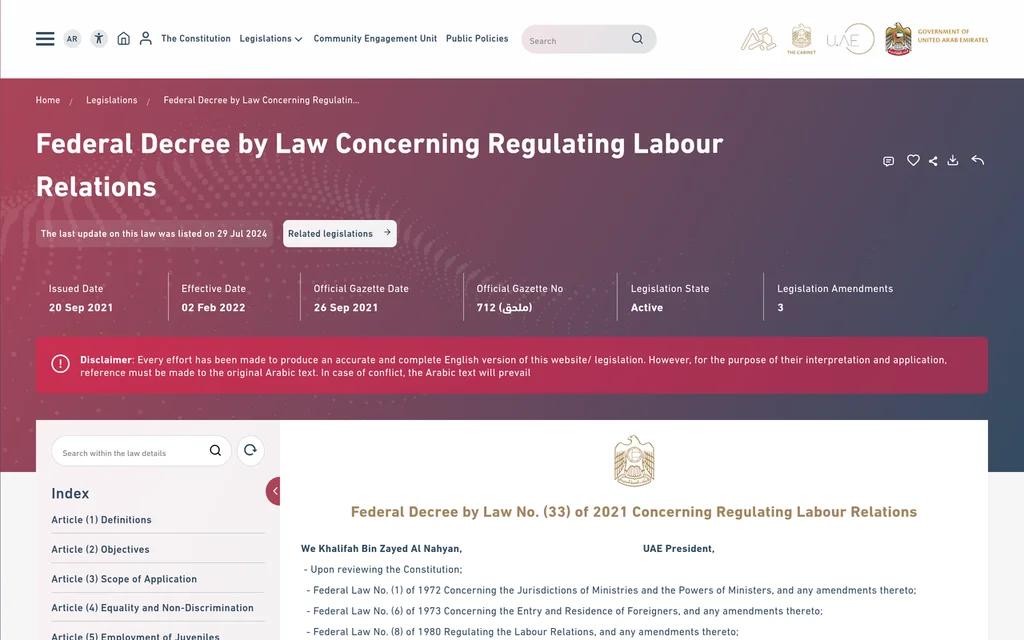
Screenshot: Federal Decree-Law No. 33 of 2021 on Regulating Labour Relations on the official uaelegislation.gov.ae website (captured October 2026).
Does the UAE Have the Legal Power to Set One for Everyone?
Yes. Article 27 of Federal Decree-Law No. 33 of 2021 allows the Cabinet, on the Minister’s proposal, to issue a resolution setting the minimum wage. So far, no general minimum wage resolution covering all workers has been issued. The binding figure that exists is the Emirati private sector wage set by MOHRE.
UAE Minimum Wage for Emiratis: The AED 6,000 Rule
This is the current, legally binding minimum wage in the UAE, and it applies the same way whether the job is based in Dubai, Abu Dhabi, or any other emirate.
Detail
Figure
Current minimum wage
AED 6,000/month, effective 1 January 2026
Previous minimum wage
AED 5,000/month
Applies to new work permits
From 1 January 2026
Deadline for existing Emirati staff
30 June 2026
Consequences begin
1 July 2026
What Happens If Employers Don’t Comply?
From 1 July 2026, Emirati employees earning below AED 6,000 no longer count toward a company’s Emiratisation quota, and the establishment risks suspension of new work permits until it complies. That directly affects a business’s ability to hire, not just its costs.
What Happens If a Company Misses Its Emiratisation Target?
Separately from the minimum wage rule, private sector companies that miss their Emiratisation target pay a financial contribution for every Emirati role left unfilled, and the amount rises each year. For 2026, it is widely reported as AED 108,000 a year (AED 9,000 a month) per unfilled role. Confirm the amount that applies to your establishment with MOHRE.
Does the AED 6,000 Figure Include Allowances?
MOHRE’s announcement sets AED 6,000 as the minimum monthly wage. It does not say the figure is basic salary only, so employers should not assume a low basic plus allowances is enough without checking. If you are an employer, confirm with MOHRE how your contract structure will be assessed; if you are an Emirati employee, check that your contract shows a total monthly wage of at least AED 6,000.
Why Basic Salary in UAE Contracts Matters Beyond This Rule
The difference between basic salary and total package also drives gratuity, overtime and end-of-service calculations. Our UAE Gratuity Calculator shows how basic salary is used at the end of your service, and our UAE overtime calculator uses the same basic figure. “Basic” means the base pay figure in your contract, not your gross monthly income.
Is There a Required Basic Salary Percentage?
No. UAE Labour Law does not require basic salary to be any specific percentage of total pay. Many employers put basic salary at around half or more of the package, with allowances making up the rest, but this is market practice, not a legal requirement. You can see your own split by doing a UAE labour contract check. See real examples and the DIFC rule in our guide to basic salary percentage.
Why Do You See AED 12,000, 7,000, and 5,000 Figures Online?
These figures come from MOHRE’s 2016 skill-level rules for changing jobs without a labour ban. They were salary thresholds for avoiding a ban, not a minimum wage employers had to pay:
Skill Level 1 (university degree): AED 12,000
Skill Level 2 (diploma): AED 7,000
Skill Level 3 (secondary school certificate): AED 5,000
The old labour-ban system linked to these thresholds no longer applies under the current labour law. If you see these figures presented as a current minimum wage, treat that content as outdated. For how job changes work today, see our labour ban check guide.
Is There a Minimum Wage for Expats in the UAE?
No general one. Expatriate salaries in the UAE private sector are set by individual employment contracts, negotiated between employer and employee, not by a statutory wage floor.
What Determines Expat Salaries in Practice?
Skill level, qualifications, and experience
Industry and sector demand
Company size and financial standing
Whether accommodation, transport or meals are provided as part of the package
Free zone versus mainland employment, since some free zones apply their own salary guidance for visas
Is AED 3,000 or 7,000 a Good Salary in the UAE?
This depends heavily on lifestyle, city, and whether accommodation is included. AED 3,000 a month is generally only workable if housing, transport, or meals are covered by the employer, since rent alone in Dubai or Abu Dhabi usually exceeds this for a private room or studio. AED 7,000 gives more flexibility for someone covering their own rent and living costs, though it still requires careful budgeting in the more expensive emirates. Neither figure is a legal minimum; they are simply common reference points people compare their offers against.
Screenshot: Jobs section on the official u.ae website (captured October 2026).
The Wage Protection System (WPS): How Wages Are Actually Enforced
Since there’s no general minimum wage, the UAE enforces on-time wage payment through the Wage Protection System, run by MOHRE with the Central Bank.
Salaries must be paid through WPS-approved banks or exchange houses
Under Ministerial Resolution No. 340 of 2026, effective 1 June 2026, wages are due on the first day of each Gregorian month
Employers must transfer at least 85% of total wages due to be considered compliant, up from the previous 80%
Late payment triggers escalating measures, including work permit suspension, administrative penalties and, in serious cases, referral to the authorities
If your employer misses a payment and doesn’t resolve it, filing a complaint with MOHRE is the correct next step. The same process covers minimum wage non-compliance for Emirati employees.
Is There a Minimum Wage Per Hour or Per Day?
No. Since there’s no general minimum monthly wage for expatriate workers, there’s no official hourly or daily figure either. Any per-hour or per-day rate you see quoted online is a calculation from a specific salary or contract, not a published statutory rate.
Salary Deduction Limits
Article 25 of Federal Decree-Law No. 33 of 2021 limits what an employer can deduct:
Certain deductions, such as recovering a loan or advance from the employer, cannot exceed 20% of the wage
Deductions for violations the worker commits cannot exceed 5% of the wage
In all cases, total deductions cannot exceed 50% of the wage
Equal Pay: The Other Wage Rule Worth Knowing
Separate from any minimum figure, Article 4 of Federal Decree-Law No. 33 of 2021 requires that a woman be paid the same wage as a man for the same work, or work of equal value. Since Federal Decree-Law No. 9 of 2024, serious labour law breaches can carry fines of AED 100,000 to AED 1,000,000.
Recent Penalty Changes Employers Should Know
Federal Decree-Law No. 9 of 2024, effective 31 August 2024, raised penalties for labour law violations, with fines reaching up to AED 1,000,000, and higher penalties where violations involve fictitious employment arrangements.
Updates Section
Last updated: October 2026. Reflects the AED 6,000 Emirati private sector minimum wage effective 1 January 2026 announced by MOHRE, and the Wage Protection System’s 85% threshold and first-of-month payment date under Ministerial Resolution No. 340 of 2026, effective 1 June 2026.
Conclusion
The only legally mandated minimum wage in the UAE is AED 6,000 a month for Emirati private sector employees, the same figure whether the role is in Dubai, Abu Dhabi or elsewhere. The AED 12,000, 7,000 and 5,000 figures still circulating online come from a scrapped labour-ban rule, not a current requirement.
For expatriate workers, pay is contract and market driven, and the Wage Protection System makes sure the agreed wage is paid on time rather than setting a floor. Since basic salary also drives gratuity, it is worth knowing exactly how your package is split. When in doubt, confirm salary rules directly with MOHRE.
Frequently Asked Questions
Is there a minimum wage in the UAE?
Yes, specifically for Emirati nationals in the private sector, set at AED 6,000 a month from 1 January 2026. There is no general minimum wage for expatriate workers.
What is the UAE minimum wage law for 2026?
AED 6,000 per month for Emirati private sector employees, up from AED 5,000 previously. Employers must bring existing Emirati staff up to this level by 30 June 2026.
Is AED 12,000 the minimum wage in the UAE?
No. This figure comes from MOHRE’s old 2016 skill-level rules for avoiding a labour ban when changing jobs. It was never a minimum wage and no longer applies.
Do expatriate workers have a minimum wage in the UAE?
No general one. Expat salaries are set by individual employment contracts and market conditions, not a statutory minimum.
What happens if an employer doesn’t pay the Emirati minimum wage?
From 1 July 2026, affected employees won’t count toward the company’s Emiratisation quota, and the business risks suspension of new work permits until it complies.
Does the UAE have the legal authority to set a minimum wage for everyone?
Yes. Article 27 of Federal Decree-Law No. 33 of 2021 lets the Cabinet issue a minimum wage resolution, but no general one covering all workers has been issued so far.
What is the Wage Protection System, and how does it relate to minimum wage?
WPS is the UAE’s system for making sure wages are paid on time through approved banks and exchange houses. It doesn’t set a minimum wage. Under Ministerial Resolution No. 340 of 2026, wages are due on the first of each Gregorian month, and employers must pay at least 85% of wages due to be compliant.
Does UAE law require equal pay for men and women?
Yes. Article 4 of Federal Decree-Law No. 33 of 2021 requires a woman to be paid the same as a man for the same work or work of equal value.
Is there a required basic salary percentage under UAE labour law?
No. The law doesn’t set a split between basic salary and allowances. How it is split is a matter of contract and market practice.
Is there a UAE minimum wage per hour or per day?
No. Since there’s no general minimum monthly wage for expatriates, there’s no official hourly or daily rate either.
Is AED 3,000 a good salary in Dubai?
It depends on whether housing and other costs are covered by your employer. As a standalone salary without accommodation, AED 3,000 is tight in most emirates, since rent alone often exceeds this for a private room or studio.
Anees is a UAE-based content creator, writer, and SEO professional with over 12 years of experience. Since 2014, he has published research-backed guides on UAE visas, labour laws, jobs, traffic fines, and government services, all verified against official sources. He is certified in SEO by HubSpot Academy and Digital Marketing by Google Digital Garage.
12+ Years ExperienceHubSpot Academy — SEOGoogle Digital Garage
Disclaimer: This information is for general guidance only, based on publicly available UAE laws and regulations. It does not constitute legal advice. Always verify with official UAE government sources or a qualified legal professional.





Your email will not be published. Comments are reviewed before appearing.