UAE Visa Overstay Fine 2026: AED 50/Day RulesMinimum Salary to Sponsor Your Family Visa in UAEUAE Labour Law: Notice Period ExplainedHow to Check Your UAE Visa Status OnlineUAE Golden Visa Eligibility Requirements UpdatedUAE Visa Overstay Fine 2026: AED 50/Day RulesMinimum Salary to Sponsor Your Family Visa in UAEUAE Labour Law: Notice Period ExplainedHow to Check Your UAE Visa Status OnlineUAE Golden Visa Eligibility Requirements Updated
Health Insurance Fine in Abu Dhabi (2026): TAMM Check, Rules and How to Pay
The UAE Times
–
–
– min read
Last updated: – · Based on official UAE sources
An Abu Dhabi insurance fine applies the moment your health coverage lapses. The amount is AED 300 per month for every person without an active policy, confirmed directly by the Department of Health (DoH), Abu Dhabi’s health regulator.
This guide goes further than the basic number. It covers who actually has to pay for a dependent’s coverage, how to check your health insurance fine in Abu Dhabi on TAMM, and one thing almost nobody explains clearly: whether HAAD or DoH is the right authority to look for.
For the wider picture, Dubai’s rate, the Northern Emirates, and general UAE rules, see our complete guide to health insurance fines in the UAE. This page focuses only on Abu Dhabi.
Is HAAD or DoH the Right Authority for Abu Dhabi Health Insurance?
This mix up trips up a lot of people searching for an insurance fine in Abu Dhabi.
HAAD stands for Health Authority, Abu Dhabi. In 2018, it was renamed the Department of Health, or DoH. They are the same organisation. Nothing changed except the name.
So if you see “HAAD health insurance fine” on one site and “DoH health insurance fine” on another, they mean the same thing. Some older articles still use “HAAD” as if it is a separate, active body. It is not. Always look for the current name, DoH, when checking official information.
Abu Dhabi Health Insurance Law: The Legal Basis
Health Insurance Law No. 23 of 2005
Abu Dhabi’s mandatory health insurance rule comes from Health Insurance Law No. 23 of 2005. It came into force on 1 June 2006, making Abu Dhabi one of the first emirates to require health coverage by law.
The law applies to both UAE nationals and expatriates living in Abu Dhabi, along with their sponsored dependents. This is one reason Abu Dhabi’s system is often described as stricter than other emirates. It has simply been running longer.
How Much Is the Health Insurance Fine in Abu Dhabi?
The Abu Dhabi health insurance fine is AED 300 per month for every person without an active subscription. This comes from Item 1 of DoH’s official Violations and Penalties Schedule, and DoH confirmed the same figure directly in its own public announcement.
This rate applies flatly per person. The published schedule does not list a separate, lower rate for a spouse or child. If you come across a site claiming a different amount for dependents, treat it carefully; it is not in the official document.
A note on “exemptions”: back in 2021, DoH temporarily exempted health insurance customers from fines during a COVID related grace period. That blanket amnesty ended in October 2021 and is not active today.
However, this is different from a separate, still-active set of exemption categories, covered in detail below. If you see “Abu Dhabi health insurance fine exemptions” mentioned, it could mean either the expired 2021 relief or the ongoing categories, so it’s worth knowing both.
Who Is Exempt From a Health Insurance Fine in Abu Dhabi Today?
DoH has confirmed three specific cases where a sponsor is not fined for failing to insure someone, and these remain active, not tied to the 2021 amnesty above.
Absconding workers: No fine applies from the date the absconding report is officially filed with the authorities until the situation is resolved. The sponsor must provide documentation proving the report was made.
Death of the sponsor: No fine applies if the sponsor has passed away, provided an official death certificate is shared with the relevant authorities.
Illegal residency cases: No fine applies to sponsors of individuals found residing in Abu Dhabi illegally, without a valid residency visa.
These exemptions must be formally supported with documentation, they are not automatic just because one of these situations applies.
Other Abu Dhabi Health Insurance Violations Beyond the Base Fine
The AED 300 monthly fine is not the only penalty in Abu Dhabi’s schedule. Two others catch employers off guard:
Not handing over a beneficiary’s insurance policy or card at the time of visa issuance or renewal: AED 5,000 per case
Refusing to cover emergency treatment costs for someone left uninsured: AED 1,000 per case
Both come from DoH’s official Violations and Penalties Schedule, the same document that sets the AED 300 base fine. If you are an employer in Abu Dhabi, these two are worth knowing on top of the main fine.
A newborn baby also has its own notification window: parents generally need to register a newborn for health insurance within 30 days of birth to stay compliant. This is a separate timing rule from the standard monthly fine, and it is worth acting on quickly given how easy it is to overlook amid other post-birth paperwork.
How to Appeal or Remove a Health Insurance Fine in Abu Dhabi
If you believe your fine was issued incorrectly, DoH has an official channel for this, not a workaround, a real government service.
The service is called “Appeal Request for any Health Insurance Violations”, available directly through DoH.
For individuals (patients or sponsors), submitting a complaint or appeal against a violation decision carries a fee of AED 100.
Most appeals are resolved within 30 to 60 working days. Cases involving suspected fraud or abuse can take considerably longer.
This is different from simply paying the fine on TAMM. Paying settles the amount owed. Appealing challenges whether the fine should have applied in the first place, useful if your coverage was actually active, or the record is wrong.
Be cautious of third-party agents or typing centres promising a guaranteed “discount” or “removal” of a fine for a fee. The only real channel is DoH’s own appeal service; anything outside that is not official.
Who Has to Pay for a Health Insurance Fine in Abu Dhabi?
This is where most guides stop too early. Knowing the amount of a health insurance fine in Abu Dhabi matters less than knowing who is actually responsible for coverage in the first place.
Employer’s Obligation
Employers in Abu Dhabi must provide health insurance for:
The employee
One spouse
Up to three children under the age of 18
Anyone outside this list, a fourth child, a parent, or a domestic worker, needs separate coverage arranged individually.
The Dependent Premium Split
Here is a detail most competitor sites skip entirely, and it is a precise legal rule, not a loose guideline.
The employer covers the employee’s own premium in full.
For a spouse or child, the employer is legally required to cover exactly 50% of the premium. The remaining 50% is the employee’s responsibility, often collected through payroll deduction.
Some employers voluntarily cover more than the legal minimum as a benefit, but 50/50 is the baseline requirement, not something that varies freely by company policy.
If your employer is deducting more than half the dependent premium from your salary, that is worth raising with HR directly.
What the Minimum Health Insurance Plan Must Cover
Every mandatory plan in Abu Dhabi must include a baseline set of benefits:
Primary and outpatient care
Emergency treatment
Maternity care
In-patient and surgical treatment
Diagnostic tests
Prescribed medication
If your policy is missing any of these, it likely does not meet the minimum legal requirement, and that gap itself can lead to a fine.
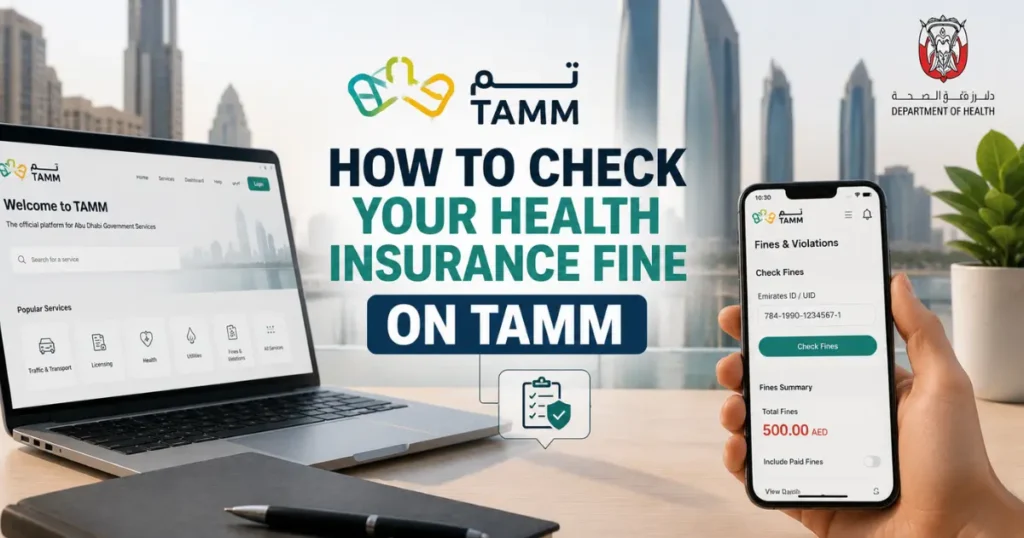
How to Check Your Health Insurance Fine on TAMM (Step by Step)
TAMM is Abu Dhabi’s official government services platform, and it is where you check and pay a health insurance fine directly.
Go to the official TAMM platform (via website or mobile app).
Log in using UAE Pass: Click the “Log in with UAE Pass” button on TAMM. Open the UAE Pass authenticator app on your phone to securely verify your identity and auto-redirect back to TAMM.
Navigate to the Department of Health services on the TAMM dashboard.
Select the “Health Insurance Penalty Payment” service.
Enter details: Put in your Emirates ID or Unified Number (UID) to fetch real-time data from the DoH database.
Review and Pay: Review any outstanding balance displayed on TAMM and settle it directly through the portal using a credit card
Menu names on TAMM can shift slightly with platform updates, so if a step looks different from what is listed here, look for wording close to “health insurance” or “DoH services” within the portal.
What Happens If You Don’t Pay a Health Insurance Fine in Abu Dhabi?
An unpaid health insurance fine in Abu Dhabi does not just sit quietly on your record. It links directly to your visa renewal.
DoH and ICP systems check for an active, valid policy before processing a residence visa renewal in Abu Dhabi. An outstanding fine, or a lapsed policy, can hold up that renewal until it is resolved.
For the full breakdown of how this works across the whole UAE, including Dubai and the Northern Emirates, see our main guide to UAE health insurance fines.
Recent Updates
Last updated: July 2026. This page reflects Abu Dhabi’s Health Insurance Law No. 23 of 2005, DoH’s official Violations and Penalties Schedule, and DoH’s 2018 rename from HAAD to Department of Health. It will be updated if DoH publishes any revised fine schedule or rules.
Conclusion
A health insurance fine in Abu Dhabi comes down to one clear number, AED 300 per month per uninsured person, confirmed directly by DoH. What actually protects you from a health insurance fine in Abu Dhabi is understanding two things this guide covers that most others skip: exactly who is responsible for a dependent’s premium, and how to check your real status on TAMM before it becomes a visa problem.
If your Abu Dhabi visa renewal is coming up, check your policy and your dependents’ policies on TAMM now, not at the last minute. It takes a few minutes and can save you a fine that only grows the longer it is left unpaid.
Frequently Asked Questions
Is HAAD the same as DoH for health insurance in Abu Dhabi?
Yes. HAAD, the Health Authority, Abu Dhabi, was renamed the Department of Health (DoH) in 2018. Both names refer to the same regulator, and any reference to a HAAD health insurance fine means the same thing as a DoH health insurance fine.
What is the fine for not having health insurance in Abu Dhabi, and how much are fines overall?
AED 300 per month for every person without an active health insurance subscription. This is confirmed both by DoH’s official Violations and Penalties Schedule and by DoH’s own public statements, and it is the base fine most cases involve.
How to check the health insurance penalty in Abu Dhabi specifically?
Use the TAMM platform’s dedicated “Health Insurance Penalty Payment” service. Log in with UAE Pass, search for this service by name, and it will show any outstanding penalty linked to your Emirates ID.
How to remove an insurance fine in Abu Dhabi?
Through DoH’s official “Appeal Request for any Health Insurance Violations” service. Individual appeals cost AED 100 and are typically resolved within 30 to 60 working days. This only works if the fine was genuinely incorrect, it does not waive a valid fine.
What is the fine for no medical insurance in the UAE compared to Abu Dhabi specifically?
Abu Dhabi’s fine is AED 300 per month per person. Other emirates set their own rates; Dubai’s is higher, at AED 500 per month. There is no single UAE wide flat fine, it depends on which emirate issued your residency.
Do employers have to pay for a dependent’s health insurance in Abu Dhabi?
Employers must offer coverage for a spouse and up to three children under 18, and are legally required to cover exactly 50% of the dependent’s premium. The remaining 50% is the employee’s responsibility, typically through payroll deduction.
How do I check an insurance fine in Abu Dhabi on TAMM?
Log into the TAMM platform with UAE Pass, go to the Department of Health services, and select the health insurance status or fine inquiry option to see any amount owed.
Are there still health insurance fine exemptions in Abu Dhabi?
The 2021 blanket COVID exemption has ended. However, DoH does maintain three ongoing exemption categories: absconding workers, death of the sponsor, and illegal residency cases, all requiring supporting documentation.
What must a minimum health insurance plan in Abu Dhabi cover?
Primary care, emergency treatment, maternity care, in-patient and surgical treatment, diagnostic tests, and prescribed medication, as required under Abu Dhabi’s basic health insurance rules.
Does an unpaid insurance fine in Abu Dhabi affect my visa renewal?
Yes. DoH and ICP check for an active health insurance policy before processing a residence visa renewal in Abu Dhabi. An unresolved fine or lapsed policy can delay that renewal.
How is a health insurance fine in Abu Dhabi calculated overall?
It is charged per person, per month, at AED 300, for as long as coverage stays inactive. There is no separate calculation for dependents in the official schedule, the same flat rate applies to everyone.
Are there other health insurance fines in Abu Dhabi besides the AED 300 monthly fine?
Yes. Employers can also be fined AED 5,000 for not handing over a beneficiary’s policy at visa issuance, and AED 1,000 for refusing to cover emergency treatment for an uninsured person, both from DoH’s official penalty schedule.
Anees is a UAE-based content creator, writer, and SEO professional with over 12 years of experience. Since 2014, he has published research-backed guides on UAE visas, labour laws, jobs, traffic fines, and government services, all verified against official sources. He is certified in SEO by HubSpot Academy and Digital Marketing by Google Digital Garage.
12+ Years ExperienceHubSpot Academy — SEOGoogle Digital Garage
Disclaimer: This information is for general guidance only, based on publicly available UAE laws and regulations. It does not constitute legal advice. Always verify with official UAE government sources or a qualified legal professional.


Your email will not be published. Comments are reviewed before appearing.