Health insurance for domestic workers in the UAE is a legal requirement, not an optional extra. If you sponsor a maid, nanny, driver, or any other household staff, valid coverage must be in place before their visa can be issued or renewed. This guide explains exactly what the law requires, what it actually costs in each emirate, and the mistakes that delay a visa renewal.
The scheme and the price both depend entirely on which emirate the domestic worker’s visa is issued in. Dubai and Abu Dhabi run their own systems. The other five emirates share a completely different one. This guide covers all three, with real, verified pricing for each. Note that this is a separate obligation from insuring a spouse, children, or a sponsored parent, each of which follows its own distinct rules.
Who Counts as a Domestic Worker Under UAE Law?
The legal definition is much wider than maids and drivers.
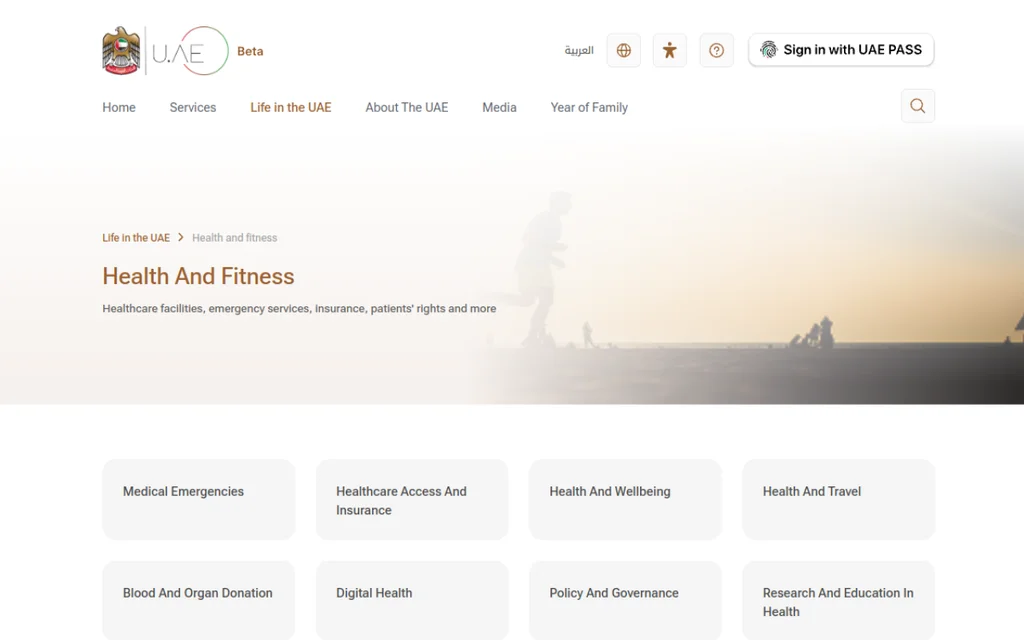
Screenshot: UAE Government Portal health section on the official u.ae website (captured October 2026).
Federal Decree-Law No. 9 of 2022 on domestic workers (amended by Federal Decree-Law No. 21 of 2023), which replaced Federal Law No. 10 of 2017, sets out the roles that count as a domestic worker in the UAE, as long as the person is employed under personal, not commercial, sponsorship:
Housemaid, housekeeper, or domestic labourer
Private driver or family chauffeur
Nanny, babysitter, private teacher, or private coach
Cook
Gardener or household farmer
Watchman or security guard
Private nurse
Private sailor or parking valet
Household shepherd, horse groomer, or falcon caretaker and trainer
Private PRO or private agriculture engineer
If your household staff fall into any of these categories, this law, and the insurance requirement that comes with it, applies to you as the sponsor. The same law also sets a separate end-of-service rule for domestic workers, which our UAE gratuity guide explains.
Is Health Insurance Mandatory for Domestic Workers in the UAE?
Yes, in every single emirate. The specific scheme changes depending on where the visa is issued, but the requirement itself does not.
As the sponsor, you are the one legally responsible for arranging and paying for this insurance, not the domestic worker. This applies whether you are a UAE national or a resident expat.
Health Insurance for Domestic Workers UAE by Emirate
The three systems work differently, which matters most if you have moved between emirates.
Dubai
Domestic worker insurance in Dubai runs through DHA‘s Essential Benefits Plan (EBP).
Real 2026 pricing sits around AED 550 to 720 a year
One licensed insurer, GIG Gulf, prices its EBP domestic helper plan at AED 630 excluding VAT specifically
The annual coverage limit is AED 150,000
Abu Dhabi
Abu Dhabi domestic worker coverage falls under the same Health Insurance Law No. 23 of 2005 that also sets the emirate’s AED 300 monthly fine for uninsured residents generally, run through Daman, the National Health Insurance Company.
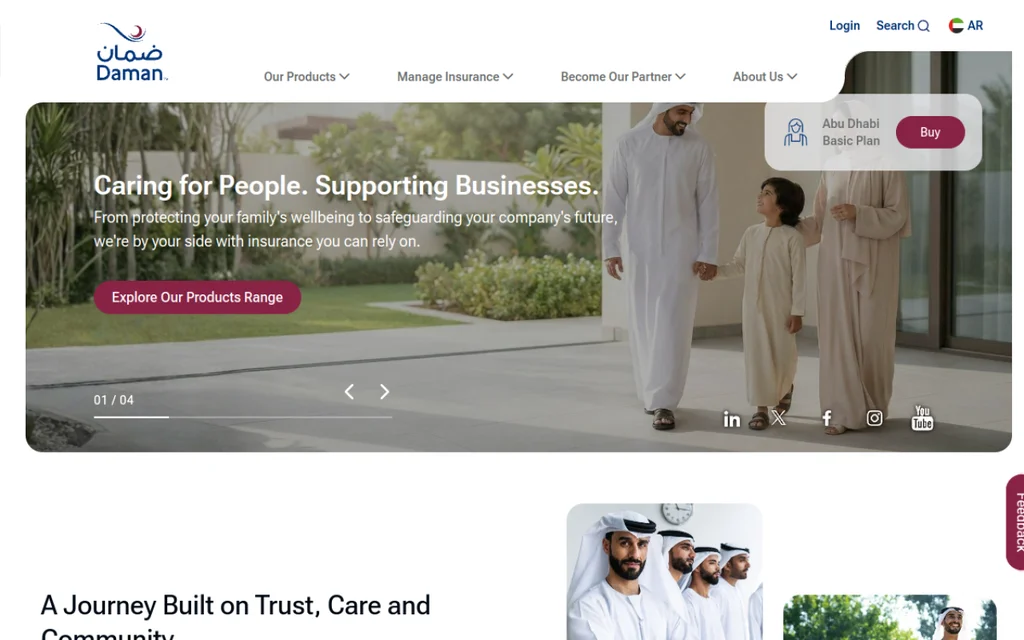
Screenshot: Daman health insurance website on the official damanhealth.ae website (captured October 2026).
For domestic helpers sponsored by a UAE national and under the age of 60, Daman’s Basic Health Insurance Plan currently costs AED 750 a year
This rate is confirmed by Abu Dhabi’s Media Office following a rate update effective 1 July 2024, up from AED 600 previously
The plan carries an annual coverage limit of AED 250,000, notably higher than Dubai’s AED 150,000
Daman revised its Basic plan rates again on 20 February 2026, and the rate for a helper sponsored by an expatriate resident can differ, so confirm the current figure with Daman before budgeting. Our guide to health insurance costs in the UAE lists the February 2026 Daman rates
Northern Emirates: Sharjah, Ajman, Umm Al Quwain, Ras Al Khaimah and Fujairah
These five emirates use a completely different scheme called Workers Health Insurance, or WHI, run jointly by MOHRE, the Federal Authority for Identity, Citizenship, Customs and Port Security, and the Ministry of Health and Prevention. WHI explicitly does not apply to Dubai or Abu Dhabi visa holders, so don’t apply this pricing to a Dubai or Abu Dhabi worker.
Plan
Employees and dependents, age 0 to 64
Partners and investors, age 0 to 64
Parents or parents in law, age 64 plus
WHI Basic
AED 320 a year
AED 483 a year
Subject to underwriting
WHI Enhanced
AED 440 a year
AED 700 a year
Subject to underwriting
These figures are before VAT and fees. Under this scheme, pre-existing conditions are covered from the start with no waiting period, and co-payments are capped (20% for inpatient care up to AED 500, 25% for outpatient visits up to AED 100, and 30% for medicines up to AED 1,500 a year).
What Does Domestic Worker Health Insurance Cover?
Here is what a compliant domestic helper policy typically includes under Dubai’s EBP:
Annual limit of around AED 150,000
Inpatient treatment, with 20% co-insurance, capped around AED 500 per visit and an annual aggregate cap of AED 1,000
Outpatient consultations, with 20% co-insurance
Pharmacy, with 30% co-insurance
Dental cover up to AED 500, at 30% co-insurance
Maternity cover up to AED 7,000 for a normal delivery and AED 10,000 for a medically necessary caesarean
Chronic and pre-existing conditions, covered after a 6 month waiting period
The Waiting Period, and How to Avoid Resetting It
This applies mainly to Dubai and Abu Dhabi plans, since the Northern Emirates scheme has no waiting period.
If a domestic worker already had continuous health insurance in the UAE, the standard 6 month waiting period for chronic and pre-existing conditions can usually be waived with the new policy, rather than starting the clock over.
Keep proof of the previous policy on hand.
Ask the outgoing insurer for continuity documentation before the old policy lapses.
Submit this documentation to the new insurer when applying.
Skipping this step is one of the easiest ways to accidentally reset a waiting period that didn’t need to be reset at all.
Common Myths About Domestic Worker Insurance in the UAE
Myth: Domestic Workers Also Need Unemployment Insurance (ILOE)
The claim: some online guides say domestic workers must have ILOE alongside health insurance.
The fact: this is false. Domestic workers are explicitly exempt from the UAE’s ILOE unemployment insurance scheme, confirmed directly on the UAE Government Portal and the official ILOE platform.
What this means for you: health insurance is the only mandatory insurance requirement for this category of worker. If you already paid for or were told to arrange ILOE for a domestic worker, that was not a legal requirement.
Myth: The Same Price Applies Everywhere in the UAE
The claim: WHI pricing, around AED 320 to 440 a year, is often assumed to apply UAE wide.
The fact: WHI only applies in Sharjah, Ajman, Umm Al Quwain, Ras Al Khaimah, and Fujairah. It does not cover a domestic worker whose visa is issued in Dubai or Abu Dhabi.
What this means for you: budgeting with WHI’s price for a Dubai or Abu Dhabi visa will leave you well short. The real cost there runs closer to AED 550 to 750 a year under EBP or Daman’s Basic plan. Always match the price to the emirate that issued the visa, not the emirate where the worker actually lives day to day.
How to Buy or Renew Domestic Worker Health Insurance?
Confirm which emirate the visa is issued in. This decides which scheme applies, EBP for Dubai, DoH’s framework for Abu Dhabi, or WHI for the Northern Emirates.
Gather the required documents: passport, current visa page, Emirates ID, labour contract or salary declaration, and proof of any previous UAE insurance if switching providers.
Buy through a licensed insurer approved for the relevant emirate: DHA approved for Dubai, DoH approved for Abu Dhabi, or through the WHI portal for the Northern Emirates.
Submit the insurance certificate as part of the visa issuance or renewal application.
Renew at least 30 days before expiry to avoid any coverage gap. You can check the policy status online before renewal.
Finding the Cheapest Health Insurance for Domestic Workers
The cheapest compliant option in Dubai is generally the EBP tier itself, priced around AED 550 to 720 a year. This meets the legal minimum but comes with the trade offs already listed above, a 6 month PEC waiting period, a AED 150,000 annual limit, and co-insurance on most treatment types.
In the Northern Emirates, WHI Basic at AED 320 a year is the lowest cost option, though it carries lower annual limits than the Enhanced tier and a more restricted clinic network.
Cheapest does not always mean best value. If a domestic worker has an ongoing health condition, or you want a wider hospital network, comparing the Enhanced or comprehensive tiers against the basic plan before committing is worth the extra few minutes.
Conclusion
Health insurance for domestic workers UAE rules come down to one decision that shapes everything else: which emirate issued the visa. Dubai and Abu Dhabi each run their own framework, priced roughly between AED 550 and 750 a year. The five Northern Emirates share a separate scheme, WHI, priced from AED 320 a year. Applying the wrong scheme’s price or rules to your situation is the single most common mistake sponsors make.
Renew at least 30 days before expiry, keep continuity documentation if you switch insurers, and remember that unemployment insurance is not required for this category, only health insurance is. Get these basics right, and health insurance for domestic workers UAE compliance stays simple for every renewal that follows.
Frequently Asked Questions
Is health insurance mandatory for domestic workers in the UAE?
Yes, in every emirate. The sponsor is legally required to arrange and pay for it before the domestic worker’s visa can be issued or renewed.
How much does health insurance for domestic workers cost in Dubai?
Typically around AED 550 to 720 a year under Dubai’s Essential Benefits Plan, with one licensed insurer pricing it at AED 630 excluding VAT.
How much does health insurance for domestic workers cost in the Northern Emirates?
Under the Workers Health Insurance (WHI) scheme, Basic plans start around AED 320 a year and Enhanced plans around AED 440 a year for workers aged 0 to 64, plus VAT and fees.
Who counts as a domestic worker under UAE law?
Federal Decree-Law No. 9 of 2022 on domestic workers defines a wide range of roles, including housemaids, drivers, nannies, cooks, gardeners, private teachers, watchmen, and several other household roles employed under personal sponsorship.
Do domestic workers need unemployment insurance (ILOE) as well as health insurance?
No. Domestic workers are explicitly exempt from the UAE’s ILOE unemployment insurance scheme. Only health insurance is mandatory for this category.
How much does health insurance for domestic workers cost in Abu Dhabi?
For a domestic helper sponsored by a UAE national and under 60, Daman’s Basic Health Insurance Plan was set at AED 750 a year in July 2024, with an annual coverage limit of AED 250,000. Daman revised its Basic plan rates again in February 2026, so confirm the current rate before paying.
Is the pricing the same for a domestic worker in Dubai and one in Sharjah?
No. Dubai and Abu Dhabi use their own emirate level health insurance frameworks, while Sharjah, Ajman, Umm Al Quwain, Ras Al Khaimah, and Fujairah use the separate Workers Health Insurance (WHI) scheme, with different pricing entirely.
What happens if a domestic worker’s insurance lapses?
Visa renewal is blocked until valid coverage is restored, and the pre-existing condition waiting period may reset unless continuity of coverage can be shown to the new insurer.
What is the cheapest health insurance for domestic workers in the UAE?
In Dubai, the EBP tier at around AED 550 to 720 a year is the cheapest compliant option. In the Northern Emirates, WHI Basic at around AED 320 a year is the lowest cost plan, though both carry lower limits than their enhanced equivalents.
Does domestic worker health insurance cover maternity or dental treatment?
Under a typical Dubai EBP plan, maternity is covered up to AED 7,000 for a normal delivery and AED 10,000 for a medically necessary caesarean, and dental cover is included up to around AED 500 with co-insurance applying.
What is the overall rule for health insurance for domestic workers UAE wide?
The rule is the same everywhere: it is mandatory, and the sponsor pays for it. Only the scheme and price change by emirate, EBP in Dubai, Daman’s Basic plan in Abu Dhabi, and WHI in the five Northern Emirates.
What if a sponsor never buys the domestic worker’s insurance at all?
Beyond blocking visa issuance or renewal entirely, the sponsor risks the same monthly health insurance fines that apply to any uninsured resident in that emirate, and the domestic worker has no coverage for any medical treatment in the meantime. There is no legal workaround, insurance is a precondition for a valid work status, not an optional add-on.
Does a domestic worker’s insurance transfer if they change employers?
No, coverage does not automatically move with the worker. A new sponsor must arrange a fresh policy under their own name. If the worker had continuous prior coverage, request a continuity document from the previous insurer so the new policy can waive the pre-existing condition waiting period rather than restarting it.
Updates Section
Last verified: October 2026. This guide reflects Federal Decree-Law No. 9 of 2022 on domestic workers, Dubai’s Essential Benefits Plan pricing, the Workers Health Insurance scheme for the Northern Emirates, and confirmed ILOE exemption rules for domestic workers as published on the UAE Government Portal.
Anees is a UAE-based content creator, writer, and SEO professional with over 12 years of experience. Since 2014, he has published research-backed guides on UAE visas, labour laws, jobs, traffic fines, and government services, all verified against official sources. He is certified in SEO by HubSpot Academy and Digital Marketing by Google Digital Garage.
12+ Years ExperienceHubSpot Academy — SEOGoogle Digital Garage
Disclaimer: This information is for general guidance only, based on publicly available UAE laws and regulations. It does not constitute legal advice. Always verify with official UAE government sources or a qualified legal professional.





Your email will not be published. Comments are reviewed before appearing.