The UAE Retirement Visa is a 5 year, renewable residence visa for expatriates aged 55 and above who meet specific financial criteria: property, savings, or income. It’s one of several types of UAE residence visa available to expats, and one of the most misunderstood, because Dubai sets a lower income figure than the rest of the UAE.
This guide covers the UAE Retirement Visa requirements in full: age, financial routes, documents, costs, and how to apply.
Who Qualifies for the UAE Retirement Visa?
You must be at least 55 years old and have worked for at least 15 years, inside or outside the UAE. You must satisfy both conditions. Being 55 alone isn’t enough, and neither is having 15 years of work history on its own.
Beyond that, you also need to meet one of the financial routes below.
The Three Financial Routes
Route
Requirement
Property
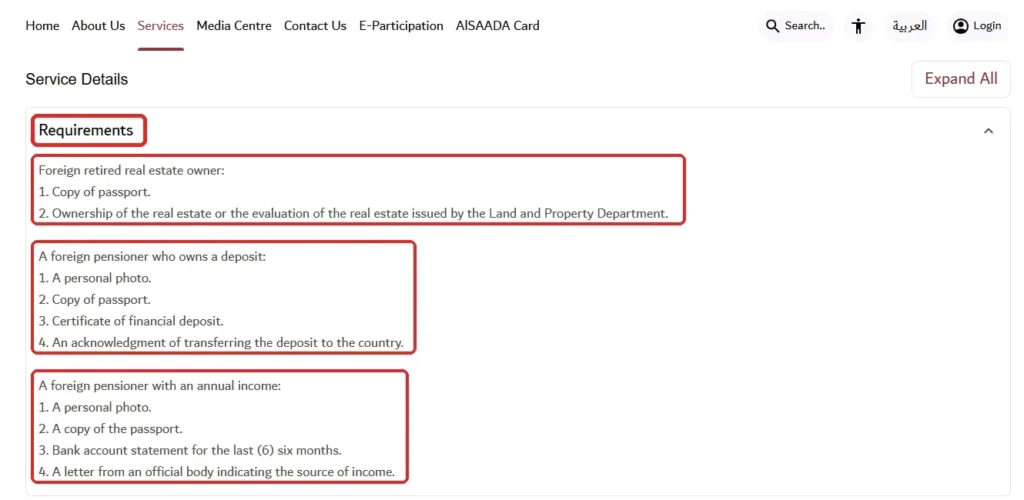
Own property worth at least AED 1,000,000, debt free or with at least AED 1,000,000 paid off if mortgaged
Savings
A fixed deposit of at least AED 1,000,000, held for a set period in a UAE financial institution (3 years in Dubai)
Income
An annual income of at least AED 180,000 (AED 15,000/month) in Dubai, or AED 240,000 (AED 20,000/month) in the other emirates, see the note below
A Lesser Known Fourth Route: Combining Savings and Property
A combination also qualifies: a 3 year fixed deposit of at least AED 1,000,000, combined with property worth at least AED 500,000, half the usual property only threshold. This combination route is part of Dubai’s published criteria and is useful if you don’t quite meet either threshold on its own. Some sources describe the split differently, so confirm the exact amounts with GDRFA before applying.
Which Income Figure Applies Where? A Genuine Conflict Worth Flagging?
The federal criteria set by ICP require a monthly income of at least AED 20,000 (AED 240,000 a year), while Dubai sets a lower figure of AED 15,000 a month (AED 180,000 a year).
So if your visa is issued in Dubai through GDRFA, the AED 15,000 monthly figure applies. In the other emirates, applications go through ICP and the AED 20,000 monthly figure applies.
Income can be from a pension or another sustainable source, and you will usually need bank statements for the last six months. Confirm the current threshold with GDRFA (Dubai) or ICP (other emirates) before applying, since criteria are updated from time to time.
Can You Work on a UAE Retirement Visa?
No, not for a salary. Retirement Visa holders cannot take up paid employment. You can manage personal investments, earn rental income from property, or act as a shareholder or board member in a business, provided you’re not on that company’s payroll.
Can You Work in the UAE After 60 Without a Retirement Visa?
Yes. The UAE has no mandatory retirement age for private sector employees. You can continue working past 60 on a standard employment visa, though the process can change: some work permits for older employees are issued for shorter periods, and extra approvals or fees may apply, so check with MOHRE or your employer. You can check your work permit status online at any time.
Working past 65 is possible too, usually case by case for specialised or senior roles. If you’d rather keep working than switch to the Retirement Visa’s no salaried employment rule, this is the alternative path.
Documents for the UAE Retirement Visa Requirements
Financial Route
Key Documents
Property
Title deed showing value of at least AED 1,000,000, property valuation certificate, search certificate confirming no legal seizure
Savings
Bank statement confirming a fixed deposit of at least AED 1,000,000, held for the required minimum period
Income
Bank statements or an official letter confirming annual income of at least AED 180,000 (Dubai) or AED 240,000 (other emirates)
All routes
Passport valid 6 or more months, recent photograph, health insurance, national ID copy for select nationalities
In Dubai, GDRFA’s criteria require the AED 1,000,000 to be held in a 3-year fixed deposit. Confirm the current requirement with your bank and GDRFA or ICP before applying.
UAE Retirement Visa Cost
Item
Cost (AED)
New 5 year visa
7,084.75
5 year renewal
6,519.75
Cancellation
190.75
These are the Dubai Land Department route figures for a property-based application. Health insurance, the medical test and Emirates ID are paid on top, so the total for a first application is higher. Government fees vary by emirate and route and may change over time, so confirm the current figure before budgeting.
How to Apply for the UAE Retirement Visa?
Confirm your eligibility: age, work history, and which financial route applies to you
Gather the required documents for your chosen route
Complete a medical fitness test at an approved centre
Arrange UAE health insurance covering the full visa period
Submit your application through GDRFA in Dubai, or ICP in the other emirates
Complete biometric registration in person
Receive your Emirates ID and residence visa confirmation
How Long Does the UAE Retirement Visa Take?
GDRFA’s own published service standard states an expected completion time of 48 hours once your application and documents are submitted. Although GDRFA lists a 48 hour service standard for the permit itself, the complete process, including medical testing, Emirates ID, and financial verification, typically takes longer.
What Happens If You Don’t Renew in Time?
GDRFA Dubai generally allows a 60 day grace period after a residence visa expires or is cancelled, during which you can remain in the UAE to renew or regularise your status before overstay fines of AED 50 a day start. Grace periods differ by emirate and visa type, so check your grace period before your visa expires.
Can You Sponsor Family on a Retirement Visa?
Yes. You can sponsor your spouse and children for the same 5 year term as your own visa, subject to standard residency requirements for each dependent. Age limits for children can vary by case, confirm the current rule for your specific situation with GDRFA or ICP rather than assuming a fixed cutoff.
If both spouses are over 55, each can qualify independently if they meet the eligibility requirements, or one eligible retiree can sponsor the other through family sponsorship.
Benefits of the UAE Retirement Visa
5 year residency, renewable if you continue meeting the criteria
No employer or sponsor required
Residency you can keep while spending part of the year abroad, as long as each stay outside the UAE is under 6 months
No personal income tax on pension, investment returns, or rental income
Access to UAE healthcare and banking as a resident
Ability to sponsor eligible family members
Renewing the UAE Retirement Visa
The Retirement Visa can be renewed every 5 years, provided you continue meeting the same financial eligibility route and maintain valid health insurance throughout. The steps are similar to a standard residence visa renewal.
How to renew the UAE Retirement Visa?
Continue meeting the financial requirement
Maintain valid health insurance
Complete any required medical examination
Submit the renewal through GDRFA or ICP
Receive the renewed 5-year residence permit
Is Health Insurance Mandatory?
Yes. Applicants must maintain valid UAE health insurance throughout the visa period. Our guide to health insurance costs in the UAE covers plans for over-55s, where premiums are higher. Proof of insurance is required before the residence visa is issued or renewed.
Retirement Visa vs Golden Visa: Which Fits You?
If you’re under 55, the Retirement Visa isn’t available to you regardless of your finances, the Golden Visa may be the relevant route instead. If you’re 55 or older and hold property or savings around the AED 1,000,000 mark, the Retirement Visa is generally the more accessible and lower cost option.
Updates Section
Last verified: October 2026. Reflects the UAE Government Portal’s most recent update (19 February 2026) on Retirement Visa eligibility, Abu Dhabi Residents Office’s published criteria, and current cost figures confirmed through a Dubai Land Department affiliated service centre.
Conclusion
The age and work history requirements apply together: you need to be 55 or older and have 15 years of work history, not one or the other. The income route is lower in Dubai (AED 15,000 a month) than in the other emirates (AED 20,000 a month), so check which authority will issue your visa.
Confirm your exact route and current costs directly with GDRFA or ICP before applying, since fee schedules and thresholds are updated periodically. For a full picture of how this compares to the UAE’s other long term options, our guide to all UAE residence visa types covers where the Retirement Visa fits among them.
Frequently Asked Questions
What are the UAE Retirement Visa requirements?
At least 55 years old, at least 15 years worked inside or outside the UAE, and one of three financial routes: property worth AED 1,000,000, a fixed deposit of AED 1,000,000, or annual income of AED 180,000 in Dubai or AED 240,000 in the other emirates.
How much does the UAE Retirement Visa cost?
Through the Dubai Land Department route, a new 5 year visa costs AED 7,084.75, with renewal at AED 6,519.75. Health insurance, the medical test and Emirates ID are paid on top.
Can you work while on a UAE Retirement Visa?
No, not for a salary. You can manage investments, earn rental income, or hold shares in a business, but you cannot take up paid employment.
Can I work in the UAE after 60 years of age?
Yes. The UAE has no mandatory retirement age. You can keep working past 60 on a standard employment visa, though the work permit process can change for older employees, and work beyond 65 is usually approved case by case.
How much money do I need to retire in the UAE?
You need to meet one of three thresholds: property worth AED 1,000,000, a fixed deposit of AED 1,000,000, or annual income of AED 180,000 in Dubai or AED 240,000 in the other emirates. A combination route also exists at a lower property value.
Who is eligible for a retirement visa in the UAE?
Expatriates aged 55 or older who have worked at least 15 years, inside or outside the UAE, and meet one of the financial routes above.
Is the income requirement the same in Dubai as the rest of the UAE?
No. Dubai requires AED 15,000 a month (AED 180,000 a year), while the federal criteria used by ICP for the other emirates require AED 20,000 a month (AED 240,000 a year).
Can you sponsor your children on a UAE Retirement Visa?
Yes, subject to standard residency requirements. Age limits for children can vary by case, so confirm the current rule with GDRFA or ICP for your specific situation.
Do you need to be 55 and have 15 years of work experience, or just one of these?
Both. The age and work history requirements apply together, not as alternatives.
Is there a way to qualify with less than AED 1,000,000 in property?
Yes, a combination route exists: a 3 year fixed deposit of AED 1,000,000 combined with property worth at least AED 500,000, half the standalone property threshold.
Can I renew my UAE Retirement Visa?
Yes. The visa is renewable every 5 years, provided you continue meeting the financial eligibility requirements and maintain valid health insurance.
Can you stay outside the UAE for long periods on this visa?
Only up to a point. Like most residence visas, staying outside the UAE for more than 6 months in a row can cancel it, unless you apply to ICP for permission to stay outside longer (AED 100 for every 30 days). Golden Visa holders are exempt from this rule; Retirement Visa holders are not.
Can I retire in Dubai permanently?
Yes. As long as you keep meeting the renewal requirements every 5 years, and follow the standard residence visa renewal process each time, you can keep renewing your Retirement Visa and remain a UAE resident indefinitely.
Anees is a UAE-based content creator, writer, and SEO professional with over 12 years of experience. Since 2014, he has published research-backed guides on UAE visas, labour laws, jobs, traffic fines, and government services, all verified against official sources. He is certified in SEO by HubSpot Academy and Digital Marketing by Google Digital Garage.
12+ Years ExperienceHubSpot Academy — SEOGoogle Digital Garage
Disclaimer: This information is for general guidance only, based on publicly available UAE laws and regulations. It does not constitute legal advice. Always verify with official UAE government sources or a qualified legal professional.




Your email will not be published. Comments are reviewed before appearing.