UAE Visa Overstay Fine 2026: AED 50/Day RulesMinimum Salary to Sponsor Your Family Visa in UAEUAE Labour Law: Notice Period ExplainedHow to Check Your UAE Visa Status OnlineUAE Golden Visa Eligibility Requirements UpdatedUAE Visa Overstay Fine 2026: AED 50/Day RulesMinimum Salary to Sponsor Your Family Visa in UAEUAE Labour Law: Notice Period ExplainedHow to Check Your UAE Visa Status OnlineUAE Golden Visa Eligibility Requirements Updated
Small Business Ideas in the UAE: 25+ Profitable Opportunities for 2026
The UAE Times
–
–
– min read
Last updated: – · Based on official UAE sources
Finding the right small business ideas in the UAE is not simply about choosing something that sounds profitable. A business that looks cheap to start can become expensive once licensing, equipment, rent, marketing, staff, inventory and working capital are added.
The good news is that the UAE has opportunities for both service based entrepreneurs and product businesses. Someone with limited capital can start with digital services, consulting, tutoring or an online business, while entrepreneurs with more capital can explore food, cleaning, e-commerce, logistics, tourism and other sectors.
This guide covers the best small business ideas in UAE for 2026, including low investment, home based, online, beginner friendly and scalable options. It also explains licensing, mainland versus free zone setup, taxes, funding, business costs and how to test an idea before investing heavily.
Important: There is no single business that is automatically the most profitable in the UAE. Profit depends on demand, pricing, operating costs, competition, skills and how efficiently the business is managed.
Best Small Business Ideas in UAE for 2026
The strongest opportunity depends on the entrepreneur’s budget, skills and target customers. A service business can often start with fewer physical assets, while product businesses may require inventory, storage and delivery.
The following small business ideas in UAE cover a mix of low investment, service based, online, home based and growth focused models.
Business idea
Investment level
Home based potential
Main revenue model
Best suited for
Digital marketing agency
Low
High
Monthly retainers
Marketing professionals
E-commerce store
Low to moderate
High
Product sales
Product focused entrepreneurs
Cleaning services
Moderate
Low
Service charges/contracts
Operations focused owners
Online tutoring
Low
High
Hourly/course fees
Teachers and experts
Freelance services
Very low
High
Project or retainer fees
Skilled professionals
Mobile car wash
Moderate
Limited
Per service/subscriptions
Service operators
Home bakery
Moderate
Depends on approvals
Product sales
Food entrepreneurs
Event management
Low to moderate
High
Event/project fees
Organised networkers
Web development
Low
High
Project/retainer fees
Developers
IT support
Low to moderate
High
Contracts/support fees
IT professionals
Fashion business
Moderate
High for online model
Product sales
Fashion entrepreneurs
Bookkeeping
Low
High
Monthly service fees
Finance professionals
Corporate gifting
Moderate
High for online model
Product sales
B2B entrepreneurs
Pet care
Moderate
Limited
Service fees
Pet service operators
AI automation services
Low
High
Setup + recurring fees
Technology professionals
1. Digital Marketing Agency
Digital marketing remains one of the more accessible small business ideas in UAE because the business can start around skills rather than expensive physical assets.
A small agency can specialise in:
SEO
Social media management
Google Ads
Content marketing
Website optimisation
Local SEO
Email marketing
Lead generation
Instead of trying to serve every company, a new agency can target one niche such as restaurants, real estate companies, clinics, salons or small retailers.
The strongest model is usually recurring revenue. For example, an agency may manage a client’s SEO and content every month rather than relying only on one time projects.
2. Niche E-commerce Store
E-commerce is one of the most scalable business ideas in UAE, but choosing the right product matters more than simply opening an online store.
A new entrepreneur could focus on a narrow category such as:
Modest fashion
Home organisation products
Personalised gifts
Pet products
Beauty accessories
Sports products
UAE themed products
Sustainable products
The business can sell through its own website or appropriate marketplaces.
Inventory is the major consideration. A dropshipping model reduces the need to hold stock but creates different challenges around supplier quality, delivery times and customer experience.
3. Cleaning Services
Cleaning is a practical service business because customers can require the service repeatedly.
Possible niches include:
Residential cleaning
Office cleaning
Deep cleaning
Move in and move out cleaning
Holiday home cleaning
Commercial cleaning
A small operation can begin with a focused service area and expand as the customer base grows.
The important costs are not just the licence. Equipment, transport, staff, insurance, uniforms, supplies and customer acquisition can all affect the real operating cost.
4. Online Tutoring and Training
Education and training can be a strong low investment business for people who already have useful knowledge.
Potential niches include:
School subjects
English and other languages
Professional certifications
Coding
Digital marketing
Business skills
Exam preparation
Corporate training
An entrepreneur can start with one to one sessions and later move towards group classes, recorded courses or corporate contracts.
Licensing and activity requirements should be checked before offering regulated education or training services.
5. Freelance Professional Services
Freelancing is one of the most accessible low investment business ideas in UAE for people who already have a marketable skill.
Examples include:
Copywriting
Graphic design
SEO
Web development
Video editing
Translation
Bookkeeping
Consulting
Virtual assistance
Photography
The advantage is low equipment and inventory requirements for many digital services.
The challenge is income stability. A freelancer who depends entirely on individual projects may have unpredictable revenue. Retainer contracts can make the business more stable.
6. Mobile Car Wash and Detailing
A mobile car wash can serve customers at homes, offices or other permitted locations.
Possible services include:
Exterior cleaning
Interior detailing
Polishing
Ceramic coating
Deep cleaning
Subscription packages
The UAE’s large vehicle market creates an obvious customer base, but competition can also be strong.
A new business can differentiate through convenience, subscription packages, high quality detailing or service to a specific customer segment.
7. Home Bakery and Food Business
Food is one of the most attractive categories for entrepreneurs, but it is also one where regulatory requirements matter.
Potential models include:
Custom cakes
Desserts
Healthy meals
Traditional food
Catering
Corporate lunch boxes
Special occasion food
A home based food business should never assume that a normal business licence automatically permits food production from a residential kitchen.
Food activities can require additional approvals and compliance depending on the emirate and activity.
8. Catering and Meal Preparation
Catering can target both consumers and businesses.
Examples include:
Corporate catering
Small events
Meal preparation
Office lunches
Healthy meal plans
Party food
Recurring corporate customers can make this model more predictable than relying entirely on occasional private events.
Food safety, premises, approvals and operational capacity should be assessed before launch.
9. Event Management
The UAE has a large events, tourism and corporate ecosystem, creating opportunities for specialised event businesses.
A small company could focus on:
Corporate events
Birthday parties
Weddings
Private celebrations
Brand activations
Small conferences
Luxury events
The business does not necessarily need to own expensive event equipment. It can coordinate venues, decorators, caterers, photographers and other suppliers.
The value comes from planning, supplier management and execution.
10. Social Media Management and Content Creation
Many small businesses need content but do not have an internal marketing team.
A specialist can offer:
Instagram management
TikTok content
Reels
Product photography
Short form video
Content calendars
Community management
Influencer coordination
This is particularly suitable for entrepreneurs who already understand digital platforms.
11. Website Design and Development
Web development is another strong small business idea in UAE for skilled professionals.
A small company can build websites for:
Restaurants
Clinics
Salons
Real estate companies
Consultants
E-commerce businesses
Professional service firms
Recurring revenue can come from maintenance, hosting management, security updates and ongoing development.
12. IT Support and Managed Technology Services
Small companies often need technical support without employing a full time IT department.
A small IT services company can offer:
Network support
Cloud setup
Cybersecurity support
Device management
Backup solutions
Software setup
Technical troubleshooting
This model becomes more attractive when services are sold through monthly support contracts rather than one off jobs.
13. Fashion and Modest Wear Business
The UAE’s diverse consumer market creates opportunities for specialised fashion businesses.
Examples include:
Abayas
Hijabs
Modest fashion
Custom clothing
Occasion wear
Accessories
Personalised fashion products
An online first model can reduce the need for a traditional retail store, although inventory, returns, photography, shipping and marketing still need to be budgeted.
14. Interior Design Consultancy
Interior design can work as a service based business without initially becoming a large contracting company.
A consultant can provide:
Space planning
Colour consultation
Furniture selection
Home styling
Office design
Mood boards
Procurement coordination
Any activity that involves regulated contracting or technical work may require additional approvals, so the exact activity should be checked before offering it.
15. Pet Care and Grooming
Pet related services are another niche worth considering.
Possible services include:
Pet grooming
Pet sitting
Dog walking
Pet transport
Pet products
Home visits
A focused niche can help a new business avoid competing directly with every large pet store or veterinary provider.
16. Tourism and Travel Services
Tourism remains an important part of the UAE economy, particularly in Dubai.
Possible businesses include:
Tour coordination
Travel consultancy
Destination services
Corporate travel support
Experience planning
Specialised tourism services
Tourism activities can be regulated, so the correct licence and approvals are essential.
17. Recruitment and HR Consultancy
Recruitment can be attractive for entrepreneurs with strong industry networks.
Possible specialisations include:
Technology recruitment
Healthcare recruitment
Hospitality recruitment
Sales recruitment
Executive search
HR consultancy
This business relies heavily on trust and relationships. A strong niche is usually more useful than trying to recruit for every industry.
18. Bookkeeping and Accounting Support
Small companies need help with financial records, invoices, expenses and reporting.
A qualified professional can build a bookkeeping or accounting support business around monthly contracts.
The exact services offered should match the person’s qualifications and the applicable professional and regulatory requirements.
19. Corporate Gifting
Corporate gifting can target companies rather than individual consumers.
Products can include:
Branded gift boxes
Employee welcome kits
Event gifts
Ramadan gifts
Client gifts
Custom merchandise
The business can operate through an online catalogue and outsource some production while focusing on sales, branding and fulfilment.
20. Logistics and Delivery Coordination
The UAE’s trade and e-commerce environment creates demand around logistics.
A small business could specialise in:
Last mile coordination
Delivery management
E-commerce fulfilment support
Business courier coordination
Inventory movement
Transport and logistics activities can have specific licensing and operational requirements, so the business activity should be verified before launch.
21. Eco Friendly Products and Sustainable Packaging
Alternative packaging for restaurants and retailers
The opportunity is particularly interesting when the business sells to other companies through recurring supply contracts.
22. Smart Home Solutions
Smart home services can combine product sales with installation and support.
Potential products include:
Smart lighting
Security systems
Smart thermostats
Home automation
Energy monitoring
Connected appliances
The business can start as a specialised installation or consultancy service rather than trying to manufacture technology.
23. Subscription Box Business
A subscription model creates recurring orders instead of depending entirely on individual purchases.
Potential niches include:
Beauty
Snacks
Coffee
Pet products
Children’s activities
Wellness products
Hobby products
The challenge is retention. A subscription business must continually give customers a reason to remain subscribed.
24. Urban Farming and Hydroponics
The UAE’s climate and reliance on food imports make controlled agriculture an interesting niche.
Possible models include:
Hydroponic farming
Indoor farming
Growing systems
Farm technology
Fresh produce supply
Home growing solutions
This is more capital intensive than a digital service business and requires technical knowledge, equipment and potentially sector specific approvals.
25. AI and Automation Services for SMEs
AI is one of the most important emerging business opportunities in UAE.
Instead of building a large AI company, a small entrepreneur can help existing businesses use AI for:
Customer support
Lead qualification
Workflow automation
Content production
Data analysis
Appointment management
Internal knowledge systems
Dubai’s digital economy is growing. Dubai Chambers reported 1,690 advanced tech startups supported in 2025, with digital startups attracted to Dubai growing 39.7% year on year.
For a small business, the opportunity is often in solving a specific business problem rather than building a complicated technology platform.
New and Emerging Small Business Opportunities in UAE
Some sectors highlighted by the UAE’s business ecosystem are more suitable for scalable startups than traditional small businesses.
DMCC’s 2026 business opportunities report highlights areas including import and export, crypto, AI, gaming, finance, diamonds, e-commerce, renewable energy, gold and agriculture.
Not every opportunity is suitable for a beginner with a small budget. But several can be adapted into smaller service businesses.
AI Services
Businesses can use AI without developing their own AI model.
Examples include automation consulting, AI workflow setup and business process optimisation.
Green Business
Sustainable packaging, energy efficiency and environmentally focused products can serve both consumers and companies.
Gaming and Esports Services
The opportunity can include event support, content, community management, gaming services and technology rather than building a large gaming studio.
Smart Home Services
Installation, configuration and after sales support can create a smaller entry point into the smart home sector.
Digital Education
Online courses, professional training and specialised learning platforms can serve UAE residents as well as customers outside the country.
Hydroponics and Urban Farming
This is more capital intensive, but it connects entrepreneurship with food security and sustainability.
Small Business Ideas in UAE by Investment Budget
There is an important difference between startup cost and first year business cost.
A business may appear cheap because the initial licence is affordable, but the entrepreneur still needs money for marketing, equipment, software, transport and working capital.
Small Business Ideas Under AED 5,000
Very low capital models generally favour skills over physical products.
Examples include:
Freelance writing
SEO services
Graphic design
Virtual assistance
Online consulting
Online tutoring
Digital services
The exact licence and setup cost depends on the emirate, activity and legal structure, so AED 5,000 should not be treated as a universal all inclusive business setup budget.
Small Business Ideas Under AED 10,000
Potential models include:
Freelance services
Digital marketing
Web development
Consulting
Online education
Small digital products
Some online business models
The entrepreneur should still reserve money for customer acquisition and working capital.
Small Business Ideas Under AED 20,000
A wider range becomes possible, including:
Niche e-commerce
Corporate gifting
Content services
Small service operations
Specialised consultancy
Online retail
Inventory based businesses need careful cash flow planning because money can remain tied up in unsold products.
Small Business Ideas Under AED 50,000
At this level, an entrepreneur may have more flexibility for:
Cleaning operations
Mobile services
Larger e-commerce inventory
Food related businesses where permitted
Small teams
Equipment based businesses
The licence is still only one part of the budget.
Businesses Requiring More Capital
Some opportunities naturally require higher investment because they involve:
Premises
Machinery
Vehicles
Large inventory
Staff
Food production
Manufacturing
Warehousing
A higher budget does not automatically mean higher profit.
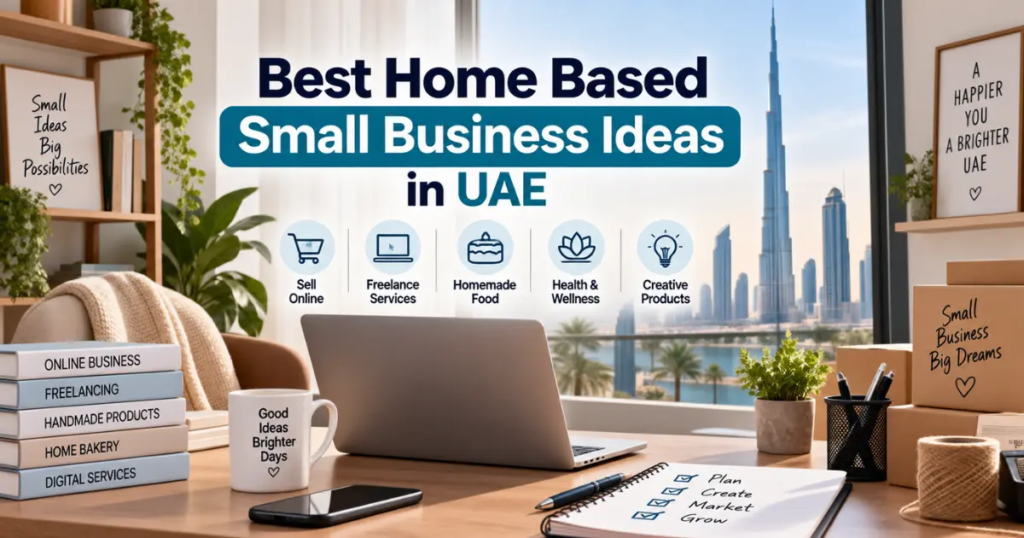
Best Home Based Small Business Ideas in UAE
Home based businesses are attractive because they can reduce the need for commercial premises. However, “home based” does not mean “no licence required.”
Dubai’s Department of Economy and Tourism currently lists an E-Trader Licence for individuals or home businesses selling products or services online in the UAE.
Depending on the activity, an entrepreneur may need a different licence or additional approval.
Good home based business ideas can include:
Freelancing
Digital marketing
Consulting
Online tutoring
Web development
Graphic design
Content creation
Online retail
Handmade products
Corporate gifting
Digital products
Food, beauty, childcare and other activities can involve additional regulatory requirements.
Can a Business Be Run From Home in the UAE?
Sometimes, yes.
The answer depends on the:
Business activity
Emirate
Licence
Premises rules
External approvals
Products or services involved
An entrepreneur should verify the exact activity before assuming a home licence is enough.
Best Online Business Ideas in UAE
Online businesses can reduce some physical overhead, but they still need to comply with applicable UAE licensing and consumer rules.
Strong options include:
E-commerce
Sell products through an online store or suitable marketplace.
Digital Marketing
Serve businesses through SEO, social media, advertising and content.
Freelancing
Sell professional skills without maintaining physical inventory.
Online Education
Offer courses, tutoring or professional training where permitted.
Digital Products
Sell templates, educational material, design assets or other digital products.
Subscription Commerce
Build recurring product deliveries around a specific niche.
Software and SaaS
Build a software product around a specific business problem.
The right choice depends on whether the entrepreneur wants quick service revenue or a slower but potentially more scalable product model.
Best Small Business Ideas in UAE for Beginners
Beginners usually benefit from a business with:
Low fixed costs
Simple operations
Limited inventory
Skills they already understand
Easy customer access
Low regulatory complexity
For many beginners, the most practical options are:
Freelance professional services
Digital marketing
Online tutoring
Consulting
Virtual assistance
Web development
Content creation
Niche e-commerce
Corporate gifting
Small specialised service businesses
The “easiest” business is different for every person. A developer may find web development easy while a person with no technical skills may find it difficult.
Small Business Ideas in UAE for Expats and Foreigners
Foreign entrepreneurs have many options in the UAE, but the correct structure depends on the activity and jurisdiction.
The UAE Commercial Companies framework has removed the old blanket assumption that every mainland company must have a UAE national holding 51% of the ownership. Foreign ownership is permitted in many activities, while specific regulated activities and structures can have additional requirements.
The Ministry of Economy and Tourism also notes that amendments to the Commercial Companies Law removed the mandatory Emirati partnership requirement for companies set up by foreign investors, while specific rules can still apply depending on the activity and structure.
An expat should therefore check:
Business activity
Mainland or free zone
Legal structure
Licence type
Visa requirements
Office requirements
External approvals
Tax obligations
Banking requirements
For entrepreneurs who also need to understand the immigration side, theUAE Business Visa Requirements 2026 guide explains the relevant business visa routes and requirements.
Small Business Ideas for Women in UAE
The UAE market supports many service and online business models that can be operated with relatively limited physical infrastructure.
Examples include:
Online tutoring
Digital marketing
E-commerce
Fashion
Beauty services
Consulting
Content creation
Event planning
Handmade products
Corporate gifting
The best option still depends on licensing, skills, capital and target customers rather than gender alone.
Which Small Businesses Are Most Profitable in UAE?
There is no reliable universal ranking of the “most profitable” small businesses.
A business with AED 1 million in sales may produce less profit than a small consultancy with much lower revenue.
A better way to compare profitability is to look at:
Gross margin
Customer acquisition cost
Monthly overhead
Staff cost
Inventory requirements
Repeat purchase rate
Pricing power
Cash flow
Scalability
High Margin Service Businesses
Digital services, consulting, professional services and specialised training can have lower physical overhead when the entrepreneur already has the required skills.
Product Businesses
E-commerce, fashion, gifting and food can generate strong sales but require careful control of inventory, delivery and product costs.
Recurring Revenue Businesses
Subscriptions, retainers, maintenance contracts and monthly service agreements can make cash flow more predictable.
The most profitable small business idea in UAE is usually the one where the entrepreneur has a strong skill or market advantage and can acquire customers at a sustainable cost.
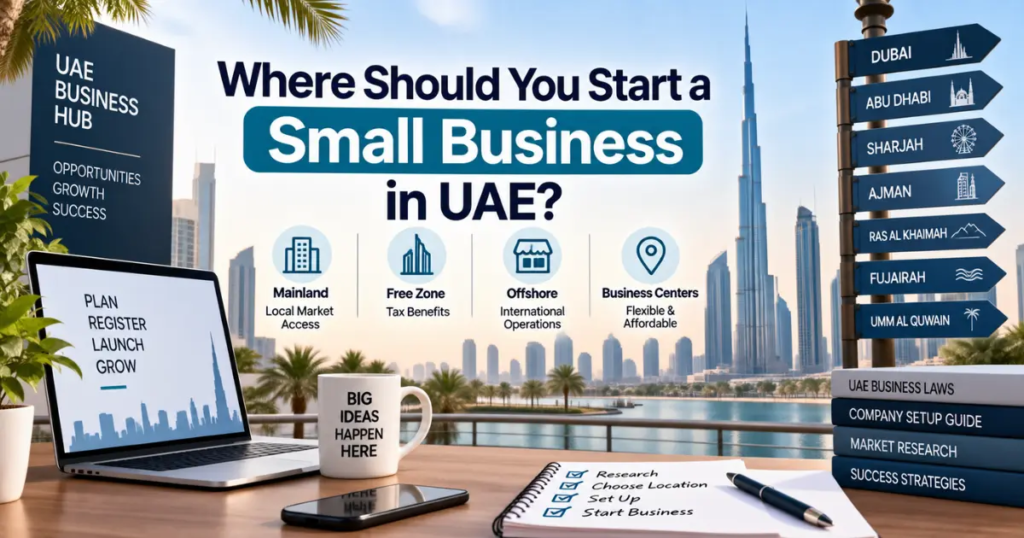
Where Should You Start a Small Business in UAE?
The best emirate depends on the business activity and customers.
Dubai
Dubai is particularly attractive for:
E-commerce
Tourism
Digital businesses
Professional services
Retail
International trade
Technology
Dubai’s official business portal allows entrepreneurs to reserve a trade name, apply for a trade licence, review legal forms and estimate setup costs.
Abu Dhabi
Abu Dhabi can be attractive for businesses connected to:
Corporate services
Energy
Technology
Healthcare
Government related ecosystems
Industrial sectors
Sharjah
Sharjah can suit businesses connected to:
Education
Creative industries
Manufacturing
Trading
Services
Ajman
Ajman is often considered by entrepreneurs comparing lower cost setup options, although the correct choice still depends on the business activity and facility requirements.
Ras Al Khaimah
Ras Al Khaimah offers opportunities across tourism, manufacturing, services and other sectors.
The right emirate should be selected based on customers, licensing, premises, logistics and total operating cost rather than licence price alone.
Mainland vs Free Zone for a Small Business
The UAE provides different company setup routes.
Dubai’s official business portal describes mainland and free zone options as separate setup routes.
Mainland
A mainland company can be suitable when the business needs to operate directly in the local market and its activity is permitted under the relevant mainland rules.
Potential advantages include:
Access to the local market
Flexible business activity options
Ability to work with many local customers
Government and corporate opportunities
Free Zone
Free zones can be attractive for businesses that benefit from specialised ecosystems and simplified setup structures.
Potential benefits vary by free zone and can include:
Sector focused infrastructure
100% foreign ownership where permitted
Different office solutions
Business support services
International trade facilities
However, not every free zone offers the same activities, facilities or operating rules.
Which Is Better for a Small Business?
There is no universal answer.
A digital consultant may value a low overhead setup, while a restaurant, retail shop or business serving customers from a physical location may have very different requirements.
The business activity should be chosen first. The jurisdiction should follow it.
What License Does a Small Business Need in the UAE?
The required licence depends on the business activity.
Dubai’s current licensing information includes categories such as:
Professional Licence
E-Trader Licence
Industrial Licence
Commercial activities
Dual Licence
Other activity specific licensing routes
DET describes the Professional Licence as covering service based businesses such as consultancies, legal firms and artisans. It also describes the E-Trader Licence for individuals or home businesses selling products or services online.
An entrepreneur should not choose a licence simply because it is advertised as cheap.
The correct question is:
What licence legally covers the activity the business will actually perform?
Some activities can also require approvals from other government bodies.
How to Start a Small Business in UAE
Starting a small business becomes much easier when the process is handled in the right order.
Step 1: Choose the Business Idea
Start with the customer problem, not the licence.
Ask:
Who will pay?
What problem does the business solve?
Why would customers choose it?
How often will they buy?
Step 2: Validate Demand
Check competitors, pricing, reviews and customer complaints.
A business idea becomes more valuable when it solves a real problem that customers already pay to solve.
Step 3: Select the Business Activity
The official activity affects licensing and approvals.
Step 4: Choose the Jurisdiction
Compare:
Mainland
Free zone
Relevant emirate
Office requirements
Customer access
Activity restrictions
Step 5: Select the Legal Structure
The appropriate legal form depends on the business and jurisdiction.
Step 6: Reserve the Trade Name
Dubai’s official Invest in Dubai platform provides a trade name reservation service.
Step 7: Obtain Initial Approvals
Some activities require additional approvals before the business can operate.
Step 8: Arrange Premises if Required
Some businesses can operate through suitable flexible or remote arrangements, while others need physical premises.
Step 9: Obtain the Business Licence
The licence legally permits the approved business activity.
Step 10: Complete Immigration and Establishment Requirements
These requirements depend on the business structure, employees and visa needs.
Step 11: Open a Business Bank Account
Banks normally assess the company, owners, business activity, source of funds and expected transactions.
For a deeper explanation, see the UAE Times guide toUAE business visa requirements and the upcoming guide on UAE business bank account requirements.
Step 12: Set Up Accounting and Tax Compliance
The business should keep proper records from the beginning instead of trying to reconstruct them later.
How Much Does It Cost to Start a Small Business in UAE?
There is no single UAE small business setup cost.
The total amount depends on:
Business activity
Emirate
Mainland or free zone
Licence type
Legal structure
Office requirement
Visa requirements
Number of employees
Equipment
Inventory
External approvals
The official Invest in Dubai platform provides a cost calculator for Dubai business setup, which is more reliable than using one fixed number for every business.
Costs Beginners Often Forget
The licence may not be the largest expense.
A realistic first year budget may also need to cover:
Rent or workspace
Equipment
Website
Software
Marketing
Transport
Inventory
Packaging
Staff
Accounting
Insurance
Working capital
This is why comparing businesses only by licence price can produce a misleading result.
Do Small Businesses Pay Tax in the UAE?
Yes, UAE businesses can have corporate tax and VAT obligations depending on their circumstances.
Corporate Tax
A small business should not assume that being small automatically means it has no corporate tax obligations.
The Federal Tax Authority states that taxable persons are generally required to register for Corporate Tax, subject to the rules applicable to their status.
Small Business Relief
The FTA’s current Small Business Relief rules allow eligible resident persons to elect for relief where revenue is AED 3 million or less in the current and all previous tax periods, subject to the applicable conditions.
The relief treats the eligible business as not having derived taxable income for that tax period. It is not available to every business, including a Qualifying Free Zone Person and certain members of multinational groups.
The rules should therefore be checked for the specific business and tax period.
VAT
For UAE resident businesses, VAT registration becomes mandatory when taxable supplies and imports exceed the mandatory threshold of AED 375,000 over the relevant period or are expected to exceed it within the next 30 days.
Voluntary VAT registration is available above AED 187,500, subject to the applicable conditions.
These thresholds are not the same thing as corporate tax thresholds.
How Can a Small Business in UAE Get Funding?
Not every small business needs outside funding.
For a service business, self funding may be more practical because the initial capital requirement can be relatively small.
Possible funding routes include:
Self Funding
The founder uses personal capital to launch and test the idea.
Family or Friends
Some early stage businesses use private funding from people close to the founder.
Bank Financing
Established businesses with suitable financial records may explore commercial financing.
Angel Investors
Angel investors can be relevant to businesses with strong growth potential.
Venture Capital
VC is generally more appropriate for scalable businesses that can grow rapidly rather than a traditional small local service business.
Government and SME Support
The UAE has a broad entrepreneurship ecosystem.
The Ministry of Economy and Tourism’s National Agenda for Entrepreneurship and SMEs focuses on business support, innovation, digital transformation, funding and improving market access for SMEs.
The National Programme for SMEs provides support and benefits for eligible Emirati SME owners, with eligibility conditions that specifically apply to UAE nationals.
How to Choose the Right Small Business Idea in UAE
A profitable idea on paper is not necessarily the right idea for a particular entrepreneur.
A better selection process looks at six things.
1. Budget
Choose a model that can survive beyond the launch.
2. Skills
Existing expertise reduces training costs and can improve service quality.
3. Demand
There should be evidence that customers actually want the product or service.
4. Competition
Competition is not automatically bad. It can prove that customers are already spending money.
The real question is whether the new business has a reason to win.
5. Regulation
Check the business activity before spending money on equipment or premises.
6. Scalability
Ask whether the business can grow without costs increasing at the same rate as revenue.
A useful framework is:
Good business idea = Real demand + Suitable margins + Manageable costs + Legal feasibility + Founder fit
How to Test a Small Business Idea Before Spending Money
One of the biggest mistakes beginners make is spending first and validating later.
A simple test can reduce the risk.
Study Existing Competitors
Check:
What they sell
What customers praise
What customers complain about
How they price
Which areas they serve
How they acquire customers
Talk to Potential Customers
Ask what they currently use and what they dislike about existing options.
Create a Minimum Offer
Instead of building a full company immediately, test one focused product or service.
Test Pricing
A customer saying “that sounds useful” is not the same as a customer willing to pay.
Measure Customer Acquisition
If acquiring one customer costs more than the profit generated from that customer, the model needs work.
Track Repeat Business
Repeat customers can be more valuable than constant one time sales.
Are Small Businesses in UAE Too Competitive?
Some sectors are crowded.
That does not mean there is no opportunity.
A new business can compete through:
A narrow niche
Better customer service
Faster response
Better quality
Specialised knowledge
Subscription packages
Convenient delivery
Better online presence
Strong local SEO
For example, “cleaning company in Dubai” is broad.
A more focused position could be:
Deep cleaning for newly rented apartments in a specific Dubai area.
The second offer is easier to explain and target.
Common Mistakes When Starting a Small Business in UAE
Choosing an Idea Only Because It Is Called Profitable
Profit depends on execution, not the label attached to an industry.
Ignoring Licensing
Starting operations before confirming the correct activity can create unnecessary problems.
Underestimating Working Capital
The business may need several months of operating cash before revenue becomes predictable.
Buying Too Much Inventory
Unsold stock locks up cash.
Renting Too Early
A physical office may not be necessary for every business model.
Ignoring Tax Records
Business records should be maintained from the beginning.
Competing Only on Price
The cheapest provider is not always the best choice for customers or the business.
Launching Without Testing Demand
A beautiful website does not prove market demand.
Mixing Personal and Business Finances
Separate records make accounting and financial management easier.
Which Small Business Is Best for You?
The answer depends on the entrepreneur.
If the priority is…
Consider…
Very low starting capital
Freelancing, consulting, tutoring
Working from home
Digital services, online education, consulting
Online sales
Niche e-commerce, subscription products
Recurring revenue
Retainers, subscriptions, maintenance
High scalability
SaaS, e-commerce, digital products
Local service demand
Cleaning, car detailing, pet care
Creative skills
Design, content, fashion, events
B2B customers
Marketing, IT, bookkeeping, gifting
Emerging technology
AI automation, smart home solutions
Sustainability
Green packaging, energy services
The best small business ideas in the UAE are not necessarily the ones with the biggest headlines.
For a first time entrepreneur, a smaller business with low fixed costs and strong customer demand can be a better starting point than a high profile business requiring heavy investment.
Updates for Small Businesses in UAE in 2026
The UAE’s business environment continues to develop around entrepreneurship, digital transformation, technology and SME growth.
The Ministry of Economy and Tourism’s National Agenda for Entrepreneurship and SMEs includes initiatives covering ease of doing business, innovation, business support, digital transformation, funding, human capital and market access.
Dubai’s digital economy is also expanding. Dubai Chambers reported 1,690 advanced tech startups in 2025 and 39.7% annual growth in digital startups attracted to Dubai.
At the same time, entrepreneurs should be careful with old articles that still quote outdated licensing, ownership or tax rules.
Before launching, the business activity and current requirements should be checked with the relevant authority.
Frequently Asked Questions
What is the best small business to start in UAE?
The best small business depends on the entrepreneur’s skills, budget, customer demand and licensing requirements. Freelancing, digital marketing, consulting, online tutoring, e-commerce and specialised services can be suitable starting points because some can operate with relatively low physical overhead.
What is the cheapest business to start in UAE?
Skill based businesses such as freelancing, consulting, online tutoring, writing, design and digital marketing can have lower startup requirements than businesses that need premises, equipment or inventory. The actual licensing cost still depends on the activity and jurisdiction.
Which business is most profitable in UAE?
There is no single most profitable business in the UAE. Profit depends on revenue, margins, customer acquisition costs, staffing, rent, inventory and operating expenses. High margin professional services can be attractive when the founder already has the required expertise.
Can I start a small business in UAE with AED 10,000?
Some service based and online business models may be possible with a limited budget, but AED 10,000 should not be treated as a universal all inclusive setup amount. The entrepreneur must also consider licensing, workspace, visas, equipment, marketing and working capital.
Can foreigners start a small business in UAE?
Yes, foreign investors can own businesses in many UAE activities and structures. The exact ownership rules, legal structure, licence and approvals depend on the activity and jurisdiction. The old blanket assumption that every mainland business requires a 51% UAE national shareholder is no longer correct.
Can I run a small business from home in UAE?
Some businesses can operate from home under suitable licensing arrangements, but this depends on the activity and emirate. Dubai, for example, lists an E-Trader Licence for individuals or home businesses selling products or services online. Other activities can have different requirements.
Do I need a licence to start a small business in UAE?
Generally, a business needs the appropriate licence or permit for its activity before legally operating. Some activities can also require approvals from other authorities.
Which business can I start without an office in UAE?
Some freelance, online and professional service businesses can use structures that do not require a traditional commercial office, depending on the licence and jurisdiction. However, not every activity can operate without physical premises.
Is Dubai or Sharjah better for a small business?
Neither is automatically better. Dubai can be attractive for tourism, digital businesses, international trade and large consumer markets. Sharjah can appeal to entrepreneurs in areas such as education, manufacturing and services. The right choice depends on the business activity, customers and total operating cost.
Do small businesses pay corporate tax in UAE?
Small businesses can have Corporate Tax obligations. Eligible resident persons may be able to elect for Small Business Relief when they meet the FTA’s conditions, including the applicable AED 3 million revenue threshold. The relief rules should be checked for the relevant tax period.
When does a small business need VAT registration in UAE?
For UAE resident businesses, mandatory VAT registration generally applies when taxable supplies and imports exceed AED 375,000 over the relevant period or are expected to exceed that amount within the next 30 days. Voluntary registration may be available above AED 187,500, subject to the rules.
Can I start an online business in UAE?
Yes, online businesses can be established in the UAE, but the entrepreneur must choose the appropriate activity and licence. Online selling, freelancing, consulting and other digital activities can have different licensing requirements.
What are the best business ideas for beginners in UAE?
Freelancing, digital marketing, online tutoring, consulting, virtual assistance, web development and specialised online businesses can be suitable for beginners because some can start with relatively low fixed costs.
What business can I start with AED 20,000 in UAE?
Potential options include certain digital services, consulting businesses, online businesses, niche e-commerce models and small specialised service businesses. The exact choice depends on licensing costs and how much capital remains for marketing and working capital after setup.
What is the easiest business to start in UAE?
There is no universally easiest business. A business that matches the founder’s existing skills and requires limited inventory, staff and premises is usually easier to manage than a capital intensive operation.
Is e-commerce a good small business idea in UAE?
E-commerce can be attractive because the business can reach customers online and scale beyond a single physical location. However, product selection, margins, inventory, delivery, returns and customer acquisition determine whether an e-commerce store becomes profitable.
Is a home based business legal in Dubai?
Some home based business models are permitted under appropriate licensing arrangements. Dubai’s DET currently lists an E-Trader Licence for individuals or home businesses selling products or services online. The exact activity should be checked before launch.
What licence is needed for a small business in Dubai?
The licence depends on the business activity. Dubai currently provides several licensing routes, including professional, commercial, industrial, E-Trader and other activity specific options. Entrepreneurs should select the activity first and then confirm the correct licence with DET.
Is a free zone better than mainland for a small business?
Not always. A free zone may suit certain online, professional, trading or specialised businesses, while mainland may be more suitable for businesses that need direct access to the local market or specific activities. The correct choice depends on the business model.
How do I choose the right small business idea in UAE?
Compare the idea against six factors: demand, startup budget, skills, competition, licensing requirements and scalability. The strongest idea is usually one that solves a real customer problem without creating fixed costs that the business cannot support.
Conclusion
The UAE offers far more than one type of small business opportunity.
A first time entrepreneur can start with a skill based business such as digital marketing, consulting, tutoring or web development. Someone with more capital can consider e-commerce, cleaning, food, mobile services, corporate gifting or other operational businesses. Technology focused founders can explore AI, automation, smart homes and other emerging opportunities.
Anees is a UAE-based content creator, writer, and SEO professional with over 12 years of experience. Since 2014, he has published research-backed guides on UAE visas, labour laws, jobs, traffic fines, and government services, all verified against official sources. He is certified in SEO by HubSpot Academy and Digital Marketing by Google Digital Garage.
12+ Years ExperienceHubSpot Academy — SEOGoogle Digital Garage
Disclaimer: This information is for general guidance only, based on publicly available UAE laws and regulations. It does not constitute legal advice. Always verify with official UAE government sources or a qualified legal professional.



Your email will not be published. Comments are reviewed before appearing.