UAE Visa Overstay Fine 2026: AED 50/Day RulesMinimum Salary to Sponsor Your Family Visa in UAEUAE Labour Law: Notice Period ExplainedHow to Check Your UAE Visa Status OnlineUAE Golden Visa Eligibility Requirements UpdatedUAE Visa Overstay Fine 2026: AED 50/Day RulesMinimum Salary to Sponsor Your Family Visa in UAEUAE Labour Law: Notice Period ExplainedHow to Check Your UAE Visa Status OnlineUAE Golden Visa Eligibility Requirements Updated
How to Open a Personal Bank Account in Dubai: Complete Guide 2026
The UAE Times
–
–
– min read
Last updated: – · Based on official UAE sources
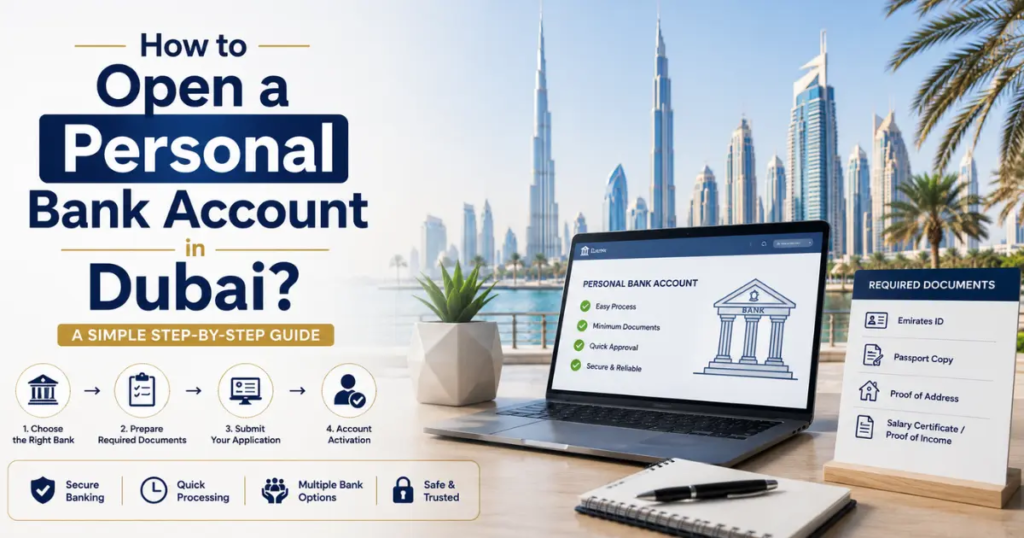
Opening a personal bank account in Dubai is usually straightforward once your UAE residency documents are in place. For most residents, you’ll need your passport, Emirates ID, residence visa, and proof of address, while some accounts also require a salary certificate or salary transfer. This sits alongside the other UAE laws topics residents deal with regularly.
The bigger question is which account you actually qualify for. UAE residents, visitors, and non-residents don’t have the same banking options, minimum balances, or documentation requirements.
This guide explains how to open a personal bank account in Dubai, what documents you need, how the process works, how much you may need to keep in the account, and which requirements apply based on your residency status.
What Do You Need to Open a Personal Bank Account in Dubai?
A valid passport, UAE residence visa and Emirates ID for residents, proof of UAE address, and often a salary certificate or salary transfer letter, though exact requirements vary by bank and account type.
Basic Eligibility
At least 18 years old
Valid passport with reasonable remaining validity
UAE residence visa and Emirates ID, for resident accounts
Proof of UAE residential address
What If I Don’t Have My Residency Visa Yet?
Some banks, including HSBC, offer an international account you can open before arriving in the UAE or before your residency visa is issued. This bridges the gap until your paperwork is sorted, though it’s a distinct product, not a standard current account.
Resident vs Non-Resident Accounts: A Real Difference
This is where most guides blur an important distinction for a bank account in Dubai for foreigners.
Residents
Non-Residents
Account types available
Full current and savings accounts
Generally savings accounts only
Typical minimum balance
AED 3,000 to 15,000
AED 25,000 to 100,000+
Emirates ID required
Yes
No, but restricts account type
Documentation
Standard
More extensive compliance checks
Confirm the exact resident vs non-resident terms with your specific bank, since this varies.
Documents Required to Open a Personal Bank Account
The documents required to open a bank account in Dubai depend on your residency status.
For UAE Residents
Original passport
Valid UAE residence visa
Original Emirates ID
Proof of UAE address, a utility bill, tenancy contract, or employment letter
Salary certificate or salary transfer letter, if applying for a salary-linked account
Original trade licence, for self-employed applicants
Original labour card or work ID, for GCC national customers specifically, some banks apply this to other sponsored applicants too, confirm with your specific bank
For Non-Residents
Passport
6 months of personal bank statements
Proof of address from home country
Proof of source of funds
For Joint Accounts
The same core documents from both applicants, though usually only one applicant needs to provide a salary certificate or salary transfer letter.
What Types of Personal Bank Accounts Are Available in Dubai?
Current account: everyday transactional account, cheque book, debit card
Savings account: interest-bearing, often used for non-resident access
Salary account: a current account your employer uses for salary deposits, sometimes with a minimum salary requirement
Joint account: shared between two account holders
Minor account: opened for a child, managed by a parent or guardian
Premium or private banking accounts: higher minimum balance or salary requirements, with added benefits
How Much Minimum Balance Do You Need?
It varies significantly by bank and account type, from AED 3,000 on standard current accounts at banks like Citibank and DIB, up to AED 25,000 or more for non-resident or premium accounts. Falling below the required balance typically triggers a modest monthly fee, commonly around AED 25, rather than automatic account closure.
How to Open a Personal Bank Account in Dubai? Step by Step
Choose your bank and account type, based on whether you’re a resident or non-resident, and your salary or balance situation
Gather your documents: passport, Emirates ID and residence visa for residents, proof of address, and salary certificate or transfer letter if needed
Apply through the bank’s app, website, or a branch visit, depending on which channel the bank and account type support
Complete identity verification, in person, by video call, or digitally depending on the bank
Sign the account opening application and any required consent forms
Receive your account details and debit card once approved
Can You Have More Than One Current Account?
Yes. You can open multiple current accounts across different banks or with the same bank, though managing several accounts adds complexity, so most people keep this to what they actually need.
Can I Open a Bank Account in Dubai Without Being There?
Generally, most banks still require you to sign documents in front of a bank officer, meaning physical presence at some stage. That said, a few options exist for opening without travelling:
Some international banks with a presence in your home country, like HSBC or Citibank, may let you start the process at a local branch
An HSBC-style international bridge account can be opened before you arrive, though it’s not a full current account
Using a financial advisor as a local representative is possible with some banks, though not universal
Confirm the exact remote options directly with your chosen bank, since this varies significantly.
Can You Open a Bank Account in Dubai Fully Online?
Increasingly, yes, you can open a UAE bank account online, though it depends heavily on the bank.
Mashreq NEO: fully branchless, account opening in around 2 minutes with just a valid Emirates ID
DIB: fully app-based “Banking in Minutes” opening via document scan and selfie
HSBC, Citibank, and several others: in-app opening is available for some accounts, though premium accounts and Arabic-language assistance generally still require a branch visit
How Long Does It Take to Open a Personal Bank Account?
Typically 1 to 3 business days for a standard personal account with complete documentation, considerably faster than a corporate account, which usually takes 2 to 4 weeks due to additional verification. If you’re setting up a business account alongside your personal one, our guide on UAE business bank account requirements covers that separate, longer process.
Top UAE Banks for a Personal Account
There’s no single “best” bank for a bank account Dubai expats can all agree on, it depends on your priorities. Here are 8 established, licensed UAE banks worth comparing directly, each verified against their own official personal banking page.
International wealth tiers, established global network
Match the bank to your actual situation, salary level, residency status, and whether you need international transfers, rather than picking by name recognition alone. Confirm current account terms and minimum balances directly on each bank’s own page before applying, since these change periodically.
Do Banks Check Your Credit Score Before Opening an Account?
Yes, some do. Banks may review your credit history through theAl Etihad Credit Bureau (AECB) as part of the account opening process. It’s worth checking your own credit report beforehand to confirm it’s accurate and up to date.
What Counts as a Valid Salary Transfer?
This matters for accounts with salary-linked benefits or fee waivers. A genuine salary transfer must come from your UAE-registered employer through the bank’s recognised channel. A remittance, cash deposit, or cheque credit generally does not qualify as a salary transfer, even if the amount matches your salary.
Conclusion
Two things matter most about opening a personal bank account in Dubai. First, the process is genuinely fast, often 1 to 3 business days, once your documents are in order. Second, resident vs non-resident status changes what’s actually available to you far more than most guides explain, non-residents are typically limited to savings accounts with meaningfully higher minimum balances.
Confirm the exact current requirements and minimum balance directly with your chosen bank before applying.
Frequently Asked Questions
What documents do I need to open a personal bank account in Dubai?
A valid passport, UAE residence visa and Emirates ID for residents, proof of UAE address, and, for some salary-linked accounts, a salary certificate or salary transfer letter. Exact requirements vary by bank and account type.
Can a non-resident open a personal bank account in Dubai?
Yes, but options are more limited than for UAE residents. Non-residents may have access to savings or other specific account types and can face higher minimum-balance requirements, depending on the bank and account.
How long does it take to open a personal bank account in Dubai?
A standard personal account can often be opened within 1 to 3 business days once all required documents have been submitted and verified. Some digital-first accounts may be activated much faster for eligible applicants.
How much minimum balance do I need for a personal bank account in Dubai?
The minimum balance varies by bank and account type. Some standard accounts may require around AED 3,000, while premium and certain non-resident accounts can require significantly higher balances.
Can I open a bank account in Dubai fully online?
Yes, some UAE banks offer fully digital account opening for eligible customers. Mashreq NEO and DIB provide app-based onboarding, while other banks may require a branch visit for certain account types or applicants.
Do I need a minimum salary to open a bank account in Dubai?
Not necessarily. Some personal accounts do not have a minimum salary requirement, while salary-linked accounts and certain premium accounts may require a specific monthly salary, depending on the bank.
What happens if I don’t maintain the minimum balance?
If your account has a minimum-balance requirement and you fall below it, the bank may charge a monthly fee. The amount and conditions vary by bank and account, so check the account’s current fee schedule.
How do I open a personal bank account in Dubai?
Choose a bank and account type, check the eligibility requirements, gather your documents, and apply through the bank’s app, website, or branch. You’ll then complete identity verification, sign the required forms, and receive your account details once approved.
Can I have more than one current account?
Yes. You can generally have multiple current accounts with different banks, and some banks may also allow multiple accounts under the same customer profile. However, it’s usually best to keep only the accounts you actually need.
Can I open a bank account in Dubai without being there?
It depends on the bank and account type. Many banks require physical presence at some stage, while certain international banking services and specific account products may allow you to start or complete part of the process remotely.
Which bank is best in the UAE for a personal account?
There is no single best bank for everyone. Your choice should depend on factors such as minimum balance, digital account opening, salary requirements, branch access, international transfers, and whether you prefer conventional or Islamic banking.
Can I open a bank account in the UAE without a salary?
Yes, some personal accounts can be opened without a salary transfer. However, salary-linked accounts and certain account benefits may have minimum salary requirements set by the bank.
Can I open a bank account in Dubai on a visit visa?
Generally, a visit visa does not qualify you for a standard UAE resident current account because banks usually require UAE residency and an Emirates ID. However, some banks may offer limited non-resident account options, subject to their eligibility requirements and minimum balances.
Can I open a bank account before getting an Emirates ID?
Some banks may accept temporary or alternative documentation while your Emirates ID is being processed, depending on the account and the bank’s policy. However, a standard resident account generally requires Emirates ID verification once the card is issued.
Can a freelancer open a personal bank account in Dubai?
Yes, freelancers can open personal bank accounts if they meet the bank’s eligibility requirements. However, keeping personal and business finances separate is generally better for accounting, record-keeping, and compliance. Freelancers who receive regular business income may also need an appropriate business account linked to their freelance or business setup.
Can a student open a bank account in Dubai?
Yes. Students who have UAE residency, such as through family or study sponsorship, may be eligible for personal bank accounts. The exact requirements depend on the student’s age, residency status, bank, and account type.
Can I open a bank account with a UAE residence visa but no salary?
Yes, some banks offer personal accounts that do not require a salary transfer. However, eligibility, minimum balance requirements, and available account features vary by bank, so check the specific account’s requirements before applying.
Updates Section
Last verified: August 2026. Reflects current bank-published documentation requirements, minimum balances, and digital account opening options.
Anees is a UAE-based content creator, writer, and SEO professional with over 12 years of experience. Since 2014, he has published research-backed guides on UAE visas, labour laws, jobs, traffic fines, and government services, all verified against official sources. He is certified in SEO by HubSpot Academy and Digital Marketing by Google Digital Garage.
12+ Years ExperienceHubSpot Academy — SEOGoogle Digital Garage
Disclaimer: This information is for general guidance only, based on publicly available UAE laws and regulations. It does not constitute legal advice. Always verify with official UAE government sources or a qualified legal professional.


Your email will not be published. Comments are reviewed before appearing.