UAE Visa Overstay Fine 2026: AED 50/Day RulesMinimum Salary to Sponsor Your Family Visa in UAEUAE Labour Law: Notice Period ExplainedHow to Check Your UAE Visa Status OnlineUAE Golden Visa Eligibility Requirements UpdatedUAE Visa Overstay Fine 2026: AED 50/Day RulesMinimum Salary to Sponsor Your Family Visa in UAEUAE Labour Law: Notice Period ExplainedHow to Check Your UAE Visa Status OnlineUAE Golden Visa Eligibility Requirements Updated
Maternity Insurance in the UAE: What’s Covered and How to Choose a Plan
The UAE Times
–
–
– min read
Last updated: – · Based on official UAE sources
Maternity insurance in the UAE is an important part of health coverage for women planning a pregnancy or expecting a baby. Under the applicable rules, health insurance is mandatory in the UAE, and maternity benefits form part of the minimum coverage required under certain Dubai and Abu Dhabi health insurance schemes. This sits alongside the other health and insurance topics UAE residents deal with regularly.
But maternity coverage isn’t the same across every policy. The benefits, coverage limits, co-payments, waiting periods and exclusions can vary depending on the insurer, policy and emirate.
This guide explains exactly what maternity insurance covers in the UAE, how Dubai and Abu Dhabi requirements differ, what may be excluded, and what to check before choosing a plan.
What Is Maternity Insurance in the UAE?
Maternity insurance is health insurance coverage specifically for pregnancy, childbirth, and a short newborn period, built into a standard health insurance plan or added as a rider, with minimum benefit levels set by each emirate’s health regulator.
Is Maternity Insurance Required in the UAE?
Health insurance is mandatory under the applicable rules in the UAE. Maternity benefits may form part of the required or available coverage under the health insurance scheme applicable to you, but the exact benefits, limits and conditions depend on the emirate and policy. The Dubai Health Authority (DHA) regulates health insurance in Dubai under Law No. 11 of 2013, and the Department of Health (DoH) regulates the sector in Abu Dhabi.
How Does Maternity Insurance Differ Between Dubai and Abu Dhabi?
This is genuinely worth understanding before assuming one emirate’s rules apply to the other.
Dubai
Abu Dhabi
Regulator
DHA
DoH
Mandatory health insurance
Yes
Yes
Minimum maternity benefit
Set under the Essential Benefits Plan
Depends on the applicable scheme
Waiting period
Policy dependent
Policy dependent
Co-payment
Policy/scheme dependent
Policy/scheme dependent
Don’t assume Dubai’s specific benefit figures automatically apply to an Abu Dhabi policy, or the other way around. Always check the actual policy wording for your emirate rather than assuming one set of minimums applies everywhere.
What Does Maternity Insurance Cover in the UAE?
Prenatal check-ups, scans, and routine tests
Delivery costs, both normal delivery and medically necessary C-section
Postnatal care for the mother
A short newborn cover period, commonly around 30 days
Does It Cover Pregnancy and Delivery Complications?
This is one of the biggest real-world questions, and the honest answer is that it depends on the policy. Coverage for complications such as emergency C-sections, extended hospitalisation, or NICU care for the baby depends on the policy’s maternity benefit, limits, exclusions, and medical necessity rules. Check this specifically before assuming complications are automatically covered.
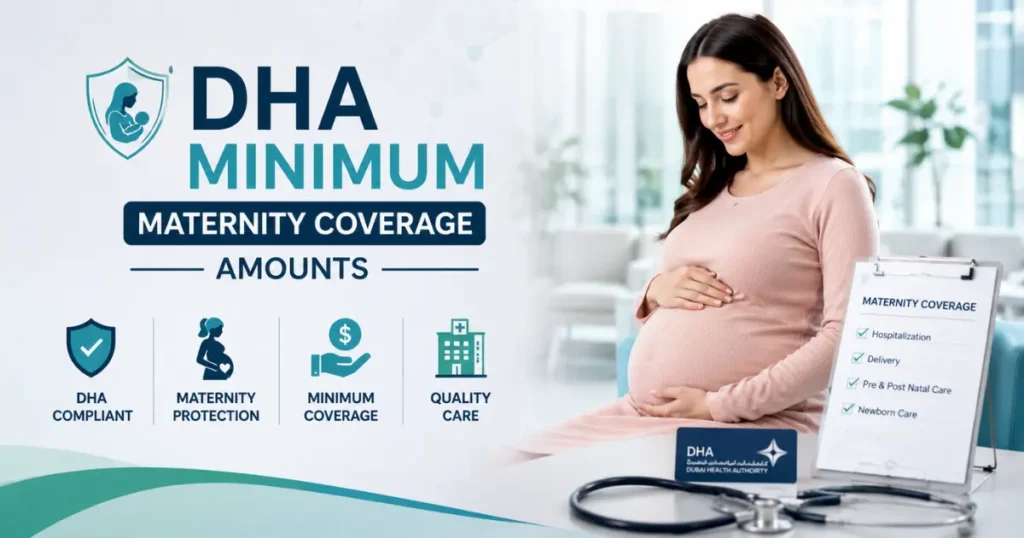
What Are the DHA Minimum Maternity Coverage Amounts?
These figures are specific to Dubai’s Essential Benefits Plan (EBP), the minimum standard for any health insurance policy issued in the emirate, rather than a universal UAE-wide amount.
AED 7,000 for a normal delivery
AED 10,000 for a medically necessary C-section
A 10% co-payment generally applies
8 antenatal consultations and 3 ultrasound scans as outpatient antenatal cover
Cover for 30 days from birth for the newborn
Under the EBP specifically, this maternity benefit applies to married female policyholders. If you’re on a comprehensive plan above the minimum EBP level, your actual benefit amounts may be higher, always check your specific policy schedule.
What Is Congenital Disorder Cover?
A distinct maternity-adjacent benefit some plans offer, covering conditions your baby is born with.William Russell’s plans, for example, offer up to AED 367,000 on their Gold plan and AED 150,000 on Silver, provided the baby is added to the policy within 30 days of birth. This is specific to that insurer’s own product, not a standard figure across all plans.
How Much Does Giving Birth Cost Without Insurance in the UAE?
Costs vary significantly by hospital, emirate, delivery type, and whether complications arise, so treat any single figure as indicative rather than official. Reported private-sector ranges commonly fall between AED 20,000 to 30,000 for the full prenatal-to-postnatal journey, with hospital delivery fees alone reported roughly between AED 2,000 and 14,000 depending on the specific hospital, before complications.
What Does Maternity Insurance Usually Exclude?
Genuinely important, and rarely covered clearly. Standard maternity cover commonly excludes:
Voluntary termination of pregnancy
Multiple births (twins, triplets), sometimes requiring an upgraded plan or rider
Voluntary C-sections, meaning a C-section chosen without medical necessity
An existing pregnancy that began before the policy started, in many cases
Coverage typically also has an age limit for the mother, specified in the individual policy
What Are Maternity Insurance Waiting Periods in the UAE?
Waiting periods vary by insurer and policy, and range widely, from no waiting period on some plans to 12 months or longer on others. Some basic plans may have shorter or no waiting periods, while other comprehensive plans impose longer maternity waiting periods. Always check the specific policy schedule before purchasing rather than assuming a fixed number applies.
Can You Buy Maternity Insurance While Already Pregnant?
Usually, you shouldn’t assume a newly purchased policy will cover an existing pregnancy. Many plans exclude maternity expenses for a pregnancy that began before coverage started, while some products may apply different underwriting terms instead. Check the policy’s maternity eligibility and pregnancy exclusion clause directly with the insurer before buying, rather than assuming either automatic coverage or automatic decline.
What Should You Check Before Buying Maternity Insurance?
Use this as a practical checklist, not just the headline maternity limit:
Maternity annual limit
Normal delivery versus C-section limit
Pregnancy complication coverage
Prenatal consultation and scan limits
Hospital network
Co-payment percentage
Newborn coverage period
NICU coverage
Waiting period
What Happens to Your Baby’s Insurance After the Newborn Period Ends?
Some policies provide automatic newborn coverage for a limited period after birth, often around 30 days, but the exact period and conditions depend on the policy. Your baby generally needs their own ongoing health insurance after that window, so don’t wait until the temporary newborn period ends to arrange it.
Check whether your baby needs to be added to the mother’s or father’s policy, and note that congenital condition coverage may carry separate terms. Our guide on newborn health insurance in the UAE covers this next step in full.
Conclusion
Don’t buy based only on the headline maternity limit. Check the waiting period, delivery limit, C-section rules, hospital network, co-payment, pregnancy complication coverage, and newborn terms before choosing a plan.
Confirm your specific policy’s terms directly with the insurer, and check your emirate’s applicable minimum, well before you plan to conceive, since buying insurance after pregnancy begins rarely covers that existing pregnancy.
Frequently Asked Questions
What does maternity insurance cover in the UAE?
Prenatal care, delivery costs for both normal and C-section births, postnatal care, and typically a newborn cover period of around 30 days, subject to the specific policy.
What are the DHA minimum maternity coverage amounts?
Under Dubai’s Essential Benefits Plan, AED 7,000 for a normal delivery and AED 10,000 for a medically necessary C-section, both with a 10% co-payment, for married female policyholders.
How long is the waiting period for maternity insurance in the UAE?
It varies significantly by insurer and policy, from no waiting period on some plans to 12 months or longer on others. Always check the specific policy schedule.
Can I buy maternity insurance if I’m already pregnant?
Usually not for that existing pregnancy. Many plans exclude maternity expenses for a pregnancy that began before the policy started, so check the eligibility and exclusion terms directly with the insurer.
What is not covered by maternity insurance in the UAE?
Common exclusions include voluntary termination of pregnancy, multiple births unless specifically added, voluntary C-sections without medical necessity, and often an existing pregnancy from before the policy started.
Does maternity insurance cover C-section in the UAE?
Yes, medically necessary C-sections are covered under the minimum benefit standard, though voluntary C-sections chosen without medical necessity are commonly excluded.
Does health insurance cover pregnancy complications in the UAE?
It depends on the specific policy’s maternity benefit, limits, exclusions, and medical necessity rules, rather than complications being automatically covered on every plan.
Does maternity insurance cover the newborn baby too?
Many policies provide a limited newborn cover period, often around 30 days, though the exact period and conditions depend on the policy, and ongoing separate coverage is generally needed afterward.
Updates Section
Last verified: August 2026. Reflects the current DHA Essential Benefits Plan minimum standard.
Anees is a UAE-based content creator, writer, and SEO professional with over 12 years of experience. Since 2014, he has published research-backed guides on UAE visas, labour laws, jobs, traffic fines, and government services, all verified against official sources. He is certified in SEO by HubSpot Academy and Digital Marketing by Google Digital Garage.
12+ Years ExperienceHubSpot Academy — SEOGoogle Digital Garage
Disclaimer: This information is for general guidance only, based on publicly available UAE laws and regulations. It does not constitute legal advice. Always verify with official UAE government sources or a qualified legal professional.


Your email will not be published. Comments are reviewed before appearing.