UAE e invoicing requirements now apply to every business that trades in the UAE, whether or not it is registered for VAT. Businesses with annual revenue of AED 50 million or more had to appoint an Accredited Service Provider by 30 October 2026 and must go live on 1 January 2027, while all other businesses follow on 31 March 2027 and 1 July 2027.
This guide explains who must comply, the exact dates, the e invoice format, the new penalty table under Cabinet Decision No. 173 of 2026, how to choose a provider and what to do now. Every figure comes from Ministry of Finance documents, and we list them in the references. For VAT basics, see our guides to VAT registration in the UAE and UAE VAT penalties.
UAE E Invoicing Requirements: Quick Answer
UAE e invoicing means issuing invoices and credit notes as structured data through an Accredited Service Provider, which passes the data to the buyer and reports it to the Federal Tax Authority. A PDF, Word file, image, scan or email does not count as an e invoice.
Item
What applies
Who must comply
Any person conducting business in the UAE, including businesses not registered for VAT
Revenue AED 50 million or more
Appoint a provider by 30 Oct 2026, go live 1 Jan 2027
Revenue below AED 50 million
Appoint a provider by 31 Mar 2027, go live 1 Jul 2027
Government entities
Appoint a provider by 31 Mar 2027, go live 1 Oct 2027
Invoice format
XML following Peppol PINT AE
Issue window
Within 14 business days of the transaction
Latest penalty decision
Cabinet Decision No. 173 of 2026
Last reviewed on 2 November 2026 against the Ministry of Finance guidelines version 2.0 dated 26 October 2026.
Official Documents to Read First
The Ministry of Finance publishes the guidelines, the mandatory field list, the legal decisions and the provider list on one page. Start there instead of relying on summaries, because several rules changed in October 2026.
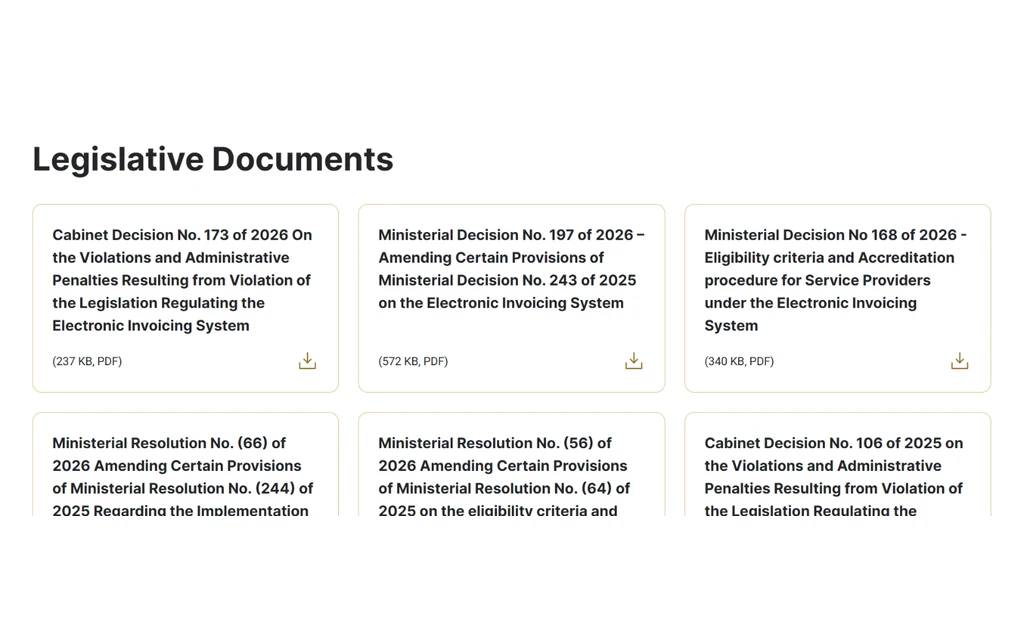
The Legislative Documents section of the official page lists Cabinet Decision No. 173 of 2026 on penalties and Ministerial Decision No. 197 of 2026. Source: mof.gov.ae
What Is E Invoicing in the UAE?
E invoicing in the UAE is the electronic issue, exchange and reporting of structured invoice data between supplier, buyer and the Federal Tax Authority. The Ministry of Finance describes four parties in the model: the supplier, the buyer, each side’s Accredited Service Provider and the tax authority.
The system is based on the OpenPeppol standard, and invoices follow the PINT AE specification in XML format. The guidelines state that no QR code or barcode is used. The buyer identifier is the number 0235 followed by the 10 digit Tax Identification Number.
Under Ministerial Decision No. 243 of 2025, the system covers invoices and credit notes. The Ministry confirms that unstructured formats such as PDF, Word, images, scans and emails do not qualify.
Who Must Follow UAE E Invoicing Requirements?
Every person conducting business in the UAE must use e invoicing, regardless of VAT registration status, according to guidelines version 2.0. The obligation covers business to business and business to government transactions, and supplies to individuals who are not acting in a business capacity are out of scope.
Businesses registered for VAT and businesses that are not.
Non UAE persons who must issue tax invoices in the UAE.
Free zone businesses, with a specific rule: when the customer is a free zone entity, the invoice must include beneficiary details.
Members of a tax group, who get a 24 month exclusion for transactions between members starting 1 January 2027.
What Is Excluded?
Ministerial Decision No. 197 of 2026 lists the exclusions from the system. The Minister can add further excluded persons or transactions by decision.
Government entities acting in a sovereign capacity that do not compete with the private sector.
International airline passenger transport where an electronic ticket is issued, and ancillary passenger services with an electronic miscellaneous document.
International airline goods transport with an airway bill, for 24 months from the date the system takes effect.
Financial services that are exempt from VAT or zero rated under Article 42 of the VAT Executive Regulation.
Can You Use E Invoicing Voluntarily?
Yes, any business can issue, send and report e invoices voluntarily, and the pilot and voluntary phase started on 1 July 2026. Once a business starts, the system rules apply to it, but Cabinet Decision No. 173 of 2026 says the penalties do not apply to voluntary users.
UAE E Invoicing Deadlines for 2026 and 2027
The deadline that applies to you depends on annual revenue, and the AED 50 million threshold splits businesses into two tracks. The first provider deadline has already passed on 30 October 2026.
Group
Appoint a provider by
Go live by
Revenue AED 50 million or more
30 October 2026
1 January 2027
Revenue below AED 50 million
31 March 2027
1 July 2027
Government entities
31 March 2027
1 October 2027
The 30 October 2026 date replaced an earlier date of 31 July 2026 through Ministerial Resolution No. 66 of 2026. The timeline picture on the Ministry page still shows the older 31 July date, so rely on the date table in the guidelines version 2.0.
A business that is newly established and in scope must appoint a provider and onboard before it issues its first invoice. Do not wait for the group deadline if you start trading after the rollout begins.
Which Deadline Applies to You?
Check your annual revenue against AED 50 million. The guidelines use the revenue threshold to place a business in one of the two tracks.
If you are at or above the threshold, your provider deadline has passed and you must be live from 1 January 2027.
If you are below the threshold, plan to appoint a provider before 31 March 2027, so you have time to test before 1 July 2027.
If you are a government entity, the appointment date is 31 March 2027.
How Does UAE E Invoicing Work Step by Step?
The flow has five steps from invoice creation to reporting. Your accounting system creates the invoice data, your provider converts it to the PINT AE format and sends it through the network to the buyer’s provider, and the data is reported to the tax authority.
Appoint an Accredited Service Provider from the Ministry of Finance list.
Connect your accounting or ERP system to the provider.
Issue the invoice or credit note as structured data, not as a PDF.
The provider sends it to the buyer’s provider and reports it to the Federal Tax Authority.
The buyer receives and processes the e invoice through its own provider.
Ministerial Decision No. 197 of 2026 requires you to issue and transmit invoices and credit notes through the system within 14 business days from the date of the transaction.
Credit Notes Under UAE E Invoicing
Credit notes must also be electronic. The Ministry states that e credit notes are required for cancellations, reduced consideration, full or partial refunds, and administrative or numerical errors.
Partial credit notes are allowed.
One credit note can cover several earlier tax invoices.
If the total payable would be negative, you must use a credit note.
Penalties Under Cabinet Decision No. 173 of 2026
Cabinet Decision No. 173 of 2026 sets the current e invoicing penalties and repeals Cabinet Decision No. 106 of 2025. It takes effect the day after publication in the Official Gazette.
Violation
Penalty
Cap
Not implementing the system or not appointing a provider on time
AED 5,000 first instance plus AED 5,000 for each month or part of a month
AED 50,000 in any 12 consecutive months
Recipient not meeting its obligations after implementing
Same structure as above
AED 50,000 in any 12 consecutive months
Not issuing and sending an e invoice
AED 100 per invoice
AED 5,000 per calendar month
Not issuing and sending an e credit note
AED 100 per credit note
AED 5,000 per calendar month
Not telling the provider about changes to registered data
AED 250 per day or part of a day
AED 5,000 per calendar month
Only one penalty applies when the same person acts as issuer, recipient or both for the same violation. Voluntary users are not penalised.
Worked Example of the Late Invoice Cap
A business that sends 80 e invoices late in one calendar month would reach AED 8,000 at AED 100 each, but the cap limits the total for late invoices to AED 5,000 for that month. Late credit notes are capped separately at AED 5,000 per month.
What Changed From the Earlier Penalty Table?
Cabinet Decision No. 106 of 2025 listed a fine of AED 1,000 per day for not notifying the tax authority of a system malfunction, and AED 1,000 per day for not telling the provider about data changes. The new decision lists no fine for the malfunction notice and sets the data change fine at AED 250 per day with a monthly cap.
How to Choose an Accredited Service Provider
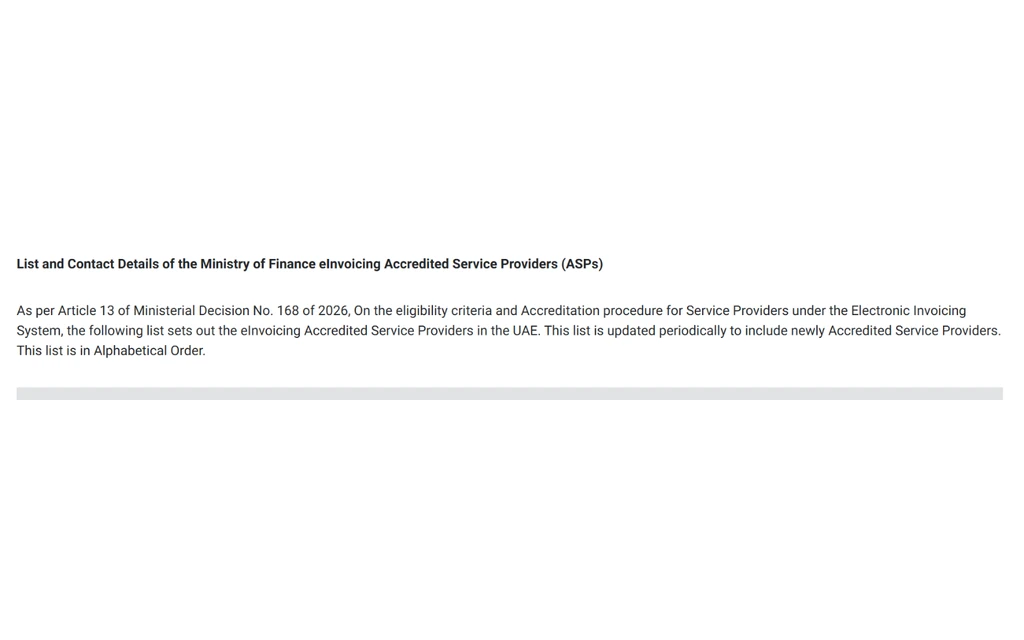
Choose a provider that appears on the Ministry of Finance list and fits your accounting system. The list is issued under Article 13 of Ministerial Decision No. 168 of 2026, shows 83 providers in alphabetical order, and is updated periodically. The Ministry gives no ranking or recommendation.
The official provider list page, issued under Article 13 of Ministerial Decision No. 168 of 2026. Source: mof.gov.ae
Because the Ministry gives no selection criteria, use your own checklist before you sign.
Is the provider’s accreditation number shown on the Ministry list?
Does it connect to your accounting or ERP system without manual uploads?
Does it support credit notes, partial credit notes and the PINT AE format?
Who tells you when an invoice is rejected, and how fast?
How does it handle record storage, and who is responsible for it?
What is the price per invoice or per month, and what does onboarding cost?
Record Keeping and Storage
Guidelines version 2.0 sets 5 years after the tax period for taxable persons, with 4 extra years if a dispute or audit arises. Non taxable persons keep records for 5 years from the end of the calendar year of creation, and real estate records for 7 years.
You can delegate storage to your provider, but the business remains responsible for the records. Providers must keep transaction logs.
What Should You Do Now?
Start with a short readiness check that you can finish this week.
Confirm which revenue track applies to you.
Pick a provider from the Ministry list and book onboarding.
Ask your accountant to map invoice fields to the Ministry mandatory field document.
Test credit notes, not only invoices.
Update customer and supplier details so the 0235 identifier with the TIN is correct.
Train the staff who issue invoices to stop sending PDFs as the official invoice.
Common Mistakes With UAE E Invoicing
Treating a PDF as the invoice after the go live date.
Waiting for the 1 July 2027 date when the deadline for appointing a provider is earlier.
Using an older guide that still shows the AED 1,000 daily fines or the 31 July 2026 date.
Forgetting credit notes, which must also be sent as e credit notes.
Assuming that a business not registered for VAT is exempt.
Figures You May Still See Online
Some websites still show figures that are no longer current. The 31 July 2026 provider date for large businesses was replaced by 30 October 2026. The AED 1,000 daily fine for system malfunction notices does not appear in Cabinet Decision No. 173 of 2026. The provider list on the Ministry page shows 83 providers, not the smaller numbers quoted earlier in 2026.
UAE E Invoicing: Latest Updates
1 November 2026: the Ministry of Finance provider page shows 83 accredited providers.
30 October 2026: the Ministry eInvoicing page was updated and lists Cabinet Decision No. 173 of 2026 on penalties.
30 October 2026: provider appointment deadline for businesses with revenue of AED 50 million or more.
26 October 2026: Ministry of Finance published guidelines version 2.0.
1 October 2026: Ministerial Decision No. 197 of 2026 takes effect.
Conclusion
UAE e invoicing requirements are now fixed in law, and the next date is 1 January 2027 for larger businesses and 31 March 2027 for everyone else. Check your revenue track, pick a provider from the official list and stop relying on PDF invoices. For the tax side of invoicing, read our guides to UAE corporate tax penalties and other topics in Businesses in UAE.
FAQs About UAE E Invoicing Requirements
Is e invoicing mandatory in the UAE?
Yes, e invoicing is mandatory for every business that conducts business in the UAE, in phases from 1 January 2027 for large businesses and 1 July 2027 for others. Government entities follow on 1 October 2027.
Does e invoicing apply if my business is not registered for VAT?
Yes, the guidelines apply regardless of VAT registration status. Supplies to individuals who are not acting in a business capacity are out of scope.
What is the AED 50 million threshold?
The threshold is annual revenue of AED 50 million, and it decides whether you appoint a provider by 30 October 2026 or 31 March 2027.
Can I still send PDF invoices?
A PDF alone is not an e invoice, because unstructured formats do not qualify. You may share a PDF copy for readability, but the official invoice must be the structured data sent through your provider.
What is the penalty for not appointing an Accredited Service Provider?
The penalty is AED 5,000 for the first instance plus AED 5,000 for each month or part of a month, capped at AED 50,000 in any 12 consecutive months.
How many accredited providers are there?
The Ministry of Finance page lists 83 accredited providers, and the list is updated periodically.
How long do I have to issue an e invoice?
You must issue and transmit it through the system within 14 business days from the date of the transaction.
Do free zone companies need e invoicing?
The guidelines apply to any person conducting business in the UAE, and they add a rule that invoices to free zone customers must include beneficiary details.
Do voluntary users face penalties?
No, Cabinet Decision No. 173 of 2026 exempts persons who use the system voluntarily.
Anees is a UAE-based content creator, writer, and SEO professional with over 12 years of experience. Since 2014, he has published research-backed guides on UAE visas, labour laws, jobs, traffic fines, and government services, all verified against official sources. He is certified in SEO by HubSpot Academy and Digital Marketing by Google Digital Garage.
12+ Years ExperienceHubSpot Academy — SEOGoogle Digital Garage
Disclaimer: This information is for general guidance only, based on publicly available UAE laws and regulations. It does not constitute legal advice. Always verify with official UAE government sources or a qualified legal professional.





Your email will not be published. Comments are reviewed before appearing.