UAE Visa Overstay Fine 2026: AED 50/Day RulesMinimum Salary to Sponsor Your Family Visa in UAEUAE Labour Law: Notice Period ExplainedHow to Check Your UAE Visa Status OnlineUAE Golden Visa Eligibility Requirements UpdatedUAE Visa Overstay Fine 2026: AED 50/Day RulesMinimum Salary to Sponsor Your Family Visa in UAEUAE Labour Law: Notice Period ExplainedHow to Check Your UAE Visa Status OnlineUAE Golden Visa Eligibility Requirements Updated
VAT Registration UAE Requirements: Thresholds, Documents and How to Apply
The UAE Times
–
–
– min read
Last updated: – · Based on official UAE sources
VAT registration UAE requirements centre on one number: AED 375,000 in taxable supplies and imports over the previous 12 months, which triggers mandatory registration, with a separate AED 187,500 voluntary threshold below that.
A new penalty framework took effect on 14 April 2026, replacing the previous structure with a simpler, flat interest rate. Non-resident businesses also face a completely different registration rule regardless of threshold. This sits alongside the other UAE businesses topics owners deal with regularly, and this guide covers both, verified against official FTA sources and current regulatory updates.
Note: If you’re a tax consultant, accounting firm, or business advisory service helping companies with VAT and FTA compliance, find out about advertising with us.
Who Must Register for VAT in the UAE?
Before looking at the exact numbers, it helps to know who this actually applies to. VAT registration requirements cover several distinct categories, each with slightly different rules:
UAE-resident businesses: follow the standard AED 375,000 mandatory and AED 187,500 voluntary thresholds
Non-resident businesses: may need to register regardless of threshold, covered in detail below
Natural persons: individuals carrying out business activities in their personal capacity, such as owners of sole establishments
Legal persons: incorporated companies, LLPs, clubs, charities, associations, and government entities
Free zone businesses: generally follow the same thresholds as mainland companies
Tax Groups: two or more related legal persons that choose to register together under one combined VAT registration
What Are the VAT Registration Thresholds in the UAE?
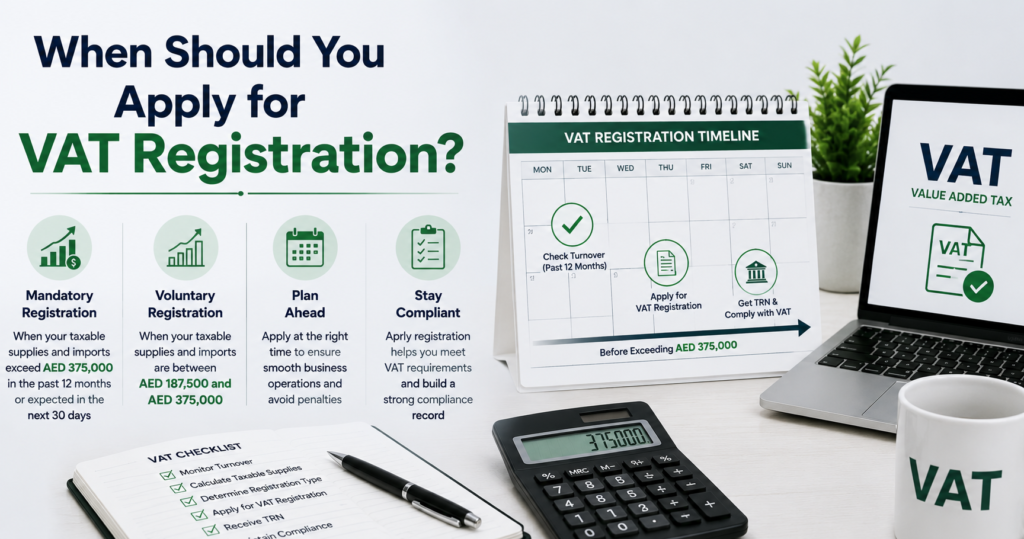
Mandatory registration applies once taxable supplies and imports exceed AED 375,000 in the past 12 months, or are expected to in the next 30 days. Voluntary registration is available from AED 187,500.
The Whichever Comes First Rule
Registration is triggered by whichever happens first: exceeding the threshold in the past 12 months, or a genuine expectation of exceeding it in the next 30 days.
Do Zero-Rated and Exempt Supplies Count Toward the Threshold?
This distinction genuinely matters, and most guides get it wrong. Zero-rated supplies count toward the AED 375,000 threshold, since VAT is technically charged, just at 0%. Exempt supplies do not count, since VAT never applies to them at all.
Can a Business Get an Exception From Registration?
Yes, in a specific case. Businesses making only zero-rated supplies can apply for an exception from VAT registration. This doesn’t apply if you also make any standard-rated supplies alongside zero-rated ones, and even if the exception is granted, the rest of the registration form must still be completed.
Can Startups Register Before Earning Revenue?
Yes. Taxable expenses, not just supplies, above AED 187,500 qualify a startup for voluntary registration, provided the business can demonstrate genuine intent to make taxable supplies.
Do Branches Need Separate VAT Registration?
No. Branches aren’t legally distinct from the wider entity they belong to. Registration is made in the name of the parent business, not the branch, so even a company operating across multiple emirates through several branches only needs one VAT registration.
Can Two Related Businesses Register as a Single Tax Group?
Yes, though eligibility isn’t as simple as “related businesses.”
Two or more UAE-resident legal persons can register together as a Tax Group
They must be associated and meet specific control and connection criteria set by the FTA
The group files under one combined VAT registration rather than separately
Eligibility rules are detailed enough to deserve their own dedicated guide, worth exploring directly with the FTA or a tax advisor if this applies to your structure
What Happens After VAT Registration?
Getting your TRN is the start of ongoing compliance, not the end of the process.
Your VAT Registration Certificate becomes available in your EmaraTax dashboard once your application is approved
Issue VAT-compliant invoices showing your TRN on every taxable supply
Charge VAT at the correct rate on applicable sales
Maintain accurate VAT records, generally for at least 5 years
File VAT returns by your assigned deadline, monthly or quarterly depending on your tax period
Pay any VAT due by the payment deadline
Claim eligible input VAT on your business expenses
How to Check Your VAT Registration Status
Log in to your EmaraTax account
Check the status of your submitted application
Once approved, your VAT Registration Certificate and TRN become available directly in your dashboard
No separate request is needed
Do Multiple Sole Establishments Need Separate VAT Registration?
No, and this is a genuinely common point of confusion.
A natural person who owns several sole establishments does not get a separate threshold for each one
All sole establishments owned by the same individual are registered under a single Tax Registration Number
The VAT threshold is assessed based on the combined taxable activities of the sole establishments owned by the same natural person, rather than treating each establishment as having a separate threshold
If you’re currently registered separately for more than one sole establishment, the FTA has published specific guidance on the corrective steps to take
When Should You Apply for VAT Registration?
Once the obligation arises, you have 30 days to submit the VAT registration application.
The 30-day clock starts the moment your past 12-month taxable supplies and imports cross AED 375,000, or the moment you genuinely expect to cross it within the next 30 days, whichever happens first
Waiting until the last moment can increase the risk of missing the deadline, especially if the FTA requests corrections or additional information
Missing the 30-day window risks a late registration penalty and having VAT backdated to the date the threshold was first exceeded
Are Non-Resident Businesses Treated Differently?
Yes, a genuinely important exception most guides miss.
The AED 375,000 mandatory threshold does not apply to foreign businesses in the same way
Non-resident businesses making taxable supplies in the UAE may be required to register regardless of the threshold
This applies where no other person in the UAE is responsible for accounting for the VAT on their behalf
Do Free Zone Companies Need to Register for VAT?
Yes, generally, a common myth worth correcting directly.
Free zone companies are not automatically exempt from VAT registration
The normal AED 375,000 and AED 187,500 thresholds generally apply the same way they do for mainland companies
Supplies involving Designated Zones can carry special VAT treatment, but this depends on the nature of the goods, the movement of those goods, and the specific transaction, not a simple goods-versus-services split
Confirm your specific supply chain with a tax advisor if you operate through a Designated Zone
VAT Registration UAE Requirements
To register, a business generally needs to:
Meet the mandatory or voluntary registration criteria
Have taxable supplies, imports, or eligible taxable expenses that support the relevant threshold
Provide business identification details
Provide turnover or expense evidence
Provide supporting business documents
Complete the application through EmaraTax
Documents Required for VAT Registration
Requirements vary by legal entity type, natural person or legal person. Companies generally need a trade licence, incorporation documents, and identity proof for the authorised signatory, while turnover evidence supports the declared registration threshold.
For Companies (Legal Persons)
Trade licence, including branch licences where applicable
Certificate of Incorporation, Memorandum of Association, or Partnership Agreement, as applicable
Emirates ID and passport of the authorised signatory
Proof of authorisation, such as a Power of Attorney where required
Depending on your specific circumstances, the FTA’s registration service also lists further supporting evidence it may request:
Official declaration of taxable supplies or monthly sales
Invoices, local purchase orders, or signed contracts
Ownership deeds or completion certificates, and lease agreements, where relevant
At least 5 VAT invoices with amounts exceeding the registration threshold, for expense-based applications
Evidence of expected revenue, such as purchase orders or contracts duly stamped and signed
A bank letter confirming account details, optional, though the account must be in the company’s name for legal entities
Customs registration information, if applicable
Accepted documents are generally uploaded in PDF format, with a maximum file size of 15 MB per document.
How to Register for VAT on EmaraTax
VAT registration is completed entirely online through EmaraTax, the FTA’s tax management platform, in 7 main steps.
Log in to EmaraTax, using UAE Pass where possible to speed up the process
Create or select your Taxable Person profile, entering trade name, legal name, address, and business activity
Go to the VAT registration section
Enter your turnover for the past 12 months, in AED only, and upload supporting evidence
Enter your expected turnover for the next 30 days
Complete the remaining business detail sections
Review and submit your application
There is no government fee charged by the FTA for submitting a VAT registration application.
How Long Does VAT Registration Take?
The FTA generally takes up to 20 business days to review a completed VAT registration application, faster for complete, error-free submissions and slower where additional documents or clarification are requested.
What Is the Penalty for Late VAT Registration?
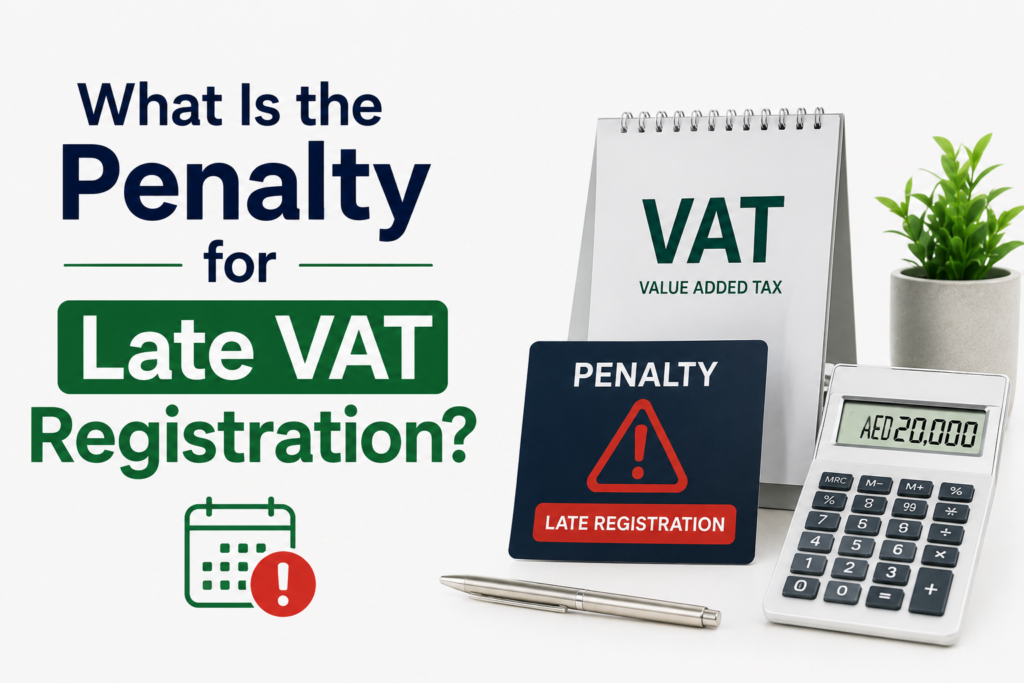
A flat AED 10,000 administrative penalty applies for missing the registration deadline.
Plus retroactive VAT liability on all taxable supplies made since the threshold was crossed
You cannot collect VAT retrospectively from customers who already paid
This specific penalty amount remains unchanged even under the newest reforms
The Penalty Framework Changed on 14 April 2026
Under Cabinet Decision No. 129 of 2025, published 11 November 2025, a significantly revised administrative penalty framework took legal effect on 14 April 2026.
It replaces the earlier structure under Cabinet Decision No. 40 of 2017
The reform applies uniformly across VAT, Excise Tax, and Corporate Tax
Late Payment Now Carries a Simplified Rate
The old late payment structure no longer applies.
Previously: an immediate 2% penalty followed by an additional 4% monthly charge
Reported under the new framework: a single rate of 14% per annum on the outstanding tax, replacing the compounding structure
The exact calculation mechanics should be confirmed directly against the FTA’s published decision text or with a tax advisor, since this is a very recent change
Correcting Your Own Mistake First Costs Less
A genuinely useful incentive under the new framework.
Businesses that submit a Voluntary Disclosure to correct an error before the FTA identifies it themselves face a substantially reduced penalty
This is compared to being caught during an audit
Filing a disclosure after an audit notice has already been issued adds a further 15% penalty on top of the standard charge
Correcting early is worth doing
What Are the Benefits of Voluntary VAT Registration?
Reclaim input VAT on business expenses earlier
Use the Reverse Charge Mechanism (RCM) on imports, which is cash-neutral, instead of paying VAT in cash at the border
A Tax Registration Number signals compliance and professionalism to larger clients and government buyers, some of whom only work with VAT-registered suppliers
Establish VAT systems and invoicing procedures ahead of when mandatory registration would apply
Don’t Charge VAT Before Your TRN Is Issued
Do not charge VAT on your invoices before your VAT registration is approved and your TRN is actually issued.
A business that isn’t yet registered shouldn’t present itself as charging UAE VAT
If VAT is incorrectly charged before registration, the amount may need to be accounted for or corrected
The customer may not be able to recover it as input VAT
The reverse mistake is just as costly: businesses that should have registered but didn’t face backdated registration
They typically end up paying the VAT they should have charged out of their own revenue, since it can’t be collected retrospectively from customers who already paid
If you’re also getting your Corporate Tax affairs in order, our guide on UAE Corporate Tax registration requirements covers that separate federal tax and its own deadlines.
Can a VAT-Registered Business Claim a Refund or Deregister?
Refund: if you’ve paid more VAT on expenses than you’ve collected on sales, commonly the case with capital-heavy purchases or mostly zero-rated exports, submit Form VAT311 through the FTA portal
Deregistration: if your turnover falls below the mandatory threshold, or never reaches it after voluntary registration, you can apply to deregister, though you’ll lose the ability to reclaim input VAT once deregistered
Both processes deserve fuller treatment than fits here, we’ll cover VAT refunds and deregistration in dedicated guides.
Conclusion
Two things matter most about VAT registration UAE requirements:
Thresholds: the AED 375,000 mandatory and AED 187,500 voluntary thresholds apply to most resident businesses, but non-residents and certain free zone activities follow different rules entirely
Penalties changed: the penalty framework changed on 14 April 2026, late payment is now reported to carry a simplified rate instead of the older compounding structure, confirm the exact current mechanics directly with the FTA before relying on any single figure
Confirm your specific situation directly with the FTA before assuming a figure from any single guide applies to you.
Frequently Asked Questions
What is the VAT registration threshold in the UAE?
AED 375,000 in taxable supplies over a rolling 12-month period triggers mandatory registration. Voluntary registration is available from AED 187,500.
Is VAT registration mandatory for all businesses in the UAE?
No. It’s mandatory only once taxable supplies and imports exceed AED 375,000, or are expected to within 30 days. Below that, registration is voluntary from AED 187,500, and not required at all below that.
Do free zone companies need to register for VAT?
Generally yes, the same thresholds apply as mainland companies. Only Designated Zones receive special treatment, and only for goods, not services.
Can I register for VAT below AED 187,500?
Generally, no. UAE-resident businesses must exceed the AED 187,500 voluntary registration threshold based on taxable supplies, imports, or taxable expenses to qualify for voluntary VAT registration.
What documents are needed for VAT registration in the UAE?
A trade licence, Certificate of Incorporation or equivalent, Emirates ID and passport of the authorised signatory, and evidence supporting your turnover declaration, such as financial statements or a revenue forecast. The FTA may request further documents depending on your specific business activity.
How long does VAT registration take in the UAE?
The FTA generally takes up to 20 business days to review a VAT registration application after submission or resubmission.
What is the penalty for late VAT registration?
A flat AED 10,000 penalty, plus retroactive VAT liability on supplies made since the threshold was crossed. This specific amount stayed unchanged even after the April 2026 penalty framework reform.
What is the penalty for late VAT payment now?
Since 14 April 2026, late payment is reported to carry a simplified rate of 14% per annum on the outstanding amount, replacing the older 2% immediate plus 4% monthly structure. Confirm the exact current mechanics directly with the FTA, since this is a very recent change.
Do non-resident businesses need to register for VAT in the UAE?
Yes, regardless of any threshold, unless a UAE-based entity handles their VAT responsibilities instead.
Is there a fee to register for VAT in the UAE?
No, the FTA does not charge a government fee for submitting a VAT registration application.
Do zero-rated supplies count toward the VAT registration threshold?
Yes. Zero-rated supplies count toward the AED 375,000 threshold since VAT technically applies at 0%. Exempt supplies don’t count, since VAT never applies to them.
Do branches need their own VAT registration?
No. Branches aren’t legally distinct from the main business, so registration is made in the parent’s name, one registration covers all branches across every emirate.
What happens if I charge VAT before receiving my TRN?
You’d be collecting money you have no legal right to collect, and the customer can’t reclaim it either. This typically results in penalties, a refund obligation, and having to reissue every affected invoice.
Can I deregister from VAT later?
Yes, if your turnover falls below the mandatory threshold or never reaches it, though you’ll lose the ability to reclaim VAT on purchases once deregistered.
Do multiple sole establishments need separate VAT registration?
No. All sole establishments owned by the same natural person register under one combined TRN, with the threshold calculated on their combined activities, not each business separately.
How do I check my VAT registration status?
Log in to your EmaraTax account to check your application status. Once approved, your VAT Registration Certificate and TRN appear directly in your dashboard.
What happens after I’m VAT registered?
You receive your TRN and certificate through EmaraTax, then must issue VAT-compliant invoices, charge VAT correctly, keep records for at least 5 years, file returns by your assigned deadline, and pay any VAT due.
Can I claim a VAT refund in the UAE?
Yes, if you’ve paid more VAT on expenses than you’ve collected on sales. Submit Form VAT311 through the FTA portal with supporting documentation.
Updates Section
Last verified: August 2026. Reflects current FTA-published thresholds, and the revised penalty framework under Cabinet Decision No. 129 of 2025, which took legal effect on 14 April 2026, replacing the earlier Cabinet Decision No. 40 of 2017.
Anees is a UAE-based content creator, writer, and SEO professional with over 12 years of experience. Since 2014, he has published research-backed guides on UAE visas, labour laws, jobs, traffic fines, and government services, all verified against official sources. He is certified in SEO by HubSpot Academy and Digital Marketing by Google Digital Garage.
12+ Years ExperienceHubSpot Academy — SEOGoogle Digital Garage
Disclaimer: This information is for general guidance only, based on publicly available UAE laws and regulations. It does not constitute legal advice. Always verify with official UAE government sources or a qualified legal professional.


Your email will not be published. Comments are reviewed before appearing.