UAE Visa Overstay Fine 2026: AED 50/Day RulesMinimum Salary to Sponsor Your Family Visa in UAEUAE Labour Law: Notice Period ExplainedHow to Check Your UAE Visa Status OnlineUAE Golden Visa Eligibility Requirements UpdatedUAE Visa Overstay Fine 2026: AED 50/Day RulesMinimum Salary to Sponsor Your Family Visa in UAEUAE Labour Law: Notice Period ExplainedHow to Check Your UAE Visa Status OnlineUAE Golden Visa Eligibility Requirements Updated
Dubai Visa For GCC Residents 2026: Eligibility, Fees and How to Apply
The UAE Times
–
–
– min read
Last updated: – · Based on official UAE sources
A Dubai visa for GCC residents, also known as a UAE visa for GCC residents, is required before travel for expats legally residing in Saudi Arabia, Qatar, Kuwait, Bahrain, or Oman, since GCC residents are not eligible for a visa on arrival the way GCC citizens are. This sits alongside the other UAE visa topics residents deal with regularly.
The distinction between citizen and resident is the single most important thing to get right before booking a flight. This guide covers exact eligibility, fees, documents, and how to apply for the GCC residents Dubai visa correctly the first time.
GCC Citizens vs GCC Residents: Why the Difference Matters
GCC citizens (nationals of Bahrain, Kuwait, Oman, Qatar, Saudi Arabia) get automatic, free visa on arrival entry to the UAE. GCC residents (expats of any nationality living legally in those countries) must obtain a pre-arranged e-visa and are not eligible for visa on arrival.
GCC Citizens
GCC Residents
Visa on arrival
Yes, automatic, free
No
What’s needed
Passport only
Pre-arranged e-visa
Where to apply
Not applicable
gccev.ae or GDRFA
Who Qualifies for the GCC Residents Dubai Visa?
Valid residence permit (Iqama or equivalent) in Bahrain, Kuwait, Oman, Qatar, or Saudi Arabia
Residence permit valid for at least 1 year from your UAE entry date
Passport valid for at least 6 months
Profession listed on GDRFA’s approved category list, subject to evaluation
How Much Does a GCC Residents Dubai Visa Cost?
UAE visa for GCC residents fees come to AED 253 total, made up of the AED 250 base fee plus 5% VAT, through GDRFA’s official channel, confirmed directly on the government service page. Some sources quote this as “AED 250 plus VAT” and others as the AED 253 total, these are the same fee, just described two different ways.
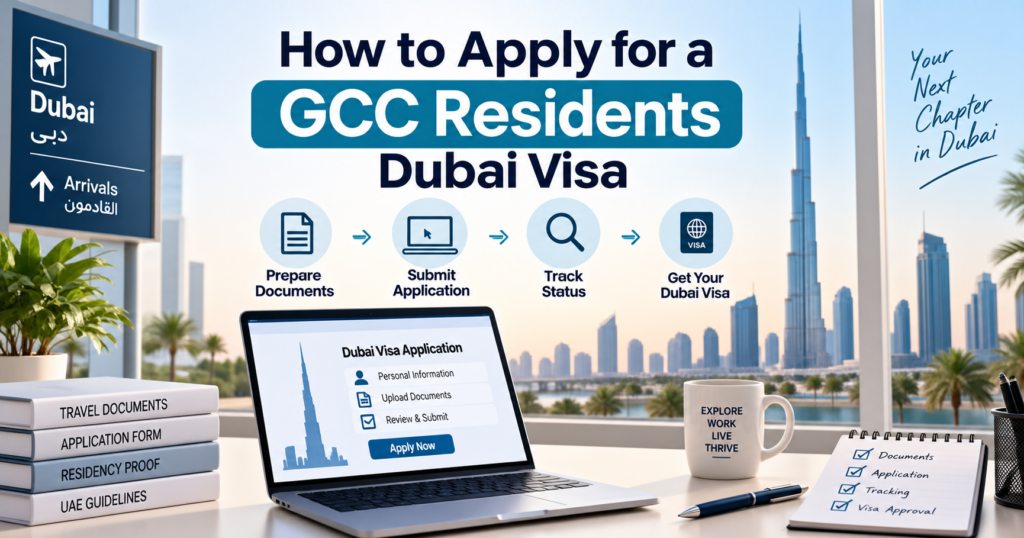
How to Apply for a Dubai Visa for GCC Residents
Apply through GDRFA’s official Smart Services portal at smart.gdrfad.gov.ae, the correct government channel for this specific permit
Sign in or create an account if required.
Select the GCC residents entry visa service.
Enter the required information and upload the supporting documents.
Pay the applicable government fees.
Once approved, receive your entry permit through the channel provided by GDRFA.
Once you’ve applied, you can track your application and confirm your approval directly, our guide on how to check UAE visa status online covers exactly how.
What Documents Do You Need?
GDRFA’s official requirements for this specific permit are:
A copy of your passport, valid for at least 6 months
A copy of your GCC residence permit, or an electronic extract showing your profession and residence validity
A recent colour photo with a white background
Depending on the application channel you use, you may also be asked for a flight booking, accommodation details, or additional supporting documents, but these aren’t part of GDRFA’s published core requirements for this specific permit.
How Long Does Processing Take?
Standard processing is commonly reported at around 48 hours, with express options available faster during off-peak periods. Apply with extra buffer time during peak periods like Eid, Ramadan, and summer holidays.
Apply Close to Your Actual Travel Dates
Since your 30-day window starts from the date of issue, not your arrival date, applying too far ahead of your trip means part of that window can pass before you even travel. Time your application close to your actual travel dates rather than booking it far in advance.
What If You’re Travelling Outside Dubai?
If your destination is Abu Dhabi, Sharjah, Ajman, Fujairah, Umm Al Quwain, or Ras Al Khaimah rather than Dubai specifically, apply through ICP’s Smart Services platform instead of GDRFA..
Are There Other UAE Visa Options for GCC Residents?
If you don’t qualify for the GCC residents entry permit specifically, or your purpose of travel falls under a different category, you may need a different UAE visa route. These are separate visa categories, not variants of the GCC residents permit itself.
Situation
Possible Route
Eligible GCC resident visiting the UAE
GCC residents entry permit
GCC resident who doesn’t qualify for this specific permit
A different applicable UAE visit or tourist visa
Short airport stopover
Transit visa
Business-related travel
The applicable business or visit visa
Don’t assume these are alternative versions of the GCC residents permit itself, each is its own distinct visa product with its own conditions. If you’re actually inviting family or friends to visit you in Dubai rather than travelling yourself, our guide on Dubai visit visa for family and friends covers that separate process.
How Long Can GCC Residents Stay in the UAE?
The GCC residents entry permit is valid for 30 days from the date of issue, allowing a stay of 30 days from your date of entry, extendable once for an additional 30 days, for a maximum continuous stay of 60 days. This 30-day issuance window is specific to the GCC residents category, a standard UAE tourist visa uses a different 60-day issuance window, so don’t mix the two up if you’re comparing visa types.
Don’t confuse this with a separate, related product: companions of GCC citizens (family members travelling with a GCC citizen sponsor) get a different entry permit, valid for 60 days from issue, extendable once for a further 60 days. These are two genuinely distinct visa categories with different validity periods, so confirm which one actually applies to your situation before assuming either figure.
Submit any extension application before your current visa expires, not after.
Can GCC Residents Travel to All 7 Emirates on One Visa?
Yes. A single entry covers travel across all 7 emirates, Dubai, Abu Dhabi, Sharjah, Ajman, Ras Al Khaimah, Fujairah, and Umm Al Quwain, without needing separate documentation for each.
Common Problems That Can Delay or Affect Approval
Immigration authorities assess each application against the eligibility and entry requirements confirmed above. GDRFA’s own requirements centre on passport validity, residence permit validity, and approved profession category, and problems in these areas are the most likely to affect your application:
Possible Problem
How to Reduce the Risk
Residence permit expires within 1 year of arrival
Confirm at least 1 year of validity remains before applying
Passport valid for less than 6 months
Renew your passport before applying
Profession not on the approved category list
Confirm your eligibility through GDRFA before applying, rather than assuming
Incomplete or unclear document scans
Upload full colour, high resolution scans, all corners visible
Inaccurate information on the application
Cross check your details against your documents before submitting
What Happens If You Overstay?
UAE overstay fines are currently standardised at AED 50 per day. Since fines and exit procedures can depend on your specific immigration record, check your outstanding amount through the relevant GDRFA or ICP channel before leaving the UAE, rather than assuming a fixed total. Our UAE visa overstay fine calculator lets you work out exactly what you’d owe based on your specific dates.
A Few Important Cautions Before You Book
Don’t rely solely on your profession title, residence card, or informal airline advice, eligibility genuinely depends on the combination of passport validity, residence permit validity, nationality, profession category, and current immigration review
Confirm your specific eligibility through the official GDRFA or ICP channel before booking flights or accommodation
Conclusion
Two things matter most about getting a Dubai visa for GCC residents. First, GCC residents genuinely cannot use visa on arrival the way GCC citizens can. Second, applying through the official gccev.ae or GDRFA channel, with the correct residence permit validity and an approved profession category, is the only reliable path for a GCC resident visa to Dubai.
Confirm your specific situation directly with GDRFA or ICP before travelling, since informal advice and assumptions based on your profession title alone can lead to denied boarding.
Frequently Asked Questions
Do GCC Residents Need a Visa for Dubai?
Yes. GCC residents who are foreign nationals living legally in Saudi Arabia, Qatar, Kuwait, Bahrain or Oman need a UAE entry permit before travelling. This is different from GCC citizens, who do not need a UAE visa to enter.
Can GCC Residents Apply for a Dubai Visa Online?
Yes. GCC residents can apply online for the UAE entry permit through the relevant digital immigration channel. For Dubai, GDRFA provides the GCC resident entry-visa service through its online system. After completing the application, uploading the required documents and paying the applicable fee, the approved visa is sent by email.
What Are the UAE Visa Fees for GCC Residents?
GDRFA Dubai currently lists the fee as AED 250 plus 5% VAT for the GCC resident entry visa. Additional service charges may apply depending on the application channel.
How Long Can GCC Residents Stay in the UAE?
The GCC resident entry permit allows a stay of up to 30 days and can be extended once for an additional 30 days, giving a maximum continuous stay of 60 days. This is different from the separate entry permit for accompanying persons of GCC citizens, which allows a stay of up to 60 days.
Can GCC Residents Get a Visa on Arrival in Dubai?
No. Simply holding a GCC residence permit does not give a foreign national the visa-free entry available to GCC citizens. Eligible GCC residents must obtain the applicable UAE entry permit before travelling.
What Documents Do GCC Residents Need to Apply for a Dubai Visa?
GDRFA’s published requirements include a passport or travel document valid for at least six months, a GCC residence permit or electronic extract showing the profession and residence validity, and a recent colour photograph with a white background. Depending on the application channel, additional supporting documents may also be requested.
What Can Affect Approval of a Dubai visa for GCC Residents Application?
Approval can be affected by problems with the core eligibility requirements, including insufficient passport validity, a GCC residence permit with less than one year remaining, or a profession that is not on the approved category list. Incomplete or unclear documents and inaccurate application information can also cause problems during processing.
How Long Do I Have to Use My GCC Residents Entry Permit?
Check the validity or expiry date shown on your approved eVisa before travelling. The GCC resident entry permit has a defined entry-validity period, while the permitted stay after entry is up to 30 days. Do not assume that the date you receive the visa is the same as the date your permitted stay begins.
Updates Section
Last verified: August 2026. Reflects current GDRFA published fees and eligibility conditions.
Anees is a UAE-based content creator, writer, and SEO professional with over 12 years of experience. Since 2014, he has published research-backed guides on UAE visas, labour laws, jobs, traffic fines, and government services, all verified against official sources. He is certified in SEO by HubSpot Academy and Digital Marketing by Google Digital Garage.
12+ Years ExperienceHubSpot Academy — SEOGoogle Digital Garage
Disclaimer: This information is for general guidance only, based on publicly available UAE laws and regulations. It does not constitute legal advice. Always verify with official UAE government sources or a qualified legal professional.



Your email will not be published. Comments are reviewed before appearing.