UAE Visa Overstay Fine 2026: AED 50/Day RulesMinimum Salary to Sponsor Your Family Visa in UAEUAE Labour Law: Notice Period ExplainedHow to Check Your UAE Visa Status OnlineUAE Golden Visa Eligibility Requirements UpdatedUAE Visa Overstay Fine 2026: AED 50/Day RulesMinimum Salary to Sponsor Your Family Visa in UAEUAE Labour Law: Notice Period ExplainedHow to Check Your UAE Visa Status OnlineUAE Golden Visa Eligibility Requirements Updated
Newborn Health Insurance in the UAE: The 30-Day Rule, Real Cost and Fines
The UAE Times
–
–
– min read
Last updated: – · Based on official UAE sources
Newborn health insurance in the UAE must be arranged within 30 days of birth in Dubai, and cover can be backdated toward the date of birth within limits. This sits alongside the other health insurance decisions new parents in the UAE juggle, and it’s one where getting the timing right matters more than most guides explain.
The commonly cited AED 500 fine genuinely traces to real UAE law, not just marketing copy. A separate, earlier decision, maternity coverage timing, also catches many parents off guard before the baby even arrives. This guide covers both, verified against official sources.
Is Newborn Health Insurance Mandatory in Dubai?
In Dubai, health insurance is mandatory for residents, and newborns are covered under specific newborn provisions confirmed underDubai’s Law No. 11 of 2013. Requirements and implementation can differ across other emirates, so parents outside Dubai should confirm the rules that apply in theirs.
The 30-Day Rule in Plain Terms
A newborn is covered under the mother’s policy for up to 30 days from birth, or up to the mother’s annual limit, whichever comes first. Parents should arrange the baby’s own enrollment within this period and confirm with the insurer how the effective date will be handled, since backdating for newborn additions is capped at a maximum of 7 days under ISAHD’s own policy directive.
This means registering promptly, ideally within the first week, matters more than the full 30-day window suggests, if you want cover to run all the way back to the date of birth without a gap.
Some hospitals also require proof of active insurance before discharge, particularly where a newborn needs NICU or neonatal support, making early enrollment a practical necessity, not just a compliance one.
What Is the Fine for Not Insuring a Newborn?
This is confirmed directly against Dubai’s actual Law No. 11 of 2013, not just repeated broker copy.
The law provides for fines ranging from AED 500 to AED 150,000 for violations, with the specific penalty determined under the applicable resolution and rules, not a single fixed figure written into the law itself
The exact penalty applicable to a particular case should be confirmed with the relevant authority rather than assumed from a general figure
Missing the deadline also creates a real coverage gap, the newborn may go uninsured for conditions identified after the mother’s 30-day cover ends, in some cases until the next policy renewal
The Two Clocks: Insurance Deadline vs Visa Deadline
A genuinely important distinction most guides blur together.
Task
Deadline from Birth
Authority
Add newborn to health insurance
30 days
DHA / ISAHD
Obtain residence visa and Emirates ID
Separate, longer deadline; confirm with the relevant authority
GDRFA / ICP
Complete the insurance step first, since the insurance card is one of the documents required for the visa application. The exact newborn insurance process can differ by emirate, so parents outside Dubai should confirm the applicable requirements with their local health authority or insurer.
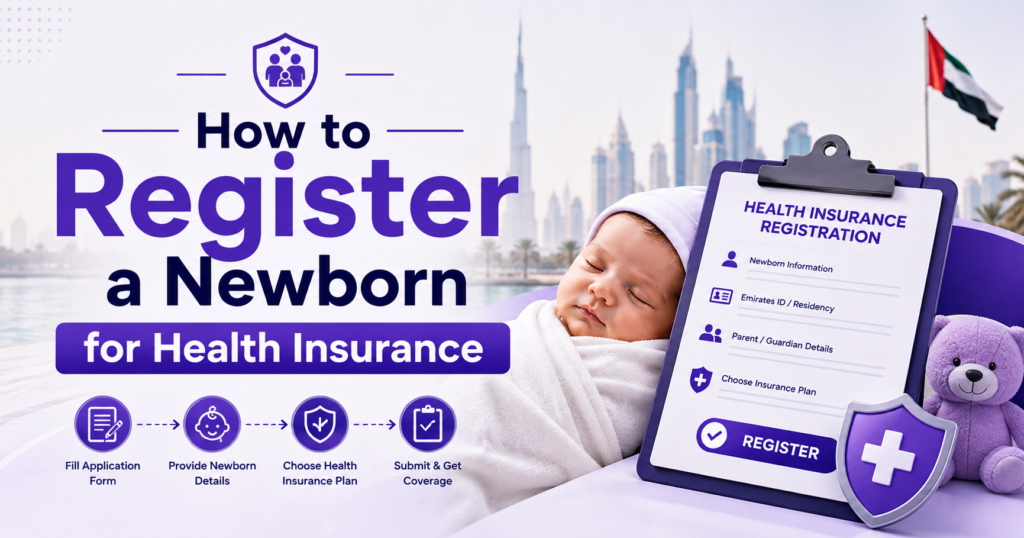
How to Register a Newborn for Health Insurance: Step by Step
Confirm the 30-day clock and your policy type, employer group vs individual or family
Obtain the birth certificate throughDHA or the relevant Dubai channel
Gather supporting documents: birth certificate, both parents’ Emirates IDs and passports, existing policy details
Notify HR or contact your insurer or broker directly, stating clearly this is a newborn addition
Pay the premium and confirm exactly how the effective date will be handled, remembering backdating is capped at 7 days
Receive the member card, and verify the child’s active status in theISAHD system
Who Is Responsible for Adding the Newborn?
The legal duty sits with the sponsoring parent, not the hospital or the insurer. How you act on it depends on your policy type.
Aspect
Employer (Group) Policy
Individual or Family Policy
Who you contact
Company HR or benefits team
Your insurer or broker directly
Who pays the added premium
Depends on company policy
The sponsor pays directly
Employers are not legally required to extend cover to dependents. If the group plan doesn’t cover family members, the sponsor must buy separate cover for the child. Once you’re insured, checking your health insurance status in the UAE confirms the newborn’s policy is active before you rely on it.
Documents Required to Add a Newborn
Newborn’s birth certificate, the core document, registration cannot proceed without it
Both parents’ Emirates IDs and passports
Newborn’s passport, if already issued
Existing policy details or member card
Completed insurer addition form
Vaccination card, required by some insurers specifically
How Much Does It Cost to Add a Newborn?
There’s no single joining fee, adding a newborn typically adds the child’s own premium, pro-rated to the remaining policy year.
Insurer (Example Plans)
Approx. Annual Premium
Medical Cover
Dubai Insurance (Value N4)
AED 2,114
AED 250,000
Takaful Emarat (ECARE Blue)
AED 1,209
AED 150,000
Orient Takaful (Plan 5)
AED 1,561
AED 1,000,000
Sukoon Bupa (Select)
AED 14,967
AED 6,239,000
Figures are indicative example plans, not guaranteed rates, confirm current premiums directly with your insurer.
Payment Flexibility
Some platforms now offer 0% interest installment payment options, splitting the premium into monthly payments rather than one lump sum.
Don’t Confuse This With the Maternity Waiting Period
This is a separate, earlier decision most parents miss entirely.
Maternity policies can carry waiting periods, and the length varies by insurer and plan, commonly reported in the 10 to 12 month range on many UAE plans
A policy purchased after pregnancy begins may also come with specific exclusions or limitations for that pregnancy
This is distinct from the newborn’s own 30-day post-birth addition rule, maternity coverage and newborn coverage are separate concepts
Families planning a pregnancy should check their plan’s exact waiting period well ahead of time, rather than assuming a specific figure applies
If you’re also weighing coverage for a sponsored parent living with you at the same time, our guide on health insurance for Golden Visa holders explains how dependent coverage can differ by visa category.
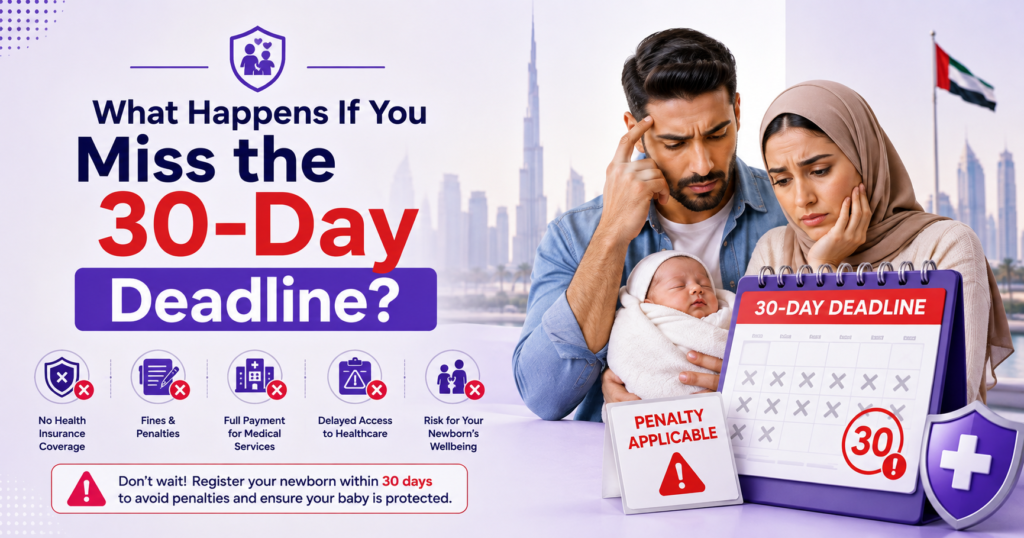
What Happens If You Miss the 30-Day Deadline?
The newborn becomes uninsured once the mother’s 30-day temporary cover ends
Care during any gap may need to be paid out of pocket
The sponsor is in breach of the mandatory insurance law
Visa and Emirates ID processing for the child stalls, since the insurance card is a required document
Late enrollment may require additional documentation or underwriting, depending on the insurer and policy, and the child may go without cover until the next renewal in some cases
Updates Section
Last verified: August 2026. Reflects Dubai’s Law No. 11 of 2013, DHA/ISAHD’s current Policy Directive on maternity and newborn additions, and current example premium figures from licensed UAE insurers.
Conclusion
Two things matter most about newborn health insurance in the UAE. First, the 30-day deadline is real, backed by real fines under actual UAE law, not just broker marketing copy. Second, it’s genuinely different from the earlier maternity waiting period decision that many parents overlook until it’s too late.
Confirm your specific policy’s terms and current fees directly with your insurer, HR team, or the Dubai Health Authority before assuming a figure from any single guide applies to your situation.
Frequently Asked Questions
Q: How long do I have to add my newborn to health insurance in the UAE?
A: 30 days from the date of birth. The newborn is automatically covered under the mother’s policy during this window, giving parents time to complete the paperwork.
Q: Is the AED 500 fine for newborn insurance real?
A: Dubai’s Health Insurance Law provides for fines ranging from AED 500 to AED 150,000 for violations, with the specific fine determined under the applicable rules. The exact penalty for a particular case should be confirmed with the relevant authority rather than assumed from a general figure.
Q: Is the newborn’s cover backdated to the date of birth?
A: Backdating is possible but capped at a maximum of 7 days under ISAHD’s policy directive. Registering within the first week of birth gives you the best chance of continuous cover from day one, registering later in the 30-day window can still leave a gap the 7-day cap won’t close.
Q: What documents do I need to add a newborn to insurance?
A: The birth certificate is the core document, alongside both parents’ Emirates IDs and passports, the existing policy details, and sometimes a vaccination card, depending on the insurer.
Q: Is the 30-day insurance deadline the same as the visa deadline?
A: No. Health insurance must be arranged within 30 days, while the residence visa and Emirates ID follow a separate, longer timeline. Complete the insurance step first, and confirm the exact visa deadline with GDRFA or ICP.
Q: How much does it cost to add a newborn to health insurance?
A: There’s no separate joining fee, you pay the child’s own premium, pro-rated to the remaining policy year. This varies significantly by insurer and plan tier, from roughly AED 1,200 to well over AED 10,000 annually depending on coverage level.
Q: Does maternity coverage automatically include newborn coverage?
A: No, these are related but separate. Maternity coverage carries its own waiting period, commonly reported at 10 to 12 months on many plans though this varies by insurer, and applies to the mother’s pregnancy and delivery. The newborn still needs to be added as their own dependent within the applicable window after birth.
Q: Can I switch insurers after adding my newborn?
A: Yes, but it’s best to wait until your policy’s renewal cycle. Switching mid-term can create overlap issues or complications with claims during the transition.
Q: What if my baby has health complications?
A: Declare any known health issues at the time of the insurance application. Some insurers may request medical reports or offer a specialised plan, sometimes at a higher premium, based on the declared condition.
Q: Can I dispute a late enrollment fine if the visa process caused the delay?
A: You can generally submit a formal appeal to DHA or DoH with documentation showing the delay was caused by administrative or government processing rather than parental inaction. Outcomes are handled case by case and aren’t guaranteed, so timely enrollment remains the safer approach.
Anees is a UAE-based content creator, writer, and SEO professional with over 12 years of experience. Since 2014, he has published research-backed guides on UAE visas, labour laws, jobs, traffic fines, and government services, all verified against official sources. He is certified in SEO by HubSpot Academy and Digital Marketing by Google Digital Garage.
12+ Years ExperienceHubSpot Academy — SEOGoogle Digital Garage
Disclaimer: This information is for general guidance only, based on publicly available UAE laws and regulations. It does not constitute legal advice. Always verify with official UAE government sources or a qualified legal professional.


Your email will not be published. Comments are reviewed before appearing.