UAE Visa Overstay Fine 2026: AED 50/Day RulesMinimum Salary to Sponsor Your Family Visa in UAEUAE Labour Law: Notice Period ExplainedHow to Check Your UAE Visa Status OnlineUAE Golden Visa Eligibility Requirements UpdatedUAE Visa Overstay Fine 2026: AED 50/Day RulesMinimum Salary to Sponsor Your Family Visa in UAEUAE Labour Law: Notice Period ExplainedHow to Check Your UAE Visa Status OnlineUAE Golden Visa Eligibility Requirements Updated
UAE Gratuity Calculator: How Your End-of-Service Pay Is Calculated (2026)
The UAE Times
–
–
– min read
Last updated: – · Based on official UAE sources
✓ Verified against MOHRE and the UAE Labour Law (Federal Decree-Law No. 33 of 2021)
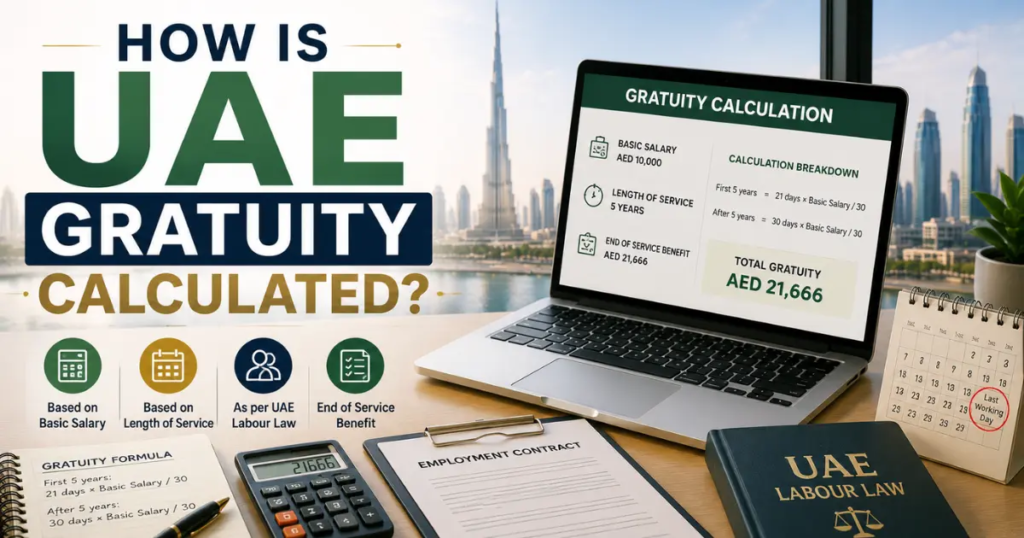
When someone leaves a job in the UAE, their end-of-service gratuity is the lump sum the employer owes them for their years of service. This falls under UAE Labour Law, and the gratuity formula itself is straightforward. You get 21 days’ basic salary for each of the first five years, then 30 days a year after that, capped at two years’ pay.
The UAE gratuity calculator above gives you an instant figure. This guide explains exactly how that number is worked out, who qualifies, and the rules people most often get wrong.
What Is End-of-Service Gratuity?
End-of-service gratuity is a one-time payment an employer makes to a worker when their job ends. People also call it end-of-service benefits, or ESB.
It rewards length of service. The longer someone works, the more they receive.
The legal basis isArticle 51 of Federal Decree-Law No. 33 of 2021, the UAE Labour Law, and its Executive Regulations under Cabinet Resolution No. 1 of 2022. It applies to private-sector workers across the UAE mainland and most free zones.
Who Is Eligible for UAE Gratuity?
Not everyone qualifies. To be entitled to gratuity, a worker must:
Work in the private sector, whether full-time, part-time, or on a flexible contract.
Have completed at least one year of continuous service.
Full-time workers receive the full amount. Part-time and flexible workers are also entitled, but their gratuity is pro-rated to the hours they work, as explained in the part-time section below.
Service under one year earns no gratuity. After one year, you are entitled to it whether you resign, are let go, or finish your contract, and partial years are paid pro rata.
Unpaid leave and absences do not count toward the service total, so they can slightly reduce the final figure.
One more point: gratuity is for expatriate workers. UAE and other GCC nationals do not receive it, as they are covered by a government pension scheme (GPSSA) instead.
How Is UAE Gratuity Calculated?
UAE Gratuity is based on basic salary only, not the total package. This is the single most common mistake. Housing, transport, and other allowances are excluded. Only the basic wage stated in the contract counts.
So check your contract for the basic figure. If an employer has set an unfairly low basic just to shrink the gratuity, you can challenge it through MOHRE. So check your contract for the basic figure. Verify your labour contract online. If an employer has set an unfairly low basic just to shrink the gratuity, you can challenge it through MOHRE.
The daily wage is the starting point:
Daily wage = monthly basic salary ÷ 30
From there, the formula has two tiers:
First 5 years: 21 days of basic salary for each year.
After 5 years: 30 days of basic salary for each extra year.
Gratuity = (daily wage × 21 × first 5 years) + (daily wage × 30 × years beyond 5)
The two-year cap
There is a ceiling. The total gratuity can never exceed two years of your full wage, meaning your basic salary plus allowances (your gross pay). This cap sits in Article 51 of the law.
It is a subtle but important point: gratuity is worked out on basic salary, yet the legal maximum is measured against your total wage. In practice, it takes more than two decades of service to get near it.
UAE Gratuity Calculation Examples
Here is how the numbers look for different salaries and lengths of service:
Basic salary
Service
How it is worked out
Gratuity
AED 5,000
3 years
63 days × (5,000 ÷ 30)
AED 10,500
AED 10,000
5 years
105 days × (10,000 ÷ 30)
AED 35,000
AED 8,000
10 years
255 days × (8,000 ÷ 30)
AED 68,000
AED 15,000
8 years
195 days × (15,000 ÷ 30)
AED 97,500
The pattern is clear. The first five years build at 21 days each, and every year after that is worth more, at 30 days.
Resignation vs Termination: Does It Change Your Payout?
This used to matter a lot. It no longer does. Under the old law, resigning early cut your gratuity to a third or two-thirds. The current law scrapped that penalty.
Today, whether someone resigns, is terminated, or finishes their contract, they receive the same full gratuity, as long as they completed at least one year and served their notice period properly.
Limited vs Unlimited Contracts
The UAE has phased out unlimited contracts. Every private-sector contract is now a fixed-term (limited) contract, renewable, with a defined end date.
When the law took effect, existing unlimited contracts were converted to fixed-term, so the same 21-day and 30-day formula now applies to everyone.
Part-Time and Flexible Work
Gratuity is not only for full-time staff on a standard contract. The Executive Regulations (Cabinet Resolution No. 1 of 2022) set a pro-rated method for part-time and flexible work.
The gratuity is worked out in proportion to the hours worked compared with a full-time role. So a part-timer earns a fair share, scaled to their actual hours.
Free Zones: DIFC and ADGM Are Different
Two financial free zones run their own systems instead of the standard gratuity.
DIFC (Dubai International Financial Centre): DIFC completely replaced traditional lump-sum gratuity with the mandatoryDIFC Employee Workplace Savings (DEWS) Plan back in 2020. Instead of waiting until the end of employment, employers must make compulsory monthly contributions into a professionally managed savings fund. The contribution rates are strictly fixed at 5.83% of the basic salary for the first five years of service and rise to 8.33% for any years thereafter.
ADGM (Abu Dhabi Global Market): Operating under its own unique common-law employment rules, theAbu Dhabi Global Market (ADGM) has also transitioned away from traditional gratuity liability. It utilizes an institutional workplace savings scheme framework that parallels international retirement benefit standards.
Anyone employed within the jurisdictions of DIFC or ADGM must cross-verify their balances against these specialized setups rather than using the standard mainland UAE calculations.
The Voluntary Savings Scheme (Alternative to Gratuity)
The UAE has introduced an optional alternative to the lump-sum system.
Launched by MOHRE in 2023 under Cabinet Resolution No. 96 of 2023, the voluntary alternative end-of-service savings scheme lets employers invest gratuity money instead of holding it as a liability.
Here is how it works:
The employer opts in and pays monthly contributions into an approved investment fund.
Any gratuity earned before enrolment is frozen and protected.
After enrolment, the worker’s benefit grows with the fund’s investment returns.
Employees can keep the money invested or withdraw it when they leave.
It is voluntary. If an employer has not joined, the standard gratuity rules still apply.
When and How Gratuity Is Paid?
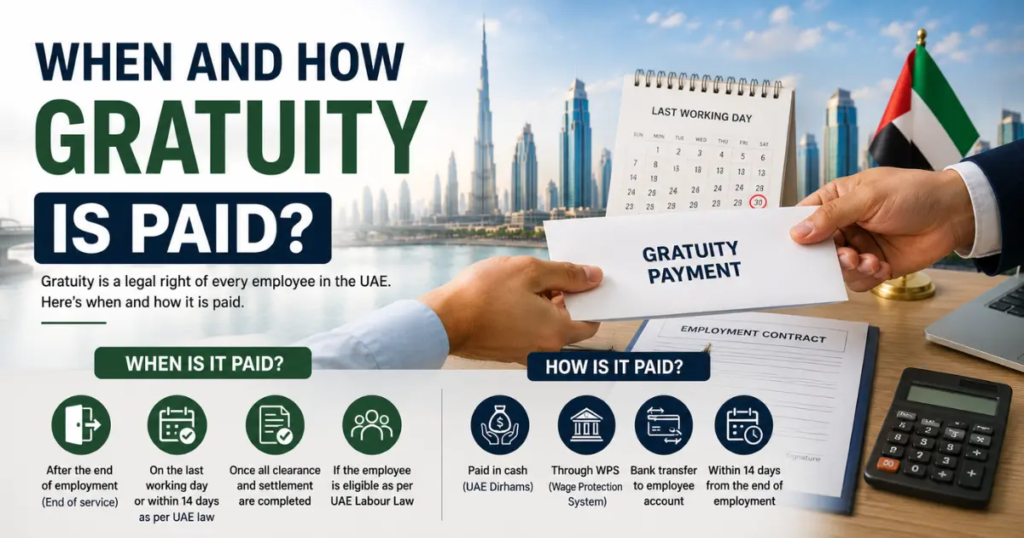
Employers cannot sit on the money. Under Article 53 of the Labour Law, they must pay gratuity and all final entitlements within 14 days of the contract ending.
Gratuity is only one part of your final settlement. It is usually paid together with any unused annual leave, your last salary, and any pay in lieu of notice.
This applies whether the worker resigned, was let go, or finished the contract. Employers may deduct amounts the worker genuinely owes, such as an outstanding loan or salary advance, but nothing arbitrary.
What If Your Employer Doesn’t Pay?
A worker who is not paid on time has a clear, free route.
Disputes under AED 50,000 can now be settled by MOHRE directly, without going to court.
Late or non-payment exposes the employer to fines and restrictions on new work permits.
You can file through the MOHRE app, theMOHRE website, or its call centre. Keep copies of the contract, payslips, and the cancellation paperwork. They make any claim far stronger.
A Few Special Cases Worth Knowing
Death of the employee: the gratuity and final entitlements are paid to the worker’s beneficiaries or family.
Tax: the UAE has no personal income tax, so gratuity is paid in full and is not taxed.
Gratuity for Domestic Workers
Domestic workers (maids, drivers, nannies, gardeners, cooks) fall under a separate law, Federal Decree-Law No. 9 of 2022, so their end-of-service terms differ from the standard formula above.
The formula is simpler and does not increase after 5 years:
Gratuity = (Basic salary ÷ 30) × 14 × years of service
Unlike private-sector employees, domestic workers earn 14 days’ basic salary for every year of service, whether it is year 1 or year 10. There is no jump to 30 days after the fifth year.
Example: A domestic worker on a basic salary of AED 1,500 who completes 3 years of service: (1,500 ÷ 30) × 14 × 3 = AED 2,100
If the recruitment agency (not the direct employer) placed the worker, the agency may be liable to reimburse the employer under Article 6 of Cabinet Resolution No. 106 of 2022 in certain early-termination cases. As with the standard formula, the one-year minimum service requirement still applies before any gratuity is owed.
If you’re between jobs after leaving, you may also be eligible for a payout under UAE Unemployment Insurance (ILOE), a separate benefit from gratuity.
How to Use the UAE Gratuity Calculator?
The UAE gratuity calculator above does the maths for you. Enter your monthly basic salary and your years and months of service, then read the result.
It applies the correct 21-day and 30-day tiers and the daily-wage division by 30. For a binding figure, confirm with your employer or MOHRE.
Conclusion
UAE gratuity caluclator rewards the time someone gives an employer, and the rules are fairer now than they used to be. Resigning no longer costs you part of it, the formula is the same for every contract, and the money must land within 14 days.
The one thing to get right is the basis. It is a basic salary, not your full package. Check the basic figure on your contract, run it through the calculator, and you will know what you are owed before you ever raise it with HR.
And if a payment is late, the MOHRE complaint route is free and fast, so no one should walk away with less than the law guarantees.
Frequently Asked Questions
How is UAE gratuity calculated in 2026?
It is 21 days’ basic salary for each of the first five years of service, then 30 days a year after that. The daily wage is your basic salary divided by 30, and the total is capped at two years’ pay.
How does the UAE gratuity calculator work?
The UAE gratuity calculator uses the official Article 51 formula. Enter your monthly basic salary and length of service: it divides the basic by 30 for your daily wage, then adds 21 days for each of the first five years and 30 days for every year after. The result is an instant estimate of your end-of-service pay.
Is gratuity calculated on basic salary or total salary?
Basic salary only. Housing, transport, and other allowances are not included, which is why a calculated figure is often lower than people expect.
Do I get gratuity if I resign?
Yes. Under the current law, resigning no longer reduces your gratuity. As long as you have completed one year and served your notice, you receive the same full amount as someone who was terminated.
What is the minimum service to qualify for gratuity?
One full year of continuous service. Less than that, and no gratuity is due. After one year, partial years are paid pro rata.
Is there a maximum gratuity in the UAE?
Yes. Total gratuity cannot exceed two years of your full wage, that is your basic salary plus allowances. Gratuity is calculated on basic salary, but this cap is measured against your total wage.
How many days does an employer have to pay gratuity?
Fourteen days from the end of the contract, under Article 53 of the Labour Law. This applies to resignation, termination, and contract expiry alike.
What can I do if my employer doesn’t pay my gratuity?
File a free complaint with MOHRE. Disputes under AED 50,000 can be resolved by MOHRE without court, and late payment can lead to fines and work-permit restrictions for the employer.
Is UAE gratuity taxed?
No. The UAE has no personal income tax, so your gratuity is paid in full.
Official Sources & References
Federal Decree-Law No. 33 of 2021 (UAE Labour Law): Read the foundational rules on gratuity, the cap, and the 14-day payment deadline via the MOHRE Official Portal Announcement.
Cabinet Resolution No. 96 of 2023: Download the official legal framework governing the alternative workplace savings structures directly through the MOHRE Cabinet Resolution No. 96 PDF Document.
Ministry of Human Resources and Emiratisation (MOHRE): Review guidelines, dispute channels, and employment protection details via the direct MOHRE Guidance and Awareness Portal.
Anees is a UAE-based content creator, writer, and SEO professional with over 12 years of experience. Since 2014, he has published research-backed guides on UAE visas, labour laws, jobs, traffic fines, and government services, all verified against official sources. He is certified in SEO by HubSpot Academy and Digital Marketing by Google Digital Garage.
12+ Years ExperienceHubSpot Academy — SEOGoogle Digital Garage
Disclaimer: This information is for general guidance only, based on publicly available UAE laws and regulations. It does not constitute legal advice. Always verify with official UAE government sources or a qualified legal professional.


Your email will not be published. Comments are reviewed before appearing.