A UAE private notary fine is not one single number. Depending on what went wrong, a private notary can face a criminal penalty, an administrative fine, or a disciplinary action, and Dubai actually runs its own separate rules from the rest of the country.
You will often see one blended range quoted, usually “AED 5,000 to AED 50,000.” That figure is incomplete and partly outdated. For private notaries covered by the federal framework, criminal offences can carry fines of up to AED 100,000, and Dubai updated its local fee and fine schedule in 2025.
This guide covers each track using the legal text, plus two real enforcement cases from Abu Dhabi.
Quick answer: There is no single UAE private notary fine. Federal criminal offences can carry imprisonment of at least 6 months and/or a fine of AED 30,000 to AED 100,000.
Administrative penalties under the federal framework range from AED 5,000 to AED 30,000, depending on the violation. Dubai, and emirates with their own local judicial systems, run separate local fine schedules with their own fixed amounts.
UAE Private Notary Fine at a Glance
Situation
Potential consequence
Federal criminal offence (unlicensed practice, disclosure)
AED 30,000 to AED 100,000 and/or imprisonment
Federal administrative violation
AED 5,000 to AED 30,000
Professional misconduct
Warning, suspension, or revocation
Dubai
Separate local schedule, updated in 2025
Abu Dhabi
Separate local framework under its own law
What Is a UAE Private Notary Fine?
A UAE private notary fine is a penalty imposed on a licensed private notary for breaching the laws, decisions, or regulations that govern the profession. Depending on the violation, this can mean a criminal fine, an administrative fine, or a disciplinary measure such as license suspension.
Three separate tracks exist:
Track
What it covers
Who decides
Criminal
Unlicensed practice, disclosing confidential information
The courts, following referral by the Public Prosecution
Administrative
Procedural and compliance violations
The relevant judicial or licensing authority
Disciplinary
Professional conduct breaches
The Private Notary Disciplinary Board
The Legal Framework Governing UAE Private Notaries
Private notaries in the UAE are not regulated by one single law. Understanding which one applies to you depends on where you are.
Federal Law No. 4 of 2013 was the previous law. It has been fully repealed and replaced by the 2022 Decree-Law, so any article still quoting its penalty figures is out of date.
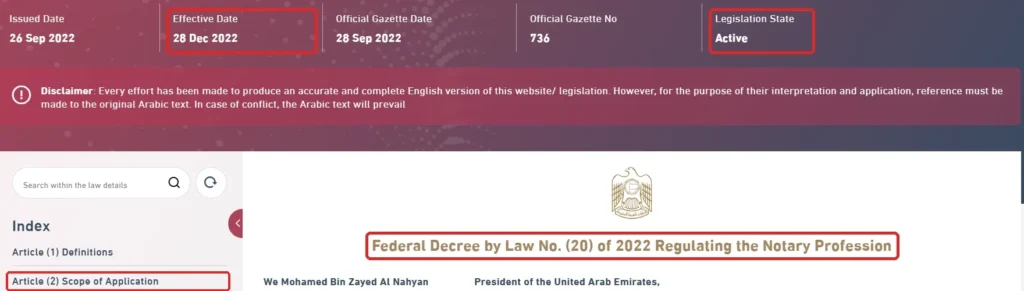
Article 2 of Federal Decree-Law No. 20 of 2022 states that the law applies to notarial duties across the UAE, with the exception of local judicial authorities, whose notarial services are governed by local legislation.
This exception is not limited to Dubai:
Abu Dhabi runs its own separate system under Abu Dhabi Law No. 11 of 2017, as stated by the Abu Dhabi Judicial Department
Dubai runs its own separate system under Executive Council Resolution No. 4 of 2014
The specific fine schedule that applies to you depends on which judicial authority governs your emirate, not on a simple federal versus Dubai split
What The UAE Times Found: The Article 2 exception is broader than a simple federal versus Dubai split. Emirates with their own local judicial authorities, including both Dubai and Abu Dhabi, run their own separate notary legislation.
Federal Criminal Penalties for Notary Violations
For notarial services that fall under the federal system, the Decree-Law sets out two specific criminal offences with prison terms and fines attached.
Violation
Penalty
Legal basis
Practicing as a notary without a license
Imprisonment of at least 6 months and/or a fine of AED 30,000 to AED 100,000
Article 48
Disclosing confidential information obtained through the role
Imprisonment of at least 6 months and/or a fine of AED 30,000 to AED 100,000
Article 49
Source: Federal Decree-Law No. 20 of 2022, Articles 48 and 49.
What The UAE Times Found: The AED 5,000 to AED 50,000 range often quoted online should not be treated as a universal UAE private notary penalty. The applicable amount depends on the governing legal framework and the specific violation, and can differ significantly from the federal criminal penalty, which reaches AED 100,000.
Administrative Penalties Under Cabinet Resolution No. 146 of 2025
Not every violation is criminal. Article 52 of the Decree-Law gives the Cabinet authority to issue separate administrative penalty regulations, and Cabinet Resolution No. 146 of 2025 is that framework, effective from 15 November 2025.
Administrative penalties cover procedural and compliance issues rather than criminal conduct. The official schedule sets specific administrative fines ranging from AED 5,000 to AED 30,000, depending on the violation. Examples include:
Violation
Fine
Failing to verify identity, legal capacity, or consent of concerned parties
AED 20,000
Failing to correct clerical or arithmetic errors properly
AED 5,000
Notarizing instruments relating to Muslim personal status or real property rights
AED 30,000
Practicing through an unlicensed office or law firm
AED 5,000
Disclosing confidential information about concerned parties
AED 20,000
Source: Cabinet Resolution No. 146 of 2025, Schedule of Administrative Penalties.
This is a different legal basis from Articles 48 and 49, which is exactly why treating this administrative range as the universal notary fine is misleading. Under Article 3(2) of Cabinet Resolution No. 146 of 2025, the Committee may also double these fines for a repeat violation committed within one year of the previous one.
Disciplinary Penalties: Warning, Suspension or Revocation
Alongside criminal and administrative penalties, a private notary can face professional discipline for breaching their duties.
Under Article 40 of the Decree-Law, the Private Notary Disciplinary Board, chaired by a president of the Courts of Appeal, can impose:
A warning
License suspension for up to 6 months
License revocation and permanent removal from the notary register
Source: Federal Decree-Law No. 20 of 2022, Article 40.
Disciplinary action does not prevent criminal or civil liability from applying separately if the conduct also breaks the law in a more serious way.
Dubai’s Own Notary Fine Schedule
Because Dubai Courts fall outside the federal Decree-Law’s scope, Dubai runs its own notary fine schedule under local legislation.
Important 2025 update: The original schedule, set out in Executive Council Resolution No. 4 of 2014, has been amended. Executive Council Resolution No. 72 of 2025 explicitly replaces all three tables attached to the 2014 resolution, covering service fees, registration and licensing fees, and the violations and fines schedule.
The violation categories carried over into the updated schedule are broadly similar to before, and include:
Practicing as a private notary without authorisation or registration
A firm hiring an unregistered person to act as a private notary
Submitting false or incorrect documents to get registered, licensed, or to renew either
Continuing to practice with an expired registration or authorisation
What The UAE Times Found: The exact fine amounts under the new 2025 schedule are not fully published in an easily accessible form at the time of writing.
Rather than repeat the older 2014 figures as if they were still current, we recommend confirming the exact current amount for your specific violation directly through Dubai Courts or the Dubai Legislation Portal before relying on any number.
The 2014 resolution also set two extra rules on top of the fine amount, so confirm whether the updated schedule keeps them:
If the same violation happens again within one year, the fine is doubled.
No single fine may exceed AED 50,000, even after doubling.
Beyond the fine itself, Dubai’s Notary Public Affairs Committee can also issue a warning, suspend registration or authorisation, or cancel the registration entirely, depending on the severity of the violation.
Real UAE Private Notary Fine Cases (2024 to 2026)
Two enforcement actions by the Abu Dhabi Judicial Department show how these rules are applied.
April 2026: The Private Notary Affairs Committee at the Abu Dhabi Judicial Department (ADJD) imposed an administrative fine of Dh30,000 on a private notary for failing to comply with the laws, decisions, and regulations governing the profession.
The decision came during a committee meeting chaired by Yousef Saeed Al Abri, Undersecretary of the ADJD.
September 2024: The same committee fined three private notaries a combined total of AED 50,000 for similar non compliance issues. That meeting also reviewed customer satisfaction data, which stood at 92 percent for the first half of that year.
What both cases have in common: both were handled by the ADJD’s Private Notary Affairs Committee, both involved failing to follow standard laws and regulations, and both were framed publicly as part of ongoing oversight rather than one off punishment.
Common Violations That Lead to a UAE Private Notary Fine
Based on the legal text and the enforcement pattern above, these are the violations that come up most often:
Failing to properly verify a party’s identity, legal capacity, or genuine consent
Notarizing documents outside legal authority, such as certain real estate or Muslim personal status matters
Practicing without a valid, current license or authorisation
Disclosing confidential client information obtained through the role
Processing a transaction involving a personal or family conflict of interest
Providing false information to obtain registration or a license
If you are verifying other official paperwork alongside a notary transaction, our guide on how to check and spot a fake UAE labour contract covers a similar verification process for employment documents.
Notary Service Fees vs Notary Fines: Don’t Confuse the Two
A notary fine and a notary service fee are two completely different things, and search results often blur them together.
A service fee is what a licensed notary legally charges for a transaction, such as attesting a signature or drafting a power of attorney. A fine is a penalty for breaking the rules.
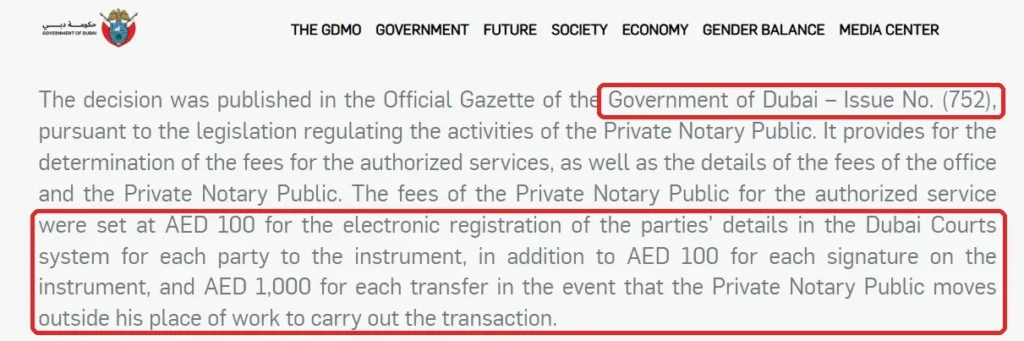
Important 2026 update: Dubai Courts introduced a new, unified private notary fee structure effective 2 January 2026, published in the Dubai Official Gazette (Issue No. 752) and replacing the older 2014 fee schedule. Under the new structure:
Service
Fee
Electronic registration of party details in the Dubai Courts system
AED 100 per party
Each signature on the instrument
AED 100
Private notary travelling outside their office to complete a transaction
AED 1,000 per transfer
Source: Dubai Courts fee structure, effective 2 January 2026.
A high service fee on your invoice is not a sign of a fine or a violation. If something feels off, the right move is to ask the notary’s office directly rather than assume wrongdoing.
How to File a Complaint Against a Private Notary in the UAE
If you believe a private notary has acted improperly, you do not need a lawyer to raise the issue.
Identify the correct authority. This depends on the emirate and the legal framework governing the notary. Dubai matters generally fall under Dubai Courts’ Notary Public Directorate, Abu Dhabi has its own judicial framework through the ADJD’s Private Notary Affairs Committee, and federally regulated private notaries fall under the Ministry of Justice‘s Private Notary Admission Committee.
Submit your complaint in writing with supporting documents.
For notaries under the federal framework, Article 35 of Federal Decree-Law No. 20 of 2022 requires the Competent Department to notify the notary of the complaint, giving them 15 working days to respond.
The relevant committee decides whether to dismiss the complaint or refer it for formal investigation and possible disciplinary action.
Updates and Current Legal Status (2026)
Rules like this change, so treat any figure as something to verify rather than assume.
Penalty type
Amount
Legal source
Checked
Federal criminal, unlicensed practice or disclosure
AED 30,000 to AED 100,000 and/or 6 months or more imprisonment
Federal Decree-Law No. 20 of 2022, Articles 48 to 49
October 2026
Federal administrative
AED 5,000 to AED 30,000, doubled on repeat within a year
Cabinet Resolution No. 146 of 2025
October 2026
Federal disciplinary
Warning, suspension up to 6 months, or revocation
Federal Decree-Law No. 20 of 2022, Article 40
October 2026
Dubai local, per violation
Updated schedule now in force, exact amounts not confirmed here, verify directly
Executive Council Resolution No. 72 of 2025, replacing the 2014 schedule
October 2026
Dubai notary service fees
AED 100 per party for registration, AED 100 per signature, AED 1,000 for off site transfers
Dubai Courts fee structure, effective 2 January 2026
October 2026
Abu Dhabi local
Governed by Abu Dhabi’s own law, separate from the federal Decree-Law
Abu Dhabi Law No. 11 of 2017
October 2026
Repealed predecessor law
No longer in force
Federal Law No. 4 of 2013 (repealed)
October 2026
Federal Decree-Law No. 20 of 2022 remains the current governing law for notarial services under the federal system, and Cabinet Resolution No. 146 of 2025 remains the current administrative penalty framework under it. Emirates with their own local judicial authorities, including Dubai and Abu Dhabi, continue to apply their own separate local legislation, and Dubai specifically updated its own fee and fine schedule through Executive Council Resolution No. 72 of 2025.
Always confirm the latest figures directly at uaelegislation.gov.ae or with the relevant judicial department before relying on any number for a real decision.
Conclusion
A UAE private notary fine depends entirely on which legal track and which authority governs your emirate.
For private notaries covered by the federal framework, criminal offences under Articles 48 and 49 can carry fines of up to AED 100,000 and/or imprisonment
Federal administrative penalties under Cabinet Resolution No. 146 of 2025 range from AED 5,000 to AED 30,000
Dubai, Abu Dhabi, and any other emirate with its own local judicial authority run separate local legislation instead. Dubai updated its own fee and fine schedule through Executive Council Resolution No. 72 of 2025, so any figure quoted from the older 2014 rules should be treated as outdated
Before you assume a single number applies to your situation, check which framework governs your emirate and your specific violation. And whether you are hiring a notary for a property deal, a power of attorney, or a company document, always confirm their registration is current. Continuing to practice after expiry is specifically listed as a violation under the applicable framework.
Legal information notice: This article provides general information about UAE private notary regulations and is not legal advice. Penalties can depend on the emirate, governing authority, facts of the violation, and current legislation. Confirm the applicable rule with the relevant UAE judicial authority or a qualified legal professional before taking action.
Frequently Asked Questions
What Is the Maximum Fine for a UAE Private Notary?
Under the federal framework, a criminal violation such as practicing without a license or disclosing confidential information can carry a fine of up to AED 100,000 and/or at least 6 months’ imprisonment. Dubai has its own separate fine schedule, updated in 2025, so its current penalty should be confirmed directly with Dubai Courts rather than assumed from older figures.
Source: Federal Decree-Law No. 20 of 2022, Articles 48 and 49; Executive Council Resolution No. 72 of 2025.
What Law Governs Private Notary Penalties in the UAE?
Federal Decree-Law No. 20 of 2022 governs private notary penalties for notarial services under the federal framework. Article 2 excludes local judicial authorities from its scope. Dubai follows its own legislation, most recently updated through Executive Council Resolution No. 72 of 2025, while Abu Dhabi follows its own Law No. 11 of 2017.
Are Dubai’s Notary Fines Different From the Rest of the UAE?
Yes. Dubai has its own local fine and fee schedule, updated in 2025 through Executive Council Resolution No. 72 of 2025, which replaced the earlier tables attached to the 2014 resolution. Abu Dhabi also operates under its own local framework rather than the federal Decree-Law.
This means the federal criminal penalty of up to AED 100,000 should not automatically be applied to a private notary operating under a local judicial authority.
Can a Private Notary in the UAE Go to Prison?
Yes. Under the federal framework, practicing as a notary without a license or disclosing confidential information obtained through the profession can carry imprisonment of at least 6 months and/or a fine of AED 30,000 to AED 100,000 under Articles 48 and 49 of Federal Decree-Law No. 20 of 2022.
How Do I File a Complaint Against a UAE Private Notary?
Submit a written complaint with supporting evidence to the authority responsible for the notary in your emirate. This may be Dubai Courts’ Notary Public Directorate for Dubai-based notaries, the Abu Dhabi Judicial Department’s Private Notary Affairs Committee in Abu Dhabi, or the Ministry of Justice’s Private Notary Admission Committee for notaries governed by the federal framework.
Under Article 35 of the federal Decree-Law, the notary is given 15 working days to respond before the committee decides on further action.
How Much Is the Notary Fee in Dubai?
A Dubai notary service fee is different from a fine. Under the current Dubai Courts fee structure effective from 2 January 2026, the listed charges include AED 100 per party for electronic registration of party details, AED 100 for each signature on the instrument, and AED 1,000 for a private notary travelling outside the office to complete a transaction.
The exact fee depends on the service and transaction involved, so confirm the applicable charge with Dubai Courts before proceeding.
Is a UAE Notary Fine the Same as a Notary Service Fee?
No. A notary service fee is a legitimate charge for providing a notarization service, while a fine is a penalty imposed for violating the rules governing the profession.
For example, a Dubai notary may charge a prescribed service fee for registering an instrument or completing a signature. That payment is not a penalty and does not indicate that a violation has occurred.
Who Can Notarize a Document in the UAE?
A document should be notarized by a notary public or private notary who is legally authorised to provide the relevant notarial service in the emirate where the applicable rules apply. The exact process depends on the document, the emirate, and the authority responsible for the notarization.
Before using a private notary, verify that their registration or authorisation is current and that they are permitted to handle the type of document you need notarized.
What Happens If a Private Notary’s Registration Has Expired?
Continuing to practice after registration or authorisation expires can constitute a violation, but the exact penalty depends on the legal framework governing the notary. Dubai and Abu Dhabi have separate local systems, while federally regulated notaries are subject to the federal framework.
If you are dealing with an expired registration, confirm the applicable violation and current penalty directly with the relevant judicial authority.
Is Federal Law No. 4 of 2013 Still Valid?
No. Federal Law No. 4 of 2013 on Regulating the Profession of Notary Public was repealed and replaced by Federal Decree-Law No. 20 of 2022.
Therefore, penalty figures taken from the 2013 law should not be presented as the current federal private-notary penalties.
Shoaib Afzal is a content writer and SEO specialist who has been writing since 2020. He has worked on multiple Dubai based projects and researches every guide on official UAE government websites before writing.
Writing Since 2020Dubai Based ProjectsOfficial Sources First
Reviewed by Anees, Founder and Editor of The UAE Times. He reads every article before it goes live. See our editorial policy.
Disclaimer: This information is for general guidance only, based on publicly available UAE laws and regulations. It does not constitute legal advice. Always verify with official UAE government sources or a qualified legal professional.







Your email will not be published. Comments are reviewed before appearing.