UAE Visa Overstay Fine 2026: AED 50/Day RulesMinimum Salary to Sponsor Your Family Visa in UAEUAE Labour Law: Notice Period ExplainedHow to Check Your UAE Visa Status OnlineUAE Golden Visa Eligibility Requirements UpdatedUAE Visa Overstay Fine 2026: AED 50/Day RulesMinimum Salary to Sponsor Your Family Visa in UAEUAE Labour Law: Notice Period ExplainedHow to Check Your UAE Visa Status OnlineUAE Golden Visa Eligibility Requirements Updated
Fake Degree, Real Jail Time: UAE Warns of Dh30,000 Fines
The UAE Times
–
–
– min read
Last updated: – · Based on official UAE sources
A fake degree in the UAE is no longer a paperwork problem. It is a criminal one. The Ministry of Higher Education and Scientific Research (MoHESR) confirmed this week that UAE courts have already jailed people for up to three years and fined them Dh30,000 for forging academic qualifications.
This is not a hypothetical warning. The ministry says several defendants have already been convicted, and it continues referring suspected cases to the courts. If you hold a degree from outside the UAE, or you are an employer checking a candidate’s paperwork, this guide goes one step further by explaining exactly what the penalty covers, what counts as forgery, and how qualification verification and recognition actually work.
What the UAE Ministry Just Announced
MoHESR confirmed the following on 14 September 2026:
Court rulings in academic qualification forgery cases have included prison terms of up to three years and fines of up to Dh30,000
Ahmed Abdullah Al Hammadi, Director of the Legal Affairs Department at MoHESR, said protecting the credibility of academic qualifications is a top priority, whether the qualification was issued inside the UAE or abroad
Detected forgery cases remain very limited compared with the huge volume of certificates the ministry verifies every year
This is not mass fraud. The ministry says its verification and monitoring systems are designed to detect suspected fraud early and refer potential criminal cases to the competent authorities.
Why This Warning Is Happening Now
The numbers explain the timing. MoHESR processed 178,600 academic qualification verification requests in 2025. By the start of September 2026, that figure had already climbed to 253,000.
The increase shows that demand for qualification verification has grown significantly. The ministry says its verification and monitoring framework also helps detect suspected violations at an early stage.
What Counts as Academic Certificate Forgery in the UAE?
MoHESR’s warning is not limited to printing a completely fake degree. Forgery under UAE rules covers a wider range of actions:
Creating a completely fake academic certificate or transcript
Changing information on a genuine qualification, such as a grade or graduation date
Adding or removing information that affects the content of the certificate
Knowingly using a forged qualification, even one someone else created
That last point matters. You do not need to have forged the document yourself to face consequences for using it.
The Legal Penalties, Explained
UAE forgery law separates official documents from unofficial ones, and academic certificates can fall under either category depending on how they were issued and used.
Type of forgery
Legal basis
Potential penalty
Forging an official document
Article 252, Federal Decree-Law No. 31 of 2021 on Crimes and Penalties
Prison sentence of up to 10 years
Forging an unofficial document
Article 252, Federal Decree-Law No. 31 of 2021
Detention
Academic qualification forgery cases so far
Court rulings reported by MoHESR
Up to 3 years in prison and a Dh30,000 fine
Important context on these figures:
These describe outcomes MoHESR has already seen in real court cases, not a fixed penalty that applies automatically to every case
The exact sentence depends on the specifics of each case
Cases involving suspected forgery are referred to the Ministry of Justice, the Federal Public Prosecution, and local prosecution authorities, who then handle the matter through the courts
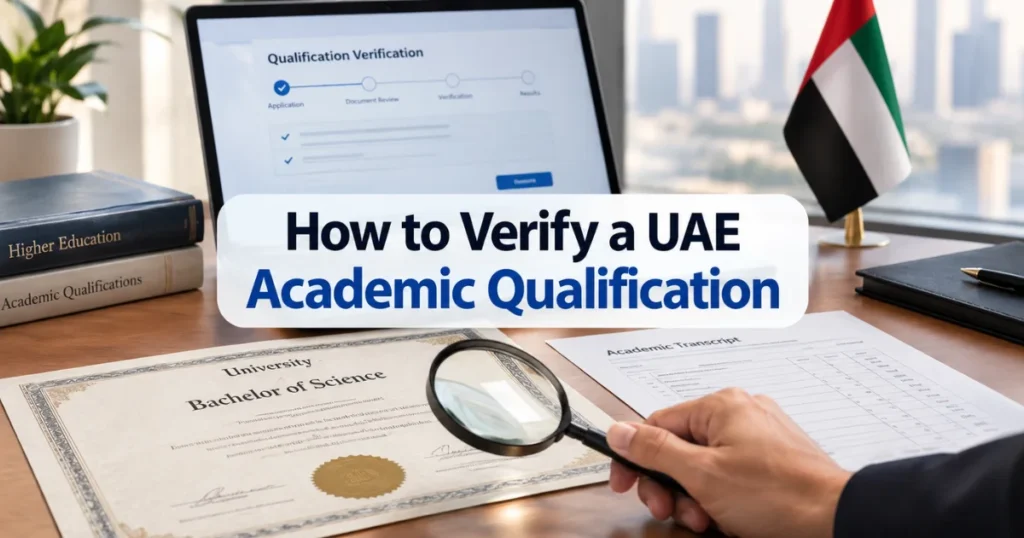
How to Verify a UAE Academic Qualification
This is the part missing from every news report on this story, and it is the most useful thing you can act on right now.
If your degree was earned outside the UAE and you want it formally recognized, you go through MoHESR’s qualification recognition process. This used to be called an equivalency certificate. It is now officially called Recognition of Higher Education Qualifications.
Here is how the process works:
Submit your degree for verification through one of MoHESR’s authorized partners, DataFlow Group or VFS Global.
Log in using UAE Pass to start the application.
Upload your academic documents and confirm your details.
A specialist reviews your application and contacts your university to confirm it is genuine.
After your degree is verified, you can proceed to the MoHESR Qualification Recognition stage. If the requirements are met, the ministry issues a Recognition Report.
A note on fees: MoHESR approved a new resolution on updated fees and financial guarantees for its services, including qualification recognition, effective 12 September 2026. Because this changed only days before the forgery warning, always check the current fee on MoHESR’s official service page or with an authorized partner before applying, rather than relying on any figure quoted elsewhere online.
Three terms get mixed up constantly in this process, so here is the difference in plain language:
Verification confirms your certificate is real and matches what your university issued.
Recognition confirms your qualification meets UAE academic standards, handled by MoHESR.
Attestation is a separate step handled by the Ministry of Foreign Affairs (MoFA), now done digitally through its eDAS 2.0 system, producing a secure e-stamp with a QR code instead of the old rubber stamp.
If you studied abroad, you may need qualification recognition, document attestation, or both, depending on your employer, profession, and the purpose the qualification is being used for.
How Employers Can Check a Candidate’s Degree
Employers are not left guessing either.
MoHESR encourages government and private sector employers to use its approved verification channels to check the authenticity of academic qualifications
MoHRE has separately worked with MoHESR on a digital initiative allowing employers to verify qualifications electronically, reducing reliance on paper documents alone
This directly supports what MoHESR keeps repeating: fraudulent qualifications put employers at risk when hiring or promotion decisions rely on inaccurate academic records
If a certificate looks inconsistent, or a candidate cannot produce a verifiable recognition report, that is the moment to use these official channels rather than take the document at face value.
What Happens If You Used a Forged Certificate Without Knowing?
The legal position can depend on what the person knew and the circumstances of the case. MoHESR specifically lists knowingly using a forged qualification among the acts of forgery it addresses, so intent matters to how a case is treated.
If you have doubts about a qualification supplied by an agent, institution, or third party, verify it through MoHESR’s approved channels rather than relying on the document alone. If you believe you may already have used a fraudulent qualification, seeking appropriate legal advice alongside verification is the safer path.
If your paperwork involves a UAE employment contract alongside your qualifications, the same verify first principle applies there too. You cancheck and verify a UAE labour contract online the same way you would verify an academic certificate, since both are part of the same document authenticity picture an employer or authority may check.
Conclusion
The contrast is significant. Qualification verification is designed to help confirm whether an academic credential is genuine, while recent UAE court rulings in forgery cases have included prison sentences of up to three years and fines of up to Dh30,000.
If you hold a qualification from outside the UAE, do not wait to be asked for proof:
Start your recognition application through DataFlow Group or VFS Global
Keep your documents consistent with what your university actually issued
Treat attestation as a separate, required step rather than an optional extra
If you are an employer, use MoHESR’s approved verification channels before a bad hire becomes a bigger problem
UAE court rulings in academic qualification forgery cases have included prison sentences of up to three years and fines of up to Dh30,000, according to the Ministry of Higher Education and Scientific Research (MoHESR). Forging an official document can carry a sentence of up to 10 years under Article 252 of Federal Decree-Law No. 31 of 2021.
How can I verify my academic qualifications in the UAE?
Submit your degree through MoHESR’s authorized verification partners, DataFlow Group or VFS Global, using UAE Pass to log in. After verification, you can proceed to the MoHESR Qualification Recognition stage, which issues an official Recognition Report if the requirements are met. Fees were recently updated under a resolution effective 12 September 2026, so check the current amount on MoHESR’s official service page before applying.
What UAE law covers academic certificate forgery?
Article 252 of Federal Decree-Law No. 31 of 2021 on Crimes and Penalties covers document forgery generally. Forging an official document can lead to up to 10 years in prison, while forging an unofficial document is punishable by detention.
Can I be punished for unknowingly using a forged certificate?
The circumstances matter. MoHESR specifically identifies knowingly using a forged qualification as one of the acts it treats as academic qualification forgery. If you are unsure about a certificate’s authenticity, verify it through the ministry’s approved channels, and seek appropriate legal advice if you believe you may already have used a fraudulent document.
Which UAE authorities investigate academic degree forgery cases?
MoHESR refers suspected criminal cases to the Ministry of Justice, the Federal Public Prosecution, and local public prosecution authorities, who handle the matter through the relevant legal and judicial procedures.
What is the difference between degree verification, recognition, and attestation in the UAE?
Verification confirms that a certificate is genuine. Recognition, handled by MoHESR, determines whether the qualification meets the applicable UAE requirements. Attestation is a separate document-authentication process handled by the Ministry of Foreign Affairs through its digital system. Whether you need one, the other, or both depends on your employer, profession, and the purpose for which the qualification is being used.
How can UAE employers verify a candidate’s degree?
Employers can use MoHESR’s approved verification channels to check the authenticity of an academic qualification. MoHRE has also worked with MoHESR on digital initiatives for electronic qualification verification, reducing reliance on paper documents.
Does the fake degree penalty apply to certificates issued outside the UAE?
Yes. MoHESR said protecting the credibility of qualifications is a priority whether they were issued inside the UAE or abroad. Its qualification verification and recognition processes also cover foreign academic qualifications.
Anees is a UAE-based content creator, writer, and SEO professional with over 12 years of experience. Since 2014, he has published research-backed guides on UAE visas, labour laws, jobs, traffic fines, and government services, all verified against official sources. He is certified in SEO by HubSpot Academy and Digital Marketing by Google Digital Garage.
12+ Years ExperienceHubSpot Academy — SEOGoogle Digital Garage
Disclaimer: This information is for general guidance only, based on publicly available UAE laws and regulations. It does not constitute legal advice. Always verify with official UAE government sources or a qualified legal professional.


Your email will not be published. Comments are reviewed before appearing.