The tax residency certificate UAE taxpayers request is an official document from the Federal Tax Authority (FTA) that confirms a person or company is a UAE tax resident. The FTA service also issues FTA stamped international forms and Commercial Activities Certificates.
This guide uses the official FTA service page. It explains who can apply, the exact fees, the documents for individuals and companies, the steps, the processing times and how to verify a certificate.
What Is a Tax Residency Certificate UAE?
A tax residency certificate (TRC) is issued by the FTA when it approves an application from a UAE tax resident. The FTA service page lists four possible results.
A TRC for Double Taxation Agreement (DTA) purposes.
A TRC for purposes other than a DTA.
An FTA stamped international form that confirms tax residency.
A Commercial Activities Certificate (CAC).
The service is open to government, business and individual customers, and a profile on the EmaraTax portal is mandatory. The application runs on the TRC platform, which the FTA says is available 24 hours a day.
Who Can Apply for a Tax Residency Certificate in the UAE?
Persons who are UAE tax residents under UAE tax law, or under a DTA, can apply for a tax residency certificate. The FTA sets clear limits on companies.
Juridical persons must have been incorporated or established for at least 12 months.
Branches of foreign companies and offshore companies are not eligible, because they are not considered established in the UAE.
Members of a Corporate Tax Group can apply individually. The group itself cannot apply and gets no discounted fees.
A Commercial Activities Certificate needs an active VAT TRN.
If your company is new, first complete your corporate tax registration so that you can use a Corporate Tax TRN, which lowers the fee.
When Can You Apply Before the Tax Period Ends?
The covered period can be a tax period or any 12 month period that you choose. A tax period must be the current one or a past one, and future periods are not allowed.
Juridical persons: after three months of the period have passed, or after it ends.
Natural persons: once the UAE tax residency criteria are met.
Government and government controlled entities: from day one of the period, or after it ends.
How Much Does a Tax Residency Certificate Cost in the UAE?
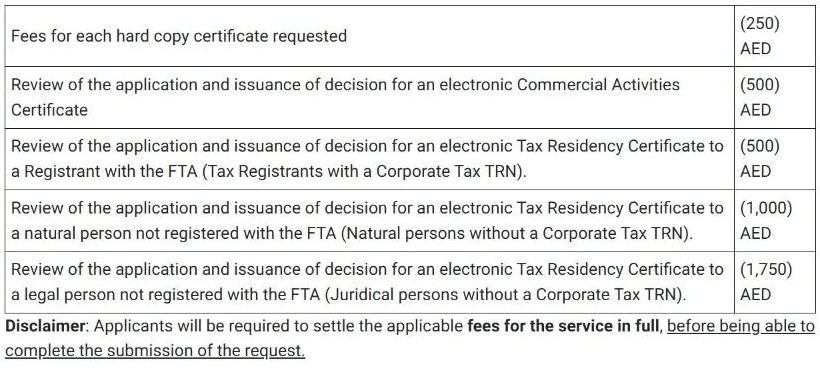
The fee depends on the applicant type, and every application also pays a submission fee of AED 50 that the FTA does not refund, even if the application is rejected. The FTA requires full payment before you can submit.
The FTA fee table lists AED 500 for FTA registrants, AED 1,000 for natural persons and AED 1,750 for legal persons without a Corporate Tax TRN. Source: tax.gov.ae
Item
Fee (AED)
Submission fee, all applications
50, non refundable
Electronic TRC, holder of a Corporate Tax TRN
500
Electronic TRC, natural person without a Corporate Tax TRN
1,000
Electronic TRC, juridical person without a Corporate Tax TRN
1,750
Electronic Commercial Activities Certificate
500
Each hard copy certificate
250
Entering a Corporate Tax TRN lowers the fee and fills in your application details. The FTA bases these fees on Cabinet Decision No. 65 of 2020 and its amendments.
Which Documents Do You Need for a Tax Residency Certificate?
The documents depend on who applies and why. The FTA lists separate sets for individuals, companies and treaty certificates.
What Documents Does an Individual Need?
For a certificate for purposes other than a DTA, the FTA sets three routes for a natural person.
183 days or more: Emirates ID, or a passport with an entry and exit report from the Federal Authority for Identity and Citizenship (ICP) or a competent local government entity.
90 to 182 days: Emirates ID and passport with an official entry and exit report, plus proof of UAE employment or business, or a permanent UAE residence.
Primary residence and centre of interests: Emirates ID and passport with an official entry and exit report, proof of financial and personal interests in the UAE, proof of the usual or primary UAE residence and proof of income if applicable.
What Documents Does a Company Need?
A juridical person needs the company records that prove it is established in the UAE.
A valid trade licence and lease agreement.
The certificate of incorporation and the memorandum of association.
The Corporate Tax TRN, if available.
The Emirates ID and passport of the authorised signatory, with proof of authority.
Proof of effective management and control in the UAE, where applicable.
A DTA certificate for a natural person needs the Emirates ID or passport with an official entry and exit report, proof of UAE income or salary if applicable and any extra evidence the DTA requires. A passport is always mandatory for a treaty certificate for an individual. A company uses the same company documents, with a certified memorandum of association.
The FTA adds that eligibility and extra documents vary by DTA, and the list of treaties is on the Ministry of Finance dashboard.
What Does a Commercial Activities Certificate Need?
A Commercial Activities Certificate needs an active VAT TRN and a request letter from the applicant. The certificate is valid for one year from the date the applicant specifies.
How Do You Apply for a Tax Residency Certificate Step by Step?
You apply online through EmaraTax, and the FTA says the form takes about ten minutes to submit.
Go to the EmaraTax portal and create an account, use an existing one, or link an account from the previous certificate portal.
Log in and choose Other Services, then Tax Residency Certificate.
Select your Corporate Tax TRN if you have one. Otherwise choose No Tax Registration Number.
Select the certificate type: for a DTA, choose the other country first, or choose other purposes.
Complete the fields and upload the documents. Request any printed copies or international form stamping here.
Pay the application and review fees in full.
Submit the application.
Download the approved certificate from the platform.
Approved certificates become available to download, are emailed to the registered address and printed copies are sent by courier within the UAE.
How Long Does It Take to Get a Tax Residency Certificate?
The FTA processes a TRC or a CAC within ten business days from receiving a complete application.
Step
Official time
Submitting the application
About 10 minutes
TRC or CAC processing
10 business days from a complete application
Hard copy only
5 business days from payment
International form attestation
10 business days from the completed form and payment
If you request a hard copy with an international form, the FTA processes the hard copy only after the form is submitted. If the form or the fee is not submitted within 30 business days, the stamping request is not processed and you must apply again.
How Does FTA Stamping of an International Form Work?
The FTA can stamp forms from other jurisdictions to confirm tax residency, but you must complete the form yourself. The FTA cannot complete it for you.
The form must be fully completed, signed and, for juridical persons, stamped.
It must match the period and the country of the TRC application.
You can upload a scanned copy. Hard copies must be sent by courier, and the applicant pays the return courier fee, or collects the form in person.
The FTA lists these rejection reasons: attestation not requested, an incomplete or unsigned form, a form not received, and a period or country mismatch.
How Do You Verify a Tax Residency Certificate?
You verify a tax residency certificate on the FTA Certificate Verification page, or by scanning the barcode on the certificate. The FTA lists the TRC platform at trc.tax.gov.ae for this check.
What Mistakes Can Delay a Tax Residency Certificate?
Most problems come from eligibility and incomplete documents.
Applying with a company that is younger than 12 months, or a branch or offshore company.
Choosing a period in the future or longer than 12 months.
Applying for a company before three months of the period have passed.
Submitting an international form that is incomplete, unsigned, unstamped or for the wrong period or country.
Forgetting that the submission fee of AED 50 is not refunded if the application is rejected.
As of 13 November 2026, the FTA service page lists a submission fee of AED 50, TRC fees of AED 500, AED 1,000 and AED 1,750, and ten business days for processing.
The page states that the August 2026 Service Card governs any discrepancy, so check the service card before you pay.
The FTA taxpayer user manual for the TRC platform on the page is Version 6, dated January 2025.
The page notes that FTA services are available through UAE PASS, while the steps mention an EmaraTax login, so confirm the login route when you start.
Conclusion
A tax residency certificate in the UAE costs AED 500 to AED 1,750 plus an AED 50 submission fee, depending on whether you hold a Corporate Tax TRN, and takes about ten business days. Check your eligibility first, prepare the documents for your category and apply through EmaraTax.
FAQs
How do I get a tax residency certificate in the UAE?
Apply on the FTA EmaraTax portal: choose Other Services, then Tax Residency Certificate, upload your documents, pay the fees in full and submit. Download the approved certificate from the platform.
How much is a tax residency certificate in the UAE?
The FTA lists AED 500 for a holder of a Corporate Tax TRN, AED 1,000 for a natural person without one and AED 1,750 for a juridical person without one. A non refundable AED 50 submission fee applies to every application.
How long does a tax residency certificate take?
The FTA gives ten business days from receipt of a complete application. A hard copy alone takes five business days from payment.
Who is eligible for a tax residency certificate in the UAE?
UAE tax residents under UAE tax law or under a DTA are eligible. Companies must be at least 12 months old, and branches of foreign companies and offshore companies are not eligible.
How many days must I stay in the UAE to get a tax residency certificate?
The FTA lists 183 days or more as one route for a natural person. Two other routes cover 90 to 182 days with proof of UAE employment, business or residence, and the primary residence and centre of interests route.
Can a new company apply for a tax residency certificate?
No, not before it has been incorporated or established for at least 12 months. The FTA states this for all juridical persons.
How can I verify a UAE tax residency certificate?
Use the FTA Certificate Verification page or scan the barcode on the certificate.
Shoaib Afzal is a content writer and SEO specialist who has been writing since 2020. He has worked on multiple Dubai based projects and researches every guide on official UAE government websites before writing.
Writing Since 2020Dubai Based ProjectsOfficial Sources First
Reviewed by Anees, Founder and Editor of The UAE Times. He reads every article before it goes live. See our editorial policy.
Disclaimer: This information is for general guidance only, based on publicly available UAE laws and regulations. It does not constitute legal advice. Always verify with official UAE government sources or a qualified legal professional.







Your email will not be published. Comments are reviewed before appearing.