UAE Visa Overstay Fine 2026: AED 50/Day RulesMinimum Salary to Sponsor Your Family Visa in UAEUAE Labour Law: Notice Period ExplainedHow to Check Your UAE Visa Status OnlineUAE Golden Visa Eligibility Requirements UpdatedUAE Visa Overstay Fine 2026: AED 50/Day RulesMinimum Salary to Sponsor Your Family Visa in UAEUAE Labour Law: Notice Period ExplainedHow to Check Your UAE Visa Status OnlineUAE Golden Visa Eligibility Requirements Updated
Qatar Visa for UAE Residents 2026: Requirements, Fees and How to Apply
The UAE Times
–
–
– min read
Last updated: – · Based on official UAE sources
A Qatar visa for UAE residents is not automatic just because you live here. Living in the UAE does not get you into Qatar visa-free by itself. What decides your entry route is your passport nationality, not your Emirates ID.
This guide covers every Qatar visa option for UAE residents: visa-free entry, visa on arrival, the Hayya A1 and A2 eVisas, fees, documents, the exact application steps, and which nationalities must book a hotel in advance.
Do UAE Residents Need a Visa for Qatar?
It comes down to your passport, not how long you’ve lived in the UAE.
Who travels visa-free:
UAE nationals and other GCC citizens (Bahrain, Kuwait, Oman, Saudi Arabia)
Citizens of over 100 other countries with visa-free or visa-on-arrival access, confirmed on Visit Qatar’s official page
Who needs to apply in advance:
UAE residents whose passport isn’t on Qatar’s visa-free or visa-on-arrival list must apply through the Hayya platform, either as a standard tourist (A1) or, if they hold valid GCC residency, through the A2 GCC Resident Visa
If you’re planning more than one Gulf trip this year, the rules work similarly next door. Check our Oman visa for UAE residents guide if Muscat is also on your list.
Qatar Visa Options for UAE Residents
Quick answer, if you’re a UAE resident:
Passport qualifies for visa-free entry → travel visa-free
Passport qualifies for visa on arrival → visa on arrival
You hold GCC residency and want advance approval → Hayya A2
Standard tourist, not covered above → Hayya A1
Visa Type
Who It Suits
Duration
Fee
Visa-free entry
GCC citizens, including UAE nationals
Up to 90 days
None
Visa on arrival
Eligible nationalities, issued at the airport
30–90 days depending on nationality
QAR 100 (some nationalities pay nothing with a Discover Qatar hotel booking)
Hayya A1 Tourist eVisa
UAE residents not eligible for visa on arrival
Up to 30 days
QAR 100
Hayya A2 GCC Resident Visa
GCC residents, including UAE residents
Up to 2 months, multiple entry
QAR 100
Family Visit Visa
Family members joining a Qatar-based sponsor
30 days
Fees vary by sponsor
Business Visa
Business travel with a Qatari company invitation
Fees vary
Fees vary
What Changed for the A2 Visa
Qatar updated the Hayya A2 GCC Resident Visa on 30 November 2025. It now allows a stay of up to two months with multiple entry, up from a single-entry, one-month visa previously.
The A2 route is useful for UAE residents because it’s an advance-approval visa you can apply for before you fly, rather than relying on an airport-issued visa on arrival.
Qatar Visa on Arrival: Approved Professions List
This is a detail most guides get wrong, and it matters for anyone choosing between visa on arrival and the Hayya A2 eVisa.
The 206-profession list applies to visa on arrival for GCC residents, not to the Hayya A2 eVisa. Qatar’s Ministry of Interior maintains this approved list specifically for GCC residents entering under the visa-on-arrival route. Your job title, exactly as printed on your Emirates ID or UAE residence permit, must match one of the approved professions.
Commonly approved professions include:
Medical and health: doctors, dentists, nurses, pharmacists
Engineering and technical: engineers, aircraft technicians, programmers, network specialists
Business and finance: accountants, auditors, bankers, business managers, consultants
Management and administration: directors, hotel managers, hospital managers
Legal, government and diplomatic: lawyers, judges, diplomats, police officers
Education and academia: teachers, professors, lecturers, researchers
Aviation and maritime: pilots, captains, air controllers
Media, arts and creative: journalists, artists, translators
Other roles: architects, veterinarians, social workers, economists
Applying Through Hayya A2 Instead
The Hayya A2 eVisa doesn’t restrict you to this fixed list. During the application, you select your job title from Hayya’s own dropdown, or choose “Others” and enter it manually. The requirement is that your job title matches your residence permit exactly, not that it appears on the 206-profession list.
If the title doesn’t match your residence permit, entry can still be refused, even with an approved visa. So the accuracy of your job title matters either way. It’s just not gated by the same fixed list.
Qatar Visa Requirements and Documents
Passport and Residency Validity
Passport validity: requirements vary by route. Visit Qatar lists at least three months of validity for several entry categories, while some GCC-resident guidance specifies six months. Check the requirement shown for your specific route before booking travel.
GCC/UAE residence card validity: at least three months remaining, for the Hayya A2 route
Documents to Prepare
Recent colour passport photo on a plain white background, full face visible, no sunglasses
Confirmed return or onward travel ticket
Proof of accommodation, such as a hotel booking
Valid travel health insurance
Physical Emirates ID (not just a photocopy; immigration may ask to see it)
Mandatory Hotel Booking Rule
Qatar requires travellers from certain nationalities to pre-book accommodation through Discover Qatar before their visa is approved. The current list includes:
India
Pakistan
Thailand
Iran
Check the official Discover Qatar page before booking, since Qatar can add nationalities to this requirement at its discretion.
Minimum stay of 2 nights through Discover Qatar
QAR 100 cancellation fee if your visa application is rejected
A hotel booking does not guarantee visa approval, and cancelling it before travel can cause problems at immigration even after approval
Pakistani nationals should note that visa on arrival is currently affected by wider restrictions (see the Pakistan update below), so a hotel booking alone doesn’t guarantee entry
Health Insurance
Valid travel health insurance from a provider recognised by Qatar’s Ministry of Public Health is a firm entry requirement, not optional.
Pakistan Visa Update
Qatar suspended visa on arrival for Pakistani passport holders from 31 March 2026, as part of tighter immigration controls. This affects Pakistani UAE residents too.
September 2026 update: Reports continue of prolonged delays for some Hayya applications from Pakistani nationals. Pakistan’s Foreign Office has said it has not received formal notification from Qatar of a broader visa ban, and has described the situation as unconfirmed rather than a formally announced suspension. Pakistani travellers should verify their individual visa status through official Hayya or Qatari embassy channels before booking travel, rather than relying on visa on arrival.
How to Apply for a Qatar Hayya Visa
Both the A1 Tourist eVisa and A2 GCC Resident Visa are applied for through the same Hayya platform.
Create an account on the Hayya website or mobile app
Log in and select “Apply for Hayya”
Choose your visa type: A1 Tourist eVisa or A2 GCC Resident Visa
Select your visit purpose
Upload a recent photo on a plain, light background
Upload your passport’s first page, with the machine-readable zone visible
For A2, enter your residency details and your occupation exactly as it appears on your residence permit
Upload your UAE residence permit or Emirates ID copy
Add accommodation details, including a hotel booking if required for your nationality
Review and submit your application
Once your application reaches the payment stage, pay the QAR 100 visa fee online by card
Receive your Hayya entry permit by email, then download and print it for travel
Apply a few days before you travel, since processing times vary with application volume.
Note on payment: Hayya payments are card-only. Cash isn’t accepted through the online application, and your bank may add its own foreign transaction charge on top of the QAR 100 fee.
Visa validity isn’t the same as your permitted stay. Your approved Hayya permit has an entry window, the period during which you must actually enter Qatar. Your stay only begins once you cross the border, and you cannot enter after the final entry date printed on the permit. Check both dates rather than assuming your stay counts from the approval date.
Qatar Visa Fees for UAE Residents
Item
Fee
Visa on arrival
QAR 100 (free for some nationalities with a confirmed Discover Qatar hotel booking)
Hayya A1 Tourist eVisa
QAR 100
Hayya A2 GCC Resident Visa
QAR 100
Family Visit Visa, 30 days
QAR 200, plus QAR 50 per month for each companion
Cash payment processing fee at immigration
QAR 25 extra
Discover Qatar cancellation fee, if visa rejected
QAR 100
Applying directly through Hayya costs only the QAR 100 government fee. Some UAE travel agencies offer done-for-you applications for an added service fee.
Which Nationalities Get Visa-Free or Visa-on-Arrival Access?
Qatar currently allows citizens of 102 nationalities to enter without arranging a visa in advance. Permitted stay and conditions depend on nationality, so use the official Visit Qatar checker with your passport details before booking travel. It’s the only way to get a result specific to your situation.
For reference, examples of nationalities in each group:
30-day group includes: Australia, Brazil, Brunei, Canada, China, Georgia, Hong Kong, India, Indonesia, Japan, Kazakhstan, Maldives, Mauritius, Mexico, New Zealand, Russia, Singapore, South Africa, South Korea, Thailand, United Kingdom, United States, and others.
90-day group (within a 180-day period) includes: Argentina, Austria, Belgium, Bulgaria, Croatia, Cyprus, Czech Republic, Denmark, Estonia, Finland, France, Germany, Greece, Hungary, Iceland, Italy, Latvia, Lithuania, Luxembourg, Malaysia, Malta, Netherlands, Norway, Poland, Portugal, Romania, Slovakia, Slovenia, Spain, Sweden, Switzerland, Turkey, and others.
Pakistani passport holders: Pakistan generally appears on Qatar’s nationality list, but visa on arrival for Pakistani nationals is currently suspended. See the Pakistan Visa Update section above before relying on this route.
If your nationality isn’t in either group, you’ll need the Hayya A1 Tourist eVisa or, if you hold GCC residency, the A2 route.
Holding a valid Schengen, UK, US, Canada, Australia or New Zealand visa or residence permit can open an alternative route even if your own passport isn’t visa-free. On Qatar’s official checker, this currently leads to visa on arrival with a mandatory Discover Qatar hotel booking, or the option to apply for an A2/A3 eVisa through Hayya in advance. This matters most for UAE residents from countries like Egypt, Jordan or the Philippines. Confirm your exact outcome on the official checker, since it depends on your specific nationality and qualifying visa.
Two duration details worth knowing:
The 90-day waiver runs across a 180-day window, usable in one trip or several shorter ones
The standard 30-day visa on arrival is single-entry. Leaving Qatar before your 30 days are up means you’ll need a fresh visa to re-enter
Visa on Arrival vs Hayya: Which Route Applies to You?
If you are…
Check this route
UAE citizen
Visa-free, as a GCC citizen
UAE resident, nationality eligible for visa-free entry
Visa-free
UAE resident, nationality eligible for visa on arrival
Visa on arrival
UAE resident who wants advance approval before flying
Hayya A2 (if holding GCC residency)
Standard tourist visa applicant
Hayya A1
Pakistani passport holder
Check current visa availability before booking
Family and Dependent Visa Rules
Dependents using the A2 GCC Resident Visa route must hold their own valid GCC residency, not just be related to someone who does
Family members without GCC residency need a separate A1 Tourist eVisa
Each family member, including children, needs their own visa application submitted alongside the parent’s or guardian’s
How Long Can You Stay, and Can You Extend?
Most Hayya visas and visa-on-arrival permits allow a 30-day stay; the updated A2 visa allows up to two months with multiple entry.
Extension eligibility depends on the visa category, and rules can change. Confirm current terms on the MOI portal or Metrash2 app before your permitted stay expires, rather than relying on figures published by third-party sites.
Overstay fine: QAR 200 per day
Apply for an extension online through the MOI portal, or in person at the Airport Passports Department at Hamad International Airport, before your current visa expires.
Also planning ahead in the UAE? Our UAE visa overstay fine check guide shows how to check your standing there too.
Travelling to Qatar by Road
There’s no direct land border between the UAE and Qatar. The route goes through Saudi Arabia, via the Abu Samra border crossing, roughly 6 to 7 hours from Abu Dhabi.
You’ll need:
A valid Saudi entry or transit visa (your Qatar visa doesn’t cover Saudi transit)
Your Qatar Hayya permit or visa-on-arrival eligibility confirmed before crossing
Separate vehicle insurance valid in both Saudi Arabia and Qatar
Most UAE residents fly instead. Dubai or Abu Dhabi to Doha takes under an hour and skips the Saudi transit step.
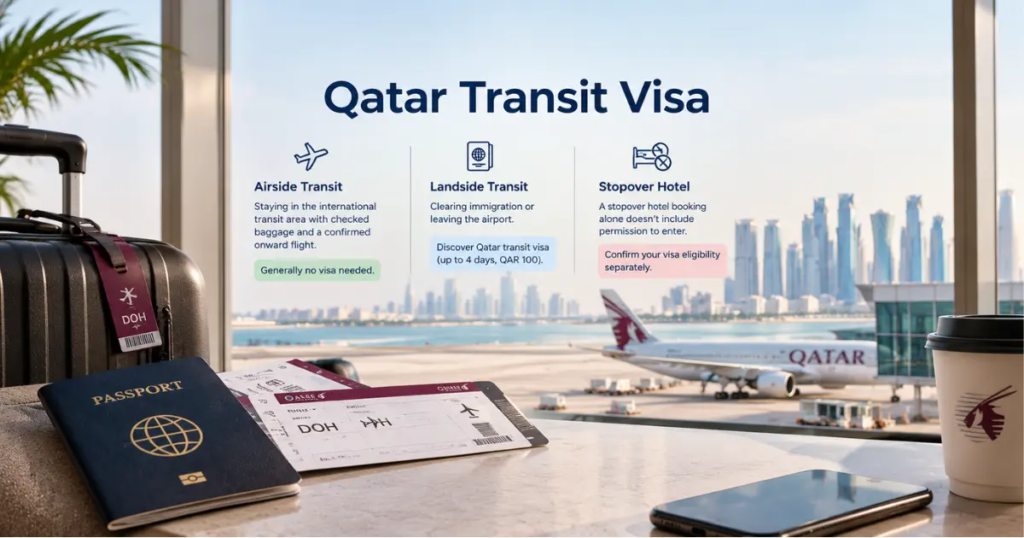
Qatar Transit Visa
Passing through Doha only? A full entry visa isn’t always necessary.
Airside transit (staying in the international transit area with checked baggage and a confirmed onward flight): generally no visa needed
Landside transit (clearing immigration or leaving the airport): a Discover Qatar transit visa, up to 4 days, QAR 100
A stopover hotel booking alone doesn’t include permission to enter. Confirm your visa eligibility separately
How to Check Your Qatar Visa Status
MOI portal (moi.gov.qa): enter your visa number, passport number and nationality under Visa Services
Hayya portal: log in for real-time updates if you applied through Hayya
Metrash2 app: Qatar’s official MOI app, for checking visa status and any outstanding fines
Is a Unified GCC Tourist Visa Coming?
No single GCC-wide tourist visa is currently available or something travellers should rely on for Qatar entry.
Plans for a unified GCC tourist visa have been discussed, but until an official launch and application process are announced, use the current Qatar visa system for your travel planning.
Common Mistakes UAE Residents Make
Assuming UAE residency alone grants visa-free entry, when only passport nationality decides that
Confusing the 206-profession list (visa on arrival) with the Hayya A2 eVisa’s job-title matching requirement
Confusing passport validity with residence card validity, which are separate rules
Forgetting the mandatory hotel booking rule for India, Pakistan, Thailand or Iran passports
Skipping travel health insurance, assuming it’s optional
Booking non-refundable flights before Hayya approval comes through
Assuming Pakistani nationals can rely on visa on arrival without checking current status first
Treating a stopover hotel booking as a valid transit visa
Assuming one motor insurance policy covers both Saudi Arabia and Qatar
Conclusion
Nationality, not UAE residency, decides how you enter Qatar.
Check whether your passport qualifies for visa-free entry or visa on arrival first. If not, the Hayya A2 route is worth checking if you hold GCC residency, since it now allows up to two months with multiple entry. Keep your passport and residence card validity within the required limits, arrange health insurance, and check the mandatory hotel booking rule if you hold an Indian, Pakistani, Thai or Iranian passport.
If you hold a Pakistani passport, verify your current visa status through Hayya or a Qatari embassy before booking, given the ongoing restrictions on visa on arrival.
Frequently Asked Questions
Do UAE residents need a visa to enter Qatar?
Most non-GCC UAE residents do. UAE nationals and other GCC citizens travel to Qatar visa-free.
What is the cost for Qatar visa for UAE residents?
QAR 100 covers visa on arrival, the Hayya A1 Tourist eVisa and the Hayya A2 GCC Resident Visa.
How long can I stay in Qatar on the Hayya A2 GCC Resident Visa?
Up to two months, with multiple entry, following Qatar’s November 2025 update to the A2 visa.
Which professions qualify for Qatar’s visa on arrival for GCC residents?
Around 206 approved professions, including doctors, engineers, accountants, teachers, lawyers and management roles. This list applies to visa on arrival specifically. The Hayya A2 eVisa instead requires your job title to match your residence permit.
Can I apply for the Hayya A2 visa if my profession isn’t on the 206-profession list?
Yes. The 206-profession list applies to the GCC-resident visa-on-arrival route. The Hayya A2 eVisa is a separate advance-application category for GCC residents. It just requires your job title to match what’s on your residence permit.
Is Qatar visa on arrival available for all UAE residents?
No. It only applies to residents whose passport nationality is on Qatar’s eligible list. Everyone else needs a Hayya eVisa.
Can I extend my Qatar visa as a UAE resident?
It depends on your visa category, and terms can change. Confirm current extension eligibility on the MOI portal or Metrash2 app before your permitted stay expires.
Is travel insurance mandatory for Qatar entry?
Yes, valid travel health insurance from a provider recognised by Qatar’s Ministry of Public Health is required.
Do UAE residents from India or Pakistan need to book a hotel in advance?
Yes. Travellers from India, Pakistan, Thailand and Iran must pre-book accommodation through Discover Qatar before their visa is approved.
Can UAE residents travel to Qatar by road?
Yes, but only by transiting through Saudi Arabia, which requires a separate Saudi transit visa. Most UAE residents fly instead.
Do children need a separate Qatar visa?
Yes. Each child needs their own visa application submitted alongside a parent’s or guardian’s.
Can Pakistani UAE residents still get a Qatar visa on arrival?
Visa on arrival for Pakistani nationals has been suspended since 31 March 2026, and reports of delays continue into September 2026. Pakistan’s Foreign Office says it hasn’t received formal notification of a broader ban. Pakistani travellers should verify their status through Hayya or a Qatari embassy before booking.
Do I need a visa if I’m only transiting through Doha airport?
Usually not, if you stay within the international transit area with checked baggage and a confirmed onward flight. Leaving the airport during a layover may require a Discover Qatar transit visa.
How can I check my Qatar visa application status?
Through the MOI portal at moi.gov.qa, your Hayya account if you applied online, or the Metrash2 mobile app.
Can I pay the Hayya visa fee in cash?
No. Hayya payments are online by card only. Cash is accepted at immigration counters for visa on arrival, with an extra QAR 25 processing fee.
Anees is a UAE-based content creator, writer, and SEO professional with over 12 years of experience. Since 2014, he has published research-backed guides on UAE visas, labour laws, jobs, traffic fines, and government services, all verified against official sources. He is certified in SEO by HubSpot Academy and Digital Marketing by Google Digital Garage.
12+ Years ExperienceHubSpot Academy — SEOGoogle Digital Garage
Disclaimer: This information is for general guidance only, based on publicly available UAE laws and regulations. It does not constitute legal advice. Always verify with official UAE government sources or a qualified legal professional.




Your email will not be published. Comments are reviewed before appearing.