Japan visa for UAE residents is a short term tourist visa of up to 90 days that most non UAE nationals living in the Emirates must obtain before flying to Japan. Since 1 August 2024 the Consulate General of Japan in Dubai no longer takes applications at its own counter. Residents now apply through VFS Global.
This guide explains who needs the visa, which documents VFS asks for, the fees that changed on 1 July 2026, the processing time and the eVISA rule at the airport. Every figure below comes from the Japanese consulate, the Ministry of Foreign Affairs of Japan or the VFS checklist.
What Is the Japan Visa Process for UAE Residents?
UAE residents who are not UAE citizens apply for a Japan tourist visa through VFS Global in Dubai, submit a document set that includes an employment certificate and three months of bank statements, pay the visa and service fees, and collect an eVISA or passport sticker after about 8 to 10 working days.
The visa allows tourism only. It does not allow paid work, and it is not the right category for visiting relatives or for business meetings.
Who needs a Japan visa from the UAE
Residents of the UAE need a visa unless their own passport is exempt under Japan short term visa exemption list. The Consulate General confirms that UAE nationals do not need a visa for stays of 90 days or less, and that they need one for longer stays.
Residents of Dubai, Sharjah, Ajman, Umm Al Quwain, Ras Al Khaimah and Fujairah apply at the VFS Global centre in Dubai. Residents of Abu Dhabi and Al Ain apply through the Embassy of Japan in Abu Dhabi, with VFS handling the submission.
VFS Global Dubai: WAFI Mall, First Floor, Phase 5, Umm Hurair 2, Dubai, open Monday to Friday, 09:00 to 17:00
Dubai, Sharjah, Ajman, Umm Al Quwain, Fujairah and Ras Al Khaimah email: info.japandxb@vfshelpline.com
Abu Dhabi and Al Ain email: info.japanauh@vfshelpline.com
Japan Visa Information Hotline: +971 800 032 1271 (24 hours, English)
The hotline answers general questions only. It does not accept questions about eligibility or the status of an eVISA.
Japan Tourist Visa Types and Validity for UAE Residents
Japan issues a single entry eVISA, a single entry sticker visa and a multiple entry sticker visa to UAE residents, and the consulate decides the final type and length of stay.
Visa type
Entries
Key rule
eVISA
Single
Valid three months, stay up to 90 days
Sticker visa
Single
Valid three months, stay up to 90 days
Sticker visa
Multiple
May be issued as single entry at the consulate decision
Stay days are counted from the day after arrival. The eVISA becomes invalid once the holder arrives at the port of entry, so it cannot be reused for a second trip.
A single entry applicant must hold a valid UAE residence visa at the time of application. The UAE residence visa must also stay valid when the traveller returns. Our page on types of UAE residence visa explains the status categories.
Documents Required for a Japan Visa from the UAE
The VFS eVISA checklist for UAE residents lists ten documents, and all of them must be valid on the application date and issued within the last three months.
Signed visa application form
One colour photo, 45 mm by 35 mm, taken within the last 6 months
Original passport with more than two blank pages, valid for 30 days beyond the return date, plus a coloured copy
UAE residence visa and Emirates ID, valid for 30 days beyond the return date
Air ticket, either provisional or confirmed
Hotel booking with full stay details
Daily itinerary for the trip in Japan
Original employment certificate addressed to the Consul General of Japan in Dubai
Three months of UAE bank statements with the IBAN, issued no more than 10 days before the application
eVISA declaration, because the traveller must show the Visa Issuance Notice on a smartphone or tablet with internet
The older consulate checklist for sticker visa applicants also asks for a copy of the passport and an itinerary form. Documents are not returned after submission, except the passport.
What the employment certificate must say
The employment certificate must state the position, the salary and the purpose of travel, and it must be addressed to the Consul General of Japan in Dubai. It needs the company seal or the signature of the person in charge, with the signer name and position.
Business owners and Golden Visa holders use a company letter
Free Zone owners also provide a Free Zone NOC, or a salary or incumbency certificate from the Free Zone
Dependents provide a sponsor NOC
Minors provide NOCs from both parents
Electronically generated certificates must carry the words Electronically generated, plus a seal or signature
Bank statement rules
The bank statement must cover the last three months and must show the account name, daily transactions and balance. VFS accepts online statements, or an account detail certificate that shows the IBAN, when it is issued within 10 days before the application. No official minimum balance is published, so avoid trusting any figure quoted without a source.
Japan Visa Fees for UAE Residents from 1 July 2026
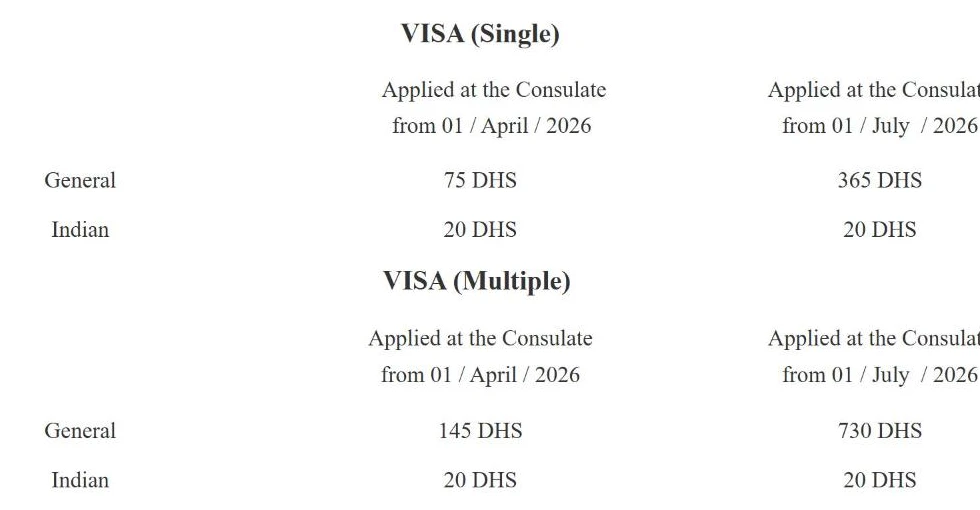
The Consulate General of Japan in Dubai lists a general single entry visa fee of 365 DHS and a general multiple entry fee of 730 DHS for applications from 1 July 2026. Applicants of Indian nationality pay 20 DHS for both types.
Visa
Until 30 June 2026
From 1 July 2026
Single entry, general
75 DHS
365 DHS
Multiple entry, general
145 DHS
730 DHS
Single or multiple, Indian
20 DHS
20 DHS
Visa fee table on the consulate website. Source: dubai.uae.emb-japan.go.jp
The Ministry of Foreign Affairs of Japan states the same change in yen: about 15,000 yen for a single entry visa and about 30,000 yen for a multiple entry visa, for applications accepted on or after 1 July 2026. Payment is generally made in the local currency of the issuing mission.
VFS service fee and refusal rules
VFS Global charges its own service fee on top of the visa fee, and the amount is shown on the VFS Japan page for the UAE. The ministry states that an agency handling fee applies even when a visa is issued.
No visa fee is charged if the visa is not issued. A fee already paid is not refunded when an issued visa is cancelled before use.
How to Apply for a Japan Visa from Dubai Step by Step
The application has six steps, and the first one is the appointment on the VFS website.
Book an appointment on the VFS Global Japan page for the UAE. Apply no earlier than 90 days before entry.
Prepare the originals and copies listed above, and make sure the bank statement is less than 10 days old.
Attend the VFS centre, submit the documents and have biometrics and photo checked.
Pay the visa fee and the VFS service fee as shown at the centre.
Wait for processing, usually 8 to 10 working days, excluding weekends and embassy holidays.
Collect the passport, or save the eVISA Visa Issuance Notice on a device that works offline and online at the airport.
The application cannot be accepted if the flight leaves within two weeks of the application date. Book the appointment early for that reason.
How Long Does the Japan Visa Take for UAE Residents?
VFS Global quotes 8 to 10 working days for processing, and incomplete files can take 3 to 4 weeks. Weekends and embassy holidays are not counted, so the real calendar time is longer.
The Ministry of Foreign Affairs of Japan states that standard processing is five working days from the day after acceptance, and that complex cases can take much longer. Use the longer VFS estimate when you plan the trip.
Japan eVISA Rule at the Airport
Travellers with an eVISA must show the Visa Issuance Notice on an internet connected device at the airport. The ministry does not accept PDF files, screenshots or printed copies for this purpose.
The eVISA suits single entry tourism and air travel, and it is also available for the Busan and Shanghai ferries. Only holders of ordinary passports can use it. The UAE appears on the ministry list of countries where the application goes through an accredited agency, so UAE residents do not open an account on the ministry site directly. Beware of fake websites.
Why a Japan Visa Application Gets Delayed or Refused
Most delays come from incomplete or incorrect documents, because the checklist says such files can lead to rejection. The consulate cannot give the reason for a refusal.
Employment certificate not addressed to the Consul General of Japan in Dubai
Bank statement older than 10 days or missing the IBAN
Passport or residence visa not valid for 30 days beyond the return date
Flight booked within two weeks of the application date
Application sent to the wrong centre, for example Abu Dhabi residents in Dubai
Reapplying for the same purpose within six months of a refusal is generally not accepted. A traveller can move a valid multiple entry or single visa to a new passport when the old passport expired or is full, damaged or renewed. A lost or stolen passport needs a new application. If your passport needs renewal first, read how to handle UAE residence visa renewal, and track any pending case with checking UAE visa status online.
Long stays such as study or employment need a Certificate of Eligibility from the Immigration Services Agency of Japan before the visa application. More visa guides are in our Visas and Residency category.
24 June 2026: the consulate fee page lists 365 DHS single entry and 730 DHS multiple entry from 1 July 2026 for general applicants
24 June 2026: the Ministry of Foreign Affairs of Japan lists about 15,000 yen and 30,000 yen from 1 July 2026
15 May 2026: the ministry eVISA page lists the UAE under application through an accredited agency
17 March 2026: the consulate visa page confirms that VFS Global handles applications since 1 August 2024
Conclusion
Japan visa for UAE residents is straightforward when the file is complete: apply through VFS Global, use documents issued within the last three months, and plan for 8 to 10 working days. The 2026 fee increase makes a complete first attempt more important.
Check the official fee and checklist pages again before booking, because the Japanese authorities update them without notice.
Frequently Asked Questions
Do UAE residents need a visa for Japan?
Most UAE residents need a visa unless their own passport is on the Japanese visa exemption list. UAE nationals do not need a visa for stays of 90 days or less.
How much is a Japan visa for UAE residents?
The consulate lists 365 DHS for a single entry visa and 730 DHS for a multiple entry visa from 1 July 2026 for general applicants. VFS Global adds a separate service fee.
How long does a Japan visa take from Dubai?
VFS Global quotes 8 to 10 working days, and up to 3 to 4 weeks for incomplete files. Weekends and embassy holidays are not counted.
Can Abu Dhabi residents apply in Dubai?
No. Abu Dhabi and Al Ain residents apply through the Embassy of Japan in Abu Dhabi, with VFS handling the submission.
Can I show a screenshot of my eVISA at the airport?
No. The ministry requires the Visa Issuance Notice to be shown on an internet connected device, and screenshots, PDF files and printed copies are not accepted.
Is the visa fee refunded if the visa is refused?
No visa fee is charged if the visa is not issued. The agency handling fee still applies.
How early can I apply for a Japan visa in the UAE?
Applications are accepted up to 90 days before entry, and not when the flight is within two weeks of the application date.
Shoaib Afzal is a content writer and SEO specialist who has been writing since 2020. He has worked on multiple Dubai based projects and researches every guide on official UAE government websites before writing.
Writing Since 2020Dubai Based ProjectsOfficial Sources First
Reviewed by Anees, Founder and Editor of The UAE Times. He reads every article before it goes live. See our editorial policy.
Disclaimer: This information is for general guidance only, based on publicly available UAE laws and regulations. It does not constitute legal advice. Always verify with official UAE government sources or a qualified legal professional.




Your email will not be published. Comments are reviewed before appearing.