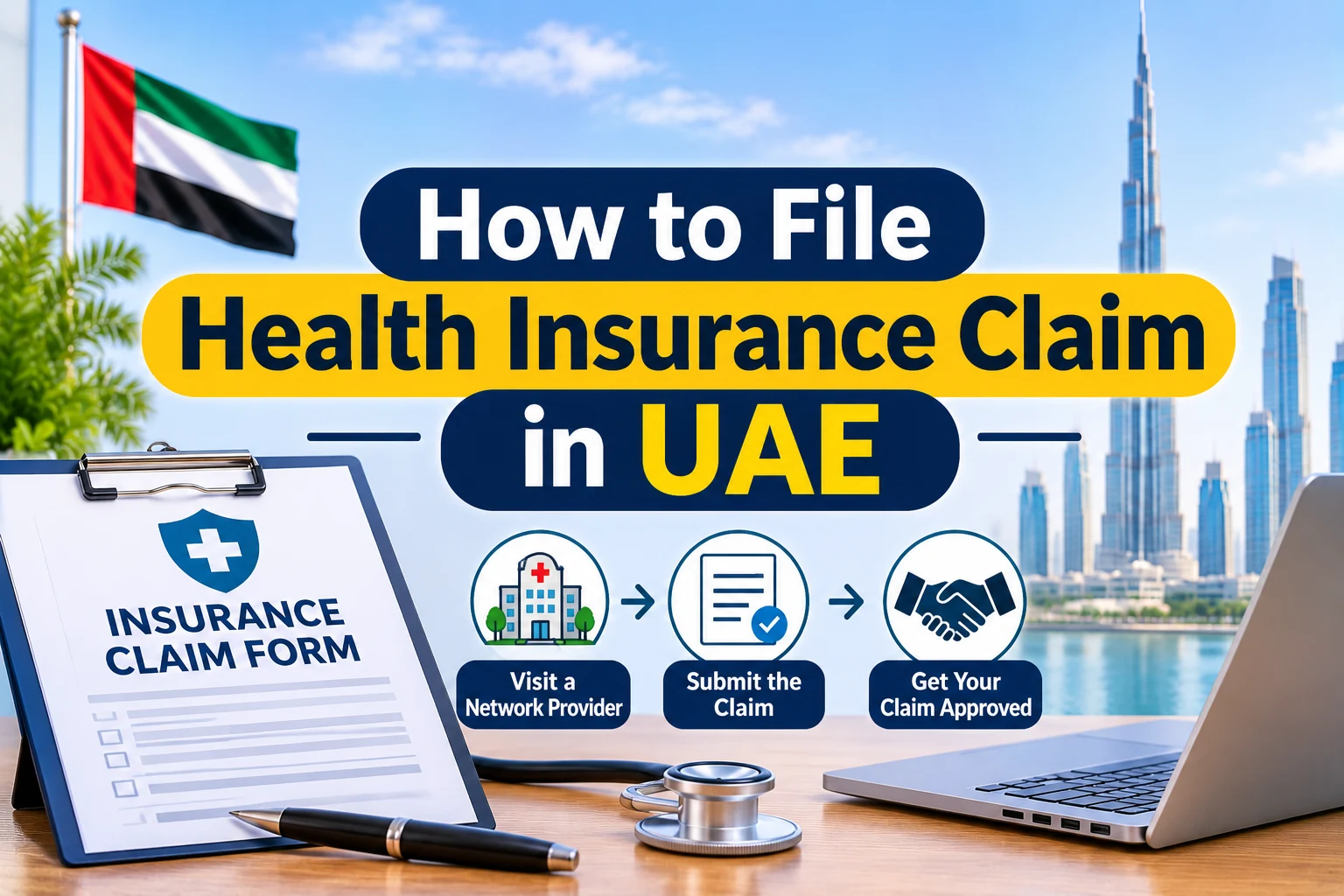
How to file health insurance claim in UAE depends on how you were treated: use your insurance card at a network provider for a direct settlement, or pay first, collect the invoice and the medical report, and submit a reimbursement claim to the insurer using the procedure written in your policy.
Dubai law requires every health insurance policy to state how financial claims are settled, so the policy is the first document to open. This guide explains the two claim routes, the step by step process, the documents, the usual deadlines and review times, how the amount paid is worked out, what to do after emergency treatment outside the network and where to go if the claim is refused.
What Is the Difference Between a Direct Settlement and a Reimbursement Claim?
With a direct settlement the provider bills the insurer for you, and with a reimbursement claim you pay first and ask the insurer to pay you back.
Route
When it is used
Who pays first
Direct settlement (cashless)
Treatment at a provider on the network list in your policy
The insurer, apart from your co insurance
Reimbursement claim
Treatment at a provider outside the network, or a bill that was not sent to the insurer
You, until the insurer pays back
Dubai law says a health insurance policy must list the provider network and the co insurance, and a beneficiary must pay the co insurance stated in the policy under Article 12. Insurers must give beneficiaries the network list and keep it updated, so check it before a planned visit.
Insurer guides add that basic plans often reimburse only emergencies, and that you should tell the insurer about an emergency quickly, with some insurers asking for notice within 24 hours. The policy decides the exact rule.
How to File Health Insurance Claim in UAE Step by Step
Filing a claim follows the same order in both routes: confirm cover, get treatment, collect the papers, submit the claim and keep the reference.
Open the policy and find the claims procedure, the network list, the co insurance and any filing period.
Show the insurance card or Emirates ID at the provider for a direct settlement, or pay the bill and keep the original invoice and receipt for a reimbursement claim.
Ask the provider for the medical report and prescription, because Article 15 of Dubai Law No. 11 of 2013 says a provider must give the beneficiary a copy of the medical reports on request.
Complete the claim form that the insurer provides. Many insurers ask the treating doctor to sign it.
Attach the documents the policy asks for and add your bank details for the payment.
Submit the claim through the channel named in the policy, such as the insurer app, portal, email or branch, and keep the reference number.
Follow up with the insurer until the claim is paid or a written reason is given.
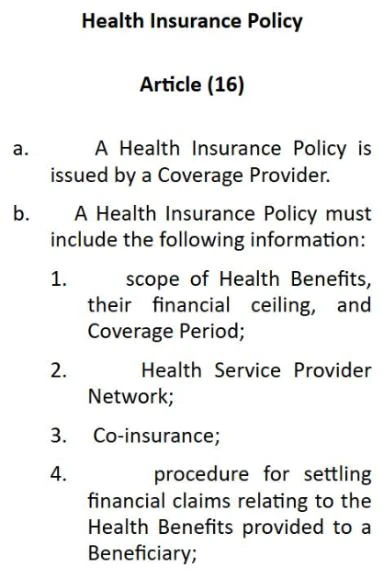
Article 16 of Dubai Law No. 11 of 2013 requires every policy to state the procedure for settling financial claims. Source: dlp.dubai.gov.ae
How Does a Direct Settlement Work in Practice?
In a direct settlement you show your card at a network clinic, hospital, pharmacy or diagnostic centre, and the provider sends the bill to the insurer.
You normally pay only the co insurance, deductible or any item that the plan does not cover. Check that the provider is on the network list for your exact plan, because a clinic that accepts one plan from an insurer may not accept another. You can confirm that your policy is active on the treatment date with our guide to check health insurance status.
When Can You File a Reimbursement Claim?
You can file a reimbursement claim when you paid a covered bill yourself, for example at a provider outside the network or for a service that was not billed to the insurer.
Only services covered by the policy and within the plan limits are repaid. Some insurers deduct a co payment or an administration charge, and the claim can be rejected for missing papers or for treatment that the plan does not cover. Check the network and benefits before you choose an outside clinic.
Which Documents Do You Need for a Health Insurance Claim?
The exact list is set by the insurer and the policy, and a reimbursement claim usually needs the claim form, the invoice, the proof of payment and the medical report.
The completed claim form, usually signed by the treating doctor, with your bank details.
The medical report and, after admission, the discharge summary.
The original invoices or receipts and the proof of payment.
Test results, scans and prescriptions.
A copy of the insurance card and the Emirates ID.
Insurer guides say scanned copies are usually accepted, while originals can be asked for on larger claims, with AED 2,500 and above quoted by one insurer guide. Keep a copy of everything you submit, and answer any request for more papers in writing with the date.
How Long Do You Have to File and How Long Does a Claim Take?
No fixed number of days for filing or paying a claim was found in the Dubai law or bylaw, so the policy and the insurer set the time limits.
Administrative Resolution No. 78 of 2022 says insurers must follow the time frames that the Dubai Health Insurance Corporation prescribes for claim cycles and settlements. Insurer guides most often quote about 60 days to submit a reimbursement claim and about 15 to 21 working days for the review, and a news guide quotes 7 to 30 working days for the refund. These figures differ by plan, so treat them as common practice and not as a rule.
Submit the claim as soon as you have the papers, and never wait for the last day.
Write down the date, the channel and the reference number of every submission.
Ask the insurer for the expected timeline when you submit.
If the insurer asks for more papers, answer in writing and keep the reply.
How Much Will the Insurer Pay?
The insurer pays the covered part of the bill after the deductible, the co payment and any cap set by the plan, so the amount paid is often lower than the invoice.
A deductible is the first part of the bill that you pay, a co payment is a share of each bill that you pay, and some plans pay only up to a usual and customary rate for a service. The table uses invented figures to show how these work together. It is an example and not an offer from any insurer.
Example item
Amount
Clinic bill
AED 500
Plan limit for the visit
AED 400
Co payment of 20 percent on the limit
AED 80
Insurer pays
AED 320
You pay in total
AED 180
Read the benefits table of your policy to find the deductible, the co payment and the annual limit. Our guide to health insurance costs explains how these items change what you pay.
Can You Claim for Emergency Treatment at a Hospital Outside the Network?
Yes, Dubai law says an insurance company must pay the cost of health benefits provided outside its network in an emergency case until the life of the beneficiary is no longer threatened.
A provider must also give emergency services until the life of the patient is no longer threatened, even if it is outside the network. For non emergency treatment outside the network, the policy decides what is covered, so check it before you go. After an emergency, keep the report that describes the condition, because it is the main proof that the treatment was urgent.
How to Avoid Delays and Rejections
Most delays come from missing papers, unclear handwriting or treatment that the plan does not cover, so a complete and accurate file is the best way to avoid them.
Check the network and the benefits before treatment, not after.
Ask the provider to write the diagnosis and the treatment clearly on the report.
Keep the originals and send clear scans of every page.
Fill in every field of the form, including the bank details.
Give accurate information, because Article 18 of the law says a person who gives incorrect information to obtain benefits must pay the total cost of the services.
Keep all messages with the insurer in one folder.
What Should You Do If Your Claim Is Rejected?
If an insurer rejects your claim, ask for the written reason, compare it with the policy, complain to the insurer, and escalate to the health authority or Sanadak if the problem stays unresolved.
Our guide on a health insurance claim rejected in UAE explains each step, the documents and the official complaint routes. In Dubai, the Dubai Health Insurance Corporation considers complaints about the covered health services, and a complaint is not considered if one year has passed since the dispute arose. Insurers may not charge fees for a complaint.
Latest Updates
As of 12 November 2026, the DoH health insurance complaint service page, last updated on 10 November 2026, says most complaints are resolved in 30 to 60 working days.
As of 12 November 2026, the Sanadak FAQ page, last updated on 10 November 2026, tells consumers to complain to the insurer first and wait 30 calendar days, while its eligibility page still quotes 15 calendar days.
As of 12 November 2026, the u.ae page on getting health insurance, last updated on 9 November 2026, says employers must buy a health insurance policy before they apply for or renew residency permits for private sector employees and domestic workers in Abu Dhabi and Dubai.
Long treatment often comes with sick leave. For the Abu Dhabi certificate process, see our guide to TAMM sick leave attestation guide.
Conclusion
A health insurance claim in the UAE goes smoothly when the policy is read first, the right route is chosen and the papers are complete. Use the card at a network provider where you can, keep every invoice and report when you pay yourself, submit early and escalate in writing if the insurer says no.
How do I file a health insurance claim in the UAE?
Follow the claims procedure written in your policy. Show your insurance card at a network provider for a direct settlement, or pay the bill, collect the invoice and medical report, and submit a reimbursement claim with the insurer claim form.
What is the difference between a direct settlement and a reimbursement claim?
With a direct settlement the provider claims from the insurer for you, and you pay only the co insurance stated in the policy. With a reimbursement claim you pay first and the insurer pays you back according to the policy terms.
Can I get a copy of my medical report for a claim?
Yes, Article 15 of Dubai Law No. 11 of 2013 says a health service provider must give the beneficiary, on request, a copy of the medical reports extracted from the medical file or a copy of the file.
Do I pay anything when the insurer settles directly?
You may pay the co insurance. Article 12 of Dubai Law No. 11 of 2013 says a beneficiary must pay the co insurance determined in the health insurance policy, so check the percentage or amount in yours.
How long do I have to submit a reimbursement claim?
The policy sets the filing period, and no fixed number of days was found in the Dubai law or bylaw. Insurer guides most often quote about 60 days, so submit as soon as you have the documents and confirm the period with your insurer.
How long does the insurer take to pay a claim?
The Dubai bylaw says insurers must follow the time frames prescribed by the Dubai Health Insurance Corporation but does not state a number of days. Insurer guides quote about 15 to 21 working days for the review, which differs by plan.
What if the insurer rejects my claim?
Ask for the written reason, compare it with the policy, complain to the insurer and escalate to the health authority or Sanadak if it is not fixed. The full steps are in our guide on a health insurance claim rejected in UAE.
Shoaib Afzal is a content writer and SEO specialist who has been writing since 2020. He has worked on multiple Dubai based projects and researches every guide on official UAE government websites before writing.
Writing Since 2020Dubai Based ProjectsOfficial Sources First
Reviewed by Anees, Founder and Editor of The UAE Times. He reads every article before it goes live. See our editorial policy.
Disclaimer: This information is for general guidance only, based on publicly available UAE laws and regulations. It does not constitute legal advice. Always verify with official UAE government sources or a qualified legal professional.





Your email will not be published. Comments are reviewed before appearing.