UAE Visa Overstay Fine 2026: AED 50/Day RulesMinimum Salary to Sponsor Your Family Visa in UAEUAE Labour Law: Notice Period ExplainedHow to Check Your UAE Visa Status OnlineUAE Golden Visa Eligibility Requirements UpdatedUAE Visa Overstay Fine 2026: AED 50/Day RulesMinimum Salary to Sponsor Your Family Visa in UAEUAE Labour Law: Notice Period ExplainedHow to Check Your UAE Visa Status OnlineUAE Golden Visa Eligibility Requirements Updated
Ejari Violation Fine in the UAE: What Actually Happens If You’re Late
The UAE Times
–
–
– min read
Last updated: – · Based on official UAE sources
Searching for an Ejari violation fine in the UAE? Here’s the short version: there is no officially published government fine specifically for late Ejari registration or renewal in Dubai, despite figures like AED 500 to AED 2,000 circulating widely online. This sits alongside the other fines and violations questions UAE residents deal with, and it’s one where the commonly repeated advice genuinely gets it wrong.
The real consequence of a late or missing Ejari isn’t a cash penalty, it’s being blocked from other services until you sort it out. Separately, a brand new law now carries genuine fines up to AED 1,000,000, but for shared housing violations specifically, not standard late registration. This guide covers exactly what’s real and what isn’t.
Quick Summary
Situation
Result
Late Ejari registration
No official fine
Missing Ejari
Services blocked (DEWA, visa, RDC)
Shared housing violation
Up to AED 1,000,000
Is There an Ejari Violation Fine in the UAE?
No officially published fine exists for late Ejari registration or renewal. This was checked directly against Law No. 26 of 2007, Law No. 33 of 2008, and RERA’s 2009 fines schedule under Executive Council Resolution No. 25, none of which list a penalty for non-registration.
Where Do the AED 500 to AED 2,000 Figures Come From?
These figures circulate across several blogs, but they don’t trace to any published law, resolution, or DLD or RERA statement. Treat any guide quoting a specific late-registration fine with caution unless it cites where the figure actually comes from.
Where Does the AED 50,000 Figure Come From?
This separate, frequently repeated figure traces to a 2010 press report quoting a private property management executive, not a regulator. It doesn’t appear in the 2007 or 2008 laws, or in RERA’s published fines schedule.
Is an Unregistered Lease Legally Unenforceable?
This is a second, related myth worth correcting.
The original 2007 version of Article 4 stated that courts and government departments couldn’t consider disputes over an unregistered contract
That sentence was removed when Law No. 33 of 2008 amended the article, so it no longer reflects current law
What remains true in practice is narrower: the Rental Dispute Centre requires a current Ejari as part of its standard claim documentation
A landlord without one can’t complete a normal filing, which creates a similar obstacle, without it being a strict legal unenforceability rule
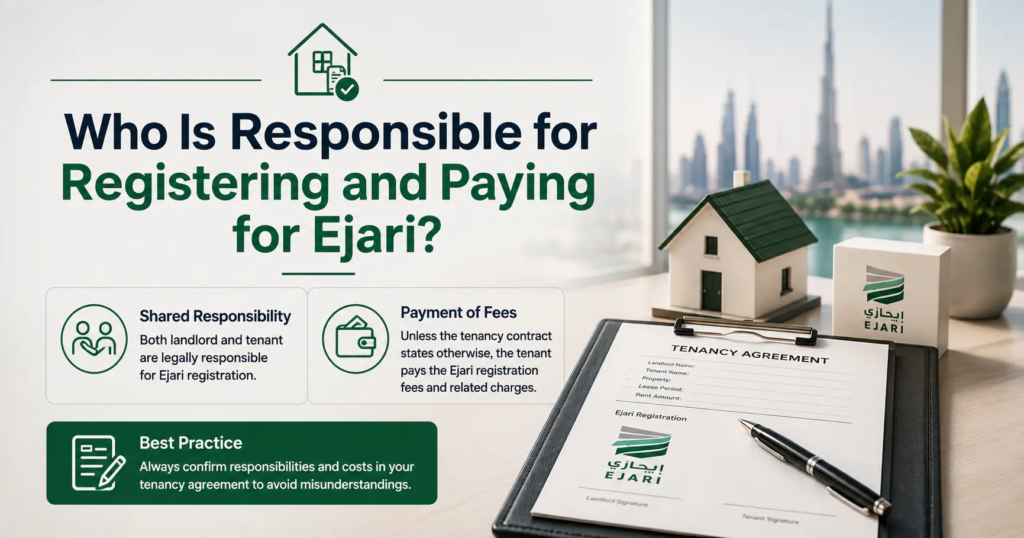
Who Is Responsible for Registering and Paying for Ejari?
Registration is technically a shared responsibility between landlord and tenant:
In practice, the tenant or the real estate agent usually completes the registration
On payment, Article 22 states that unless the tenancy agreement says otherwise, the tenant covers government fees and taxes tied to using the property
Article 22 doesn’t name the Ejari fee specifically, so it’s worth confirming who pays directly in the tenancy agreement rather than assuming
Can You Change Details on an Active Ejari?
No. An active Ejari cannot be modified once registered, not the rent, not the dates, nothing. If any detail changes, the existing contract has to be cancelled and a new one registered from scratch.
What Actually Happens If Your Ejari Is Late or Missing?
The real consequence is being blocked from services that require a current Ejari, not a cash fine:
No new DEWA connection
Visa renewals and certain sponsorship processes blocked
Rental Dispute Centre filings cannot proceed without it
Mainland business licence renewal blocked if it relies on the same tenancy, a point worth knowing if you’re also dealing with a trade licence fine check
An Unregistered Year Blocks the Next One
DLD will not register a new period if an earlier period on the same unit was never registered. The gap has to be cleared first, with the signed contract for that period, before you can move forward.
A Real Example
Ahmed’s tenancy expired in May, but he didn’t renew his Ejari until August. He wasn’t charged a late fine, since none exists, but he couldn’t reconnect DEWA at his new address or complete a visa renewal until his Ejari was updated. Once he renewed, both processes went through normally.
Common Mistakes About the Ejari Violation Fine in the UAE
Assuming AED 500 or a similar figure is an official government fine
Waiting until a visa renewal to discover the Ejari has lapsed
Forgetting that a previous year’s contract also needs registering before the current one
Confusing Ejari with Tawtheeq, Abu Dhabi’s separate system
Does an Expired Ejari Cancel Your Tenancy?
No. Under Article 6, the tenancy itself continues automatically if certain conditions are met:
The tenant remains in occupation
The landlord doesn’t object
In that case, the tenancy carries on even though the Ejari registration has lapsed. The administrative record and the legal relationship are separate, the registration simply needs renewing to bring the record back in line with reality.
How to Register or Renew a Late Ejari
Gather the signed tenancy contract and standard documents, Emirates ID, passport, DEWA premise number if available
Register or renew through theDubai Land Department portal, the Dubai REST app, a Real Estate Services Trustee Centre, or a licensed property management company
If a prior period is missing, register that period first using its own signed contract
Pay the standard fee, there’s no separate late fee on top
This works similarly to how vehicle registration renewal handles a lapsed record, catching up through the standard process, rather than a punitive one.
Current Ejari Fees
Channel
Cost
Online (Dubai REST / DLD portal)
AED 177.75
Trustee centre
AED 220
Cancellation via app or system
Free
Cancellation via trustee centre
AED 40 + VAT
How Long Does Registration Take?
Processing time depends on the channel:
Dubai REST app or DLD portal: typically a few hours to 24-48 hours
Trustee centre: often same-day, sometimes within minutes
Timing varies by document readiness and centre workload, so treat these as general ranges rather than guarantees.
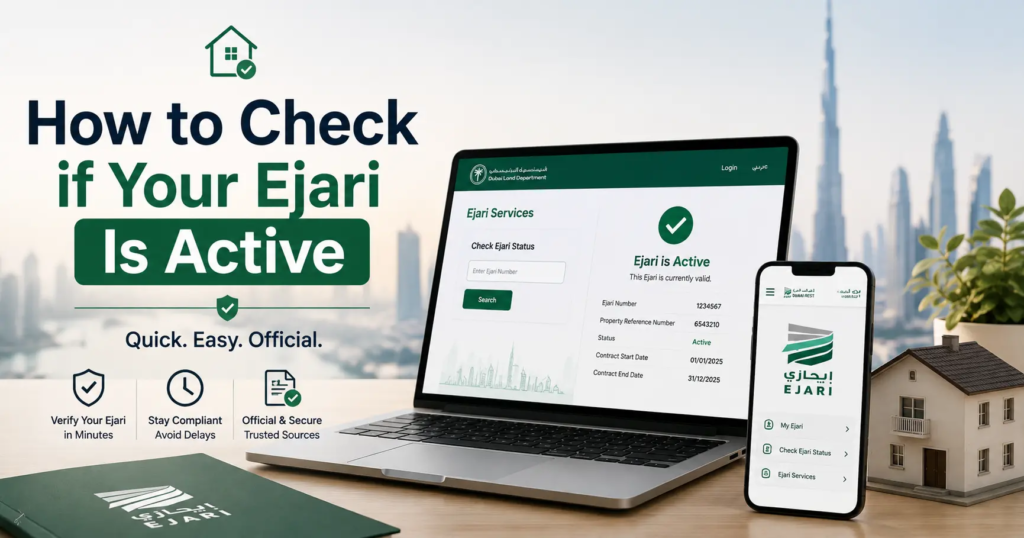
How to Check if Your Ejari Is Active
If you’re not sure whether a violation applies to you, check your status first:
Dubai REST app: log in and view your certificate under “My Contracts”
DLD portal: retrieve your certificate using your Ejari number or tenancy details
Trustee Centre: request a status check or reprint in person
This confirms whether you actually have an open issue before assuming a fine or violation applies.
Does Ejari Apply Everywhere in the UAE?
No, and assuming it does is a common mistake.
DIFC: has its own regime, leases over 6 months register with the DIFC Registrar of Real Property instead, and disputes go through DIFC Courts, not the Rental Dispute Centre
Holiday homes: cannot be registered on Ejari at all, they sit under a separate tourism authority system
Abu Dhabi: uses Tawtheeq, a different system entirely, not interchangeable with Ejari
If you’re outside Dubai mainland specifically, confirm which registration system actually applies before assuming Ejari rules, fees, or this violation guidance are relevant to you.
Dubai’s New Shared Housing Law: Fines Up to AED 1,000,000
This is a separate, much more serious violation category, distinct from standard late Ejari registration.
Law No. 4 of 2026 regulates shared housing across private development zones and free zones
It takes effect 26 August 2026
Fines range from AED 500 up to AED 500,000, doubling to AED 1,000,000 for repeat violations within a year
Tenants are barred from subletting any part of a shared unit, only owners or authorised management companies can lease shared housing
A new permit system is required, issued by Dubai Municipality in coordination with DLD
Additional penalties can include suspension of activity for up to 6 months, permit cancellation, commercial licence revocation, service disconnection, or eviction
Is There a Grace Period for the New Shared Housing Law?
Yes, a full year from the law’s effective date, putting the compliance deadline at 26 August 2027. Dubai Municipality has confirmed this grace period itself serves as the advance warning before enforcement and inspections begin.
Can You Dispute an Ejari-Related Issue?
Yes, primarily through the Rental Dispute Centre, which handles formal disputes between tenants and landlords, including situations tied to registration gaps or a landlord’s failure to cooperate with registration.
Conclusion
Two things matter most about an Ejari violation fine in the UAE:
There’s no verifiable official fine for a late Ejari specifically, the real cost is being blocked from other services until it’s sorted, not a cash penalty
Dubai’s genuinely serious new fines, up to AED 1,000,000, apply to shared housing and subletting violations under a brand new law, not standard late registration
Confirm your specific situation directly with the Dubai Land Department, and be skeptical of any guide citing a specific late-registration fine without a legal source behind it. When it comes to an Ejari violation fine in the UAE, accuracy matters more than repeating a number nobody can trace.
Updates Section
Last verified: August 2026. Reflects Law No. 26 of 2007 as amended by Law No. 33 of 2008, RERA’s 2009 fines schedule, current DLD Ejari fees as of July 2026, and Dubai Municipality’s confirmation of Law No. 4 of 2026’s effective date.
Frequently Asked Questions
Is there a fine for late Ejari registration in Dubai?
No officially published fine exists. Anyone searching for an Ejari violation fine in the UAE should know this was checked directly against the governing laws and RERA’s fines schedule, and no penalty for non-registration appears in either. The real consequence is being blocked from DEWA, visa, and other services until it’s registered.
What happens if I don’t have Ejari?
You won’t face a government fine, but you’ll be blocked from connecting DEWA, completing certain visa or sponsorship processes, filing at the Rental Dispute Centre, and renewing a mainland business licence tied to that tenancy.
What is the AED 500,000 to AED 1,000,000 fine I’ve seen mentioned for Ejari?
That figure relates to a separate, new law, Law No. 4 of 2026 on shared housing, not standard late Ejari registration. It applies specifically to subletting and shared housing violations, effective 26 August 2026.
How much is the Ejari fee in the UAE?
AED 177.75 online through the Dubai REST app or DLD portal, or AED 220 at a trustee centre, the same fee whether you’re on time or late.
What will happen if Ejari is not renewed?
The registration simply stays expired until you renew it, there’s no separate penalty, but you’ll be blocked from services requiring a current Ejari, and the tenancy itself can still continue under Article 6 if the tenant stays and the landlord doesn’t object.
Does an expired Ejari cancel my tenancy?
No. Under Article 6, the tenancy can continue automatically if the tenant stays and the landlord doesn’t object, even though the registration itself needs renewing separately.
Can I be blocked from renewing my Ejari if a previous year was never registered?
Yes. DLD requires the missing period to be registered first, using its original signed contract, before a new period can be added.
Is an unregistered lease legally unenforceable in Dubai?
Not exactly, this is a commonly overstated claim. An older provision in the 2007 law said this, but it was removed by the 2008 amendment. The Rental Dispute Centre still requires a current Ejari for a standard claim, creating a similar obstacle without it being a strict unenforceability rule.
Who pays for Ejari registration, the landlord or the tenant?
It’s technically a shared responsibility, but the tenant or agent usually completes it. Article 22 puts government fees on the tenant by default, unless the tenancy agreement states otherwise.
Does Ejari apply in Abu Dhabi or the DIFC?
No. Abu Dhabi uses Tawtheeq, a separate system, and the DIFC has its own registration regime through the DIFC Registrar of Real Property. Neither is interchangeable with Ejari.
Anees is a UAE-based content creator, writer, and SEO professional with over 12 years of experience. Since 2014, he has published research-backed guides on UAE visas, labour laws, jobs, traffic fines, and government services, all verified against official sources. He is certified in SEO by HubSpot Academy and Digital Marketing by Google Digital Garage.
12+ Years ExperienceHubSpot Academy — SEOGoogle Digital Garage
Disclaimer: This information is for general guidance only, based on publicly available UAE laws and regulations. It does not constitute legal advice. Always verify with official UAE government sources or a qualified legal professional.



Your email will not be published. Comments are reviewed before appearing.