UAE Visa Overstay Fine 2026: AED 50/Day RulesMinimum Salary to Sponsor Your Family Visa in UAEUAE Labour Law: Notice Period ExplainedHow to Check Your UAE Visa Status OnlineUAE Golden Visa Eligibility Requirements UpdatedUAE Visa Overstay Fine 2026: AED 50/Day RulesMinimum Salary to Sponsor Your Family Visa in UAEUAE Labour Law: Notice Period ExplainedHow to Check Your UAE Visa Status OnlineUAE Golden Visa Eligibility Requirements Updated
Offshore Business Setup in Dubai: Complete Guide to Cost, Requirements & Registration
The UAE Times
–
–
– min read
Last updated: – · Based on official UAE sources
Last updated: September 2026
An offshore business setup in Dubai is designed mainly for international business, holding assets, owning certain investments or property, and structuring cross-border activities. It is not the same as opening a normal Dubai mainland or free zone company, which is why choosing the right structure is one of the first decisions when planning business activities in the UAE.
For many investors, the biggest question is not simply how to register an offshore company. It is whether an offshore structure actually fits the intended business.
That distinction matters. A JAFZA offshore company can hold property in designated freehold areas, own stakes in UAE companies and maintain a UAE bank account, but it cannot simply operate in Dubai like a normal licensed trading or service company.
This guide explains offshore business setup in Dubai from the ground up, including JAFZA, RAK ICC and Ajman, costs, documents, banking, property ownership, UAE Corporate Tax, compliance and the difference between offshore, free zone and mainland companies.
What Is an Offshore Company in Dubai?
An offshore company is a legal entity created under a UAE offshore regime primarily for international or holding purposes.
It is different from a normal operating company.
A standard Dubai mainland or free zone company generally gets a business licence that allows it to conduct specified commercial, professional or industrial activities. A JAFZA offshore company, by contrast, is incorporated under the JAFZA offshore framework and receives a certificate of incorporation rather than a normal business licence.
In simple terms:
Offshore is mainly a corporate structuring vehicle. It is not a shortcut to operate any business inside Dubai.
An offshore company may be useful for:
International business activities
Holding shares in other companies
Investment holding
Asset holding
Certain Dubai property ownership structures
Intellectual property ownership
International consulting structures
Wealth and succession planning
Cross border corporate structures
JAFZA’s regulations also allow an offshore company to own property in designated freehold areas, hold a stake in another UAE operating company and maintain a UAE bank account, subject to the applicable rules.
Is Offshore Company Formation Legal in Dubai?
Yes. Offshore company formation is a legal corporate structure in Dubai when it is established and operated under the applicable regulations.
JAFZA publishes specific Offshore Companies Regulations and provides an official registration process through its registered agents.
However, legal does not mean unrestricted.
An offshore company must still comply with:
Its jurisdiction’s company regulations
Beneficial ownership requirements
KYC and AML requirements
Banking rules
Applicable tax laws
Foreign country tax rules
Property ownership rules
Any sector specific regulations
This is why the phrase “offshore means no rules” is misleading.
Offshore Company in Dubai vs Offshore Company in UAE
This is one of the most confusing parts of the subject.
The phrase offshore company in Dubai usually points to JAFZA Offshore, the offshore structure associated with Jebel Ali Free Zone in Dubai.
The UAE also has other corporate structuring jurisdictions, including RAK International Corporate Centre (RAK ICC) in Ras Al Khaimah. RAK ICC describes itself as a corporate and wealth structuring centre used for holding companies, investments, asset protection, real estate and international banking relationships.
So:
JAFZA Offshore = Dubai
RAK ICC = Ras Al Khaimah
Ajman Offshore = Ajman
They should not automatically be treated as three identical products.
JAFZA Offshore vs RAK ICC vs Ajman Offshore
For someone searching for an offshore business setup in Dubai, JAFZA is the Dubai specific option. RAK ICC and Ajman are UAE alternatives that may suit different objectives.
Feature
JAFZA Offshore
RAK ICC
Ajman Offshore
Jurisdiction
Dubai
Ras Al Khaimah
Ajman
Main focus
International and holding structures
Wealth and corporate structuring
International and holding structures
Registered agent
Required
Required
Requirements depend on current framework
Normal UAE operating licence
No
Not a normal mainland operating licence
Not a normal mainland operating licence
UAE residence visa
Not the normal route
Not the normal route
Not the normal route
Property holding
Permitted subject to applicable rules
Used for real estate and other assets subject to local rules
Property rules require separate verification
UAE bank account
Permitted under JAFZA rules, subject to bank approval
Local and international banking relationships are supported
Subject to bank approval
Best known for
Dubai corporate and property structures
Holding, wealth and asset structures
Cost conscious offshore structures
RAK ICC officially states that its structures are used for wealth preservation, asset protection, holding shares in UAE and international companies, global investments, real estate and banking relationships.
For Dubai specific offshore company registration, JAFZA is therefore the most relevant jurisdiction to examine first.
Why Set Up an Offshore Company in Dubai?
The main reason is usually structure, not day to day trading.
International business structure
An offshore company can be used as part of an international corporate structure where the actual commercial operations take place outside the UAE.
Holding company structure
An investor may use an offshore company to hold shares in other companies.
JAFZA regulations expressly allow an offshore company to own a stake in another operating company in the UAE.
Asset holding
An offshore entity can separate certain assets from an individual’s personal ownership, although asset protection is never absolute and depends on the structure and applicable laws.
Property ownership
JAFZA’s offshore regulations permit ownership of property in designated freehold areas in the UAE.
Intellectual property
Offshore structures can be used for holding intellectual property such as certain copyrights, patents and other rights, subject to the relevant registration and tax rules.
International investments
The structure can also be useful for investors who need a company to hold investments or participate in international corporate structures.
Wealth and succession planning
For larger family structures, a company or related legal structure can sometimes form part of wider succession or wealth planning.
This is also an area where RAK ICC has developed a strong corporate structuring focus.
What Can an Offshore Company in Dubai Be Used For?
A useful way to understand an offshore company is to look at what it is designed to hold or structure.
Common uses include:
International trading structures
Holding shares in other companies
Investment portfolios
Certain real estate holdings
Intellectual property
Corporate assets
International consulting structures
Family wealth structures
Cross border corporate ownership
Special purpose structures
JAFZA itself lists international trade, holding companies, real estate ownership, copyrights and patents, and international consulting among the uses of its offshore structure.
What Can an Offshore Company NOT Do in Dubai?
This is where many articles become misleading.
A JAFZA offshore company is not a normal Dubai operating company.
JAFZA states that an offshore company is not issued a business licence and cannot conduct commercial activity with persons within the UAE. Its regulations also state that appropriate licences or permits are required for business activities in the zone or another jurisdiction.
Therefore, an offshore company should not be treated as a replacement for a mainland or operating free zone licence.
Can an offshore company trade directly in Dubai?
Not simply because it has been incorporated offshore.
If the business intends to conduct regulated or commercial activities inside Dubai, the appropriate operating licence and approvals may be required.
Can it open a Dubai shop?
Not as a normal offshore company.
A retail shop requires an appropriate operating structure and licence.
Can it run a normal Dubai office?
An offshore company has a registered office arrangement, but that is different from having a commercial operating office for a licensed business. JAFZA’s regulations provide for a registered office, including the office of its registered agent in Dubai.
Can it hire employees in Dubai?
An offshore structure should not be selected on the assumption that it provides the normal employment and visa infrastructure of an operating company.
Can it sponsor UAE residence visas?
A person should not assume that offshore incorporation automatically creates a UAE residence visa route.
The visa framework is one of the major differences between offshore structures and operating free zone or mainland companies.
Offshore Company Requirements in Dubai
The exact requirements depend on the jurisdiction and ownership structure.
For a JAFZA offshore company, the official process requires a registered agent and supporting incorporation documents. JAFZA’s current service guide lists documents for individual and non individual applicants.
Typical requirements include:
At least one shareholder
Director information
Secretary information
Registered office
Registered agent
Proposed company name
Business purpose or activity
Memorandum and Articles of Association
Passport copies
KYC information
Beneficial ownership information
Additional corporate documents where the shareholder is another company
JAFZA’s regulations allow an offshore company to be formed by one or more persons and require the application to include details such as the company name, registered office, business nature and share capital.
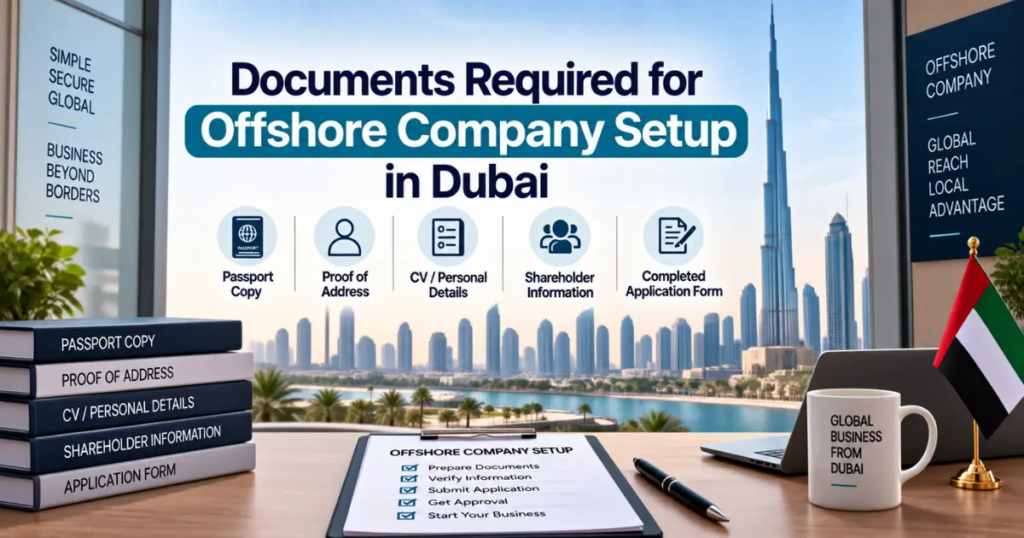
Documents Required for Offshore Company Setup in Dubai
For an Individual Shareholder
JAFZA’s current service guide lists items including:
Passport copy
Founder details and CV
Specimen signature
Application documents
Director and secretary passport copies
Registered agent appointment documents
The Registrar may request additional documents where necessary.
For a Corporate Shareholder
A corporate shareholder can expect a more detailed due diligence process.
Documents may include:
Certificate of incorporation or registration
Certificate of good standing
Memorandum and Articles of Association
Incumbency information
Board resolution
Power of Attorney
UBO information
Passport copies of relevant individuals
Attestation and legalisation where required
JAFZA specifically lists notarised and attested corporate documents for non individual applicants.
The exact checklist can change according to the applicant, ownership structure and Registrar requirements.
How to Set Up an Offshore Company in Dubai
The offshore company registration Dubai process is more straightforward when the business purpose is decided first.
Step 1: Decide Why the Company Is Needed
Before choosing a jurisdiction, define the purpose.
For example:
An investor wants a corporate entity to hold qualifying Dubai property.
That is very different from:
An entrepreneur wants to sell services to Dubai customers.
The first may justify researching an offshore structure. The second may require an operating company instead.
Step 2: Choose the Jurisdiction
For Dubai offshore structures, JAFZA is the key jurisdiction.
RAK ICC and Ajman can be considered when the objectives point toward those jurisdictions.
Step 3: Choose the Company Name
JAFZA recommends preparing multiple name choices to reduce delays caused by an unavailable name. Its regulations also specify the required company name format.
Step 4: Appoint a Registered Agent
JAFZA requires offshore company registration to be processed through its registered agents. The agent handles communication and document submission with the offshore section.
Step 5: Prepare the Documents
The applicant provides the required personal or corporate documents.
This is also when KYC and beneficial ownership information is reviewed.
Step 6: Prepare the MOA and AOA
The Memorandum and Articles of Association set out important company information and governance rules.
Step 7: Submit the Application
The registered agent submits the incorporation application and supporting documents through the applicable JAFZA process.
Step 8: Receive the Certificate of Incorporation
Unlike a normal operating business licence, the JAFZA offshore structure is issued a certificate of incorporation.
Step 9: Arrange Banking
Once the company exists, the owner can approach a bank for a corporate account.
Approval is not automatic.
Step 10: Maintain the Company
Formation is only the beginning.
The company must continue meeting its:
Corporate requirements
KYC obligations
Beneficial ownership requirements
Banking requirements
Tax obligations where applicable
Annual renewal obligations
Record keeping requirements
How Much Does Offshore Business Setup in Dubai Cost?
There is no single universal offshore company setup cost in Dubai.
The total depends on the jurisdiction, ownership structure, professional services and additional compliance work.
For JAFZA, the current official service guide lists:
AED 10,000 registration fee
AED 50 specimen signature fee per signature
Courier charges where applicable
JAFZA currently states a processing time of 5 to 7 working days for its New Offshore Company service.
That does not mean every applicant’s total bill will be AED 10,000.
Other possible costs
The overall budget can include:
Registration fee
Registered agent fee
Registered office or administration fee
Document attestation
Legalisation
Translation
Courier charges
Banking support
Accounting
Tax compliance
Annual renewal
Corporate secretarial services
Additional regulatory approvals
This is why two offshore company formation quotes can look very different even when both are described as “company registration.”
A better way to compare quotes
The applicant should ask:
What exactly is included?
A quote that looks cheaper may exclude the registered agent, annual renewal, document attestation or compliance services.
JAFZA also provides an official cost calculator for its wider company formation services.
How Long Does Offshore Company Formation Take in Dubai?
For JAFZA, the current official service page states 5 to 7 working days for a new offshore company application.
That is the stated processing time, not a promise that every complete setup will finish within that period.
Delays can happen because of:
Missing documents
Incorrect information
Name issues
Document attestation
Complex ownership
Corporate shareholders
Additional KYC checks
Registrar requests
Banking due diligence
The company formation stage and bank account stage should also be treated as separate processes.
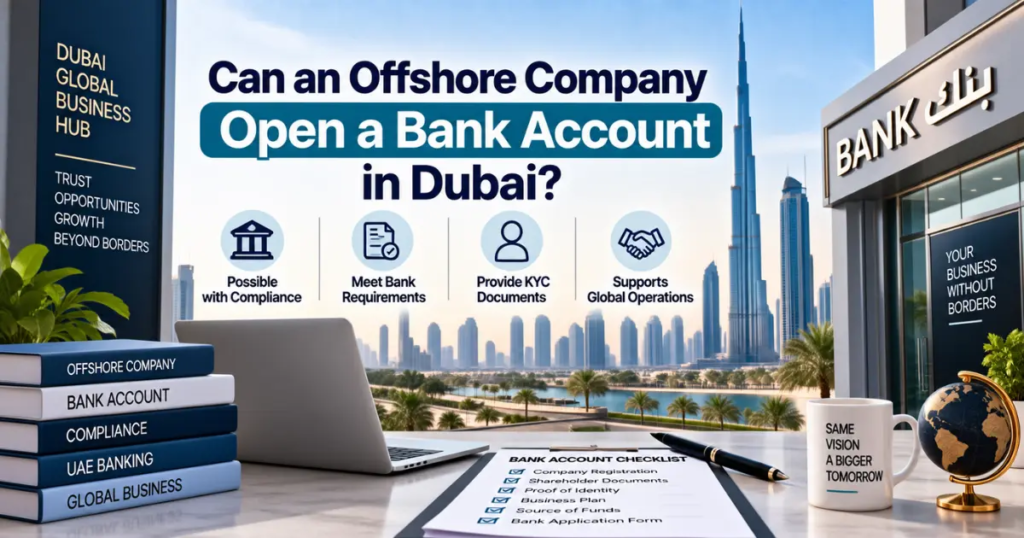
Can an Offshore Company Open a Bank Account in Dubai?
Yes, a JAFZA offshore company can hold an account with a bank in the UAE under the JAFZA regulations. The regulations specifically list holding a UAE bank account among permitted activities.
But this does not mean a bank must approve the application.
Banks conduct their own due diligence.
They may want to understand:
Who owns the company?
Who is the ultimate beneficial owner?
What does the company do?
Where does its money come from?
Who are its customers?
Which countries will it transact with?
What is the expected transaction volume?
Why is a UAE bank account required?
What is the source of wealth?
What is the source of funds?
Why offshore bank account applications can take longer
An offshore structure can involve cross border ownership and transactions.
That can lead to deeper KYC and AML checks.
A clean application should therefore have:
Clear business purpose
Consistent company documents
Transparent ownership
Source of funds evidence
Source of wealth information where required
Realistic transaction expectations
Complete KYC documents
An offshore company should never be marketed as a guaranteed way to obtain a UAE corporate bank account.
Can an Offshore Company Own Property in Dubai?
Yes, a JAFZA offshore company can own property in designated freehold areas in the UAE, subject to the applicable property rules.
JAFZA’s offshore regulations expressly permit an offshore company to own property in designated freehold areas.
The company may also request certain property related documents from JAFZA. Its current services include a No Objection Certificate for owning property.
However, the company structure does not remove the need to follow Dubai real estate rules.
Before purchasing, the investor should confirm:
Whether the specific property permits the proposed ownership structure
Dubai Land Department requirements
Corporate documents required for registration
Beneficial ownership information
Financing requirements
Any lender restrictions
Transfer and registration costs
The Dubai Land Department remains the relevant authority for Dubai property registration and related services.
Can an Offshore Company Own Shares in a UAE Company?
Yes, JAFZA’s offshore regulations expressly allow an offshore company to own a stake in another operating company in the UAE.
This makes the structure relevant to holding company arrangements.
For example:
Investor → Offshore Holding Company → Shares in Operating Company
The operating company would still need its own appropriate licence and regulatory permissions.
The offshore entity does not turn an unlicensed activity into a licensed one.
Is an Offshore Company in Dubai Tax Free?
This is one area where older articles can be misleading.
An offshore company should not automatically be described as “tax free.”
The UAE has had a federal Corporate Tax regime for financial years beginning on or after 1 June 2023. The Ministry of Finance states that UAE incorporated juridical persons are broadly within the Corporate Tax framework, while specific rules determine the taxable position.
The standard Corporate Tax rates are:
0% on taxable income up to AED 375,000
9% on taxable income above AED 375,000
The rate applies to taxable income, not simply company revenue.
Therefore, the statement:
“Dubai offshore companies pay zero tax.”
is too broad for a current 2026 guide.
The actual tax position depends on factors such as:
Entity status
Source and nature of income
UAE tax residence
Permanent establishment
Property income
Applicable exemptions
Free zone tax rules where relevant
Foreign country tax rules
International tax treaties
Ownership and management arrangements
The FTA also states that a UAE incorporated juridical person is a Resident Person for Corporate Tax purposes.
What about JAFZA’s tax exemption letter?
JAFZA still lists a Tax Exemption Letter among its offshore company letters.
That should not be interpreted as a blanket exemption from every federal tax obligation.
The JAFZA administrative document and the UAE federal Corporate Tax rules are separate matters.
For a real structure, the tax position should be reviewed against the current Corporate Tax Law and FTA guidance.
Does an Offshore Company Need to Register for Corporate Tax?
There is no safe rule that says every offshore company is automatically exempt.
The FTA states that all juridical persons subject to Corporate Tax must register and obtain a Corporate Tax Registration Number. It also provides specific registration rules for UAE resident juridical persons.
For that reason, an offshore company should first determine:
Whether it is a taxable person.
Whether it is a UAE resident juridical person.
What income it earns.
Whether any exemption applies.
Whether registration is required.
What filing obligations apply.
This is much safer than relying on an old “offshore equals tax exempt” statement.
What About VAT for an Offshore Company?
VAT is separate from Corporate Tax.
The UAE standard VAT rate is 5%.
The FTA currently states that a business generally must register when its taxable supplies and imports exceed AED 375,000, while voluntary registration can apply above AED 187,500. The mandatory threshold does not apply to foreign businesses in the same way, so the facts of the business matter.
An offshore company should therefore not assume:
“Offshore means no VAT.”
The VAT treatment depends on the nature and location of the supplies, imports and the company’s circumstances.
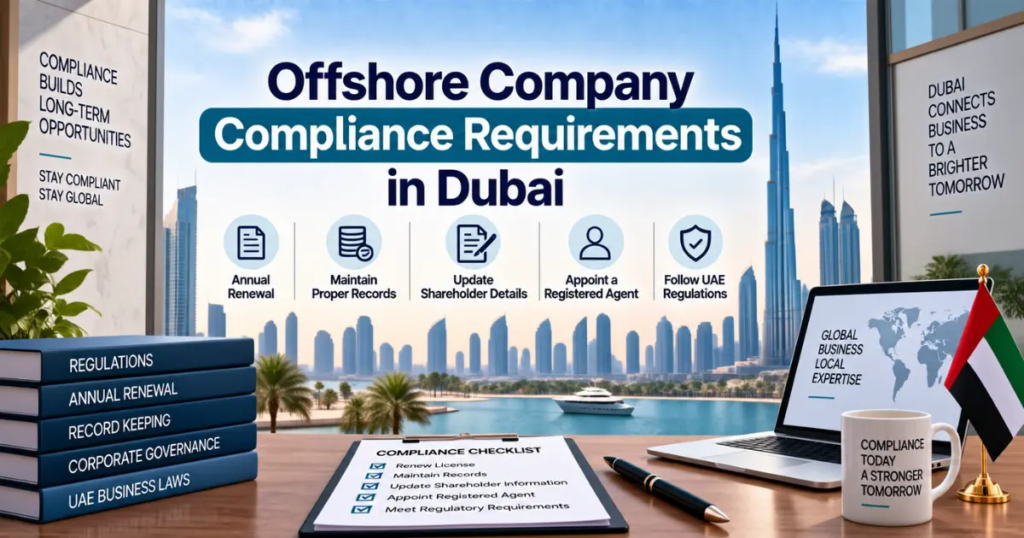
Offshore Company Compliance Requirements in Dubai
Keeping the company active requires more than paying the initial registration fee.
Important areas include:
Annual renewal
The company must remain in good standing with its offshore jurisdiction.
Corporate records
Important company records should remain current.
Beneficial ownership
The real people behind the company must be properly identified where required.
KYC and AML
Banks, agents and authorities may require ongoing due diligence.
Accounting records
Financial records should be maintained according to applicable requirements.
Tax compliance
Corporate Tax registration and filing requirements must be assessed where applicable.
Banking compliance
The bank may periodically request updated corporate documents or information about transactions.
RAK ICC, for example, requires annual returns and updated documents where KYC documents have expired, and it states that UBO changes should be reported within two weeks.
Is Economic Substance Still Relevant to Offshore Companies in the UAE?
This subject requires care because older offshore articles often repeat the UAE’s former Economic Substance Regulations without considering subsequent changes.
The correct approach in a 2026 article is not to automatically tell every offshore company that it has a separate ESR notification requirement.
Instead, the company should check its current obligations under the applicable UAE tax and corporate framework.
The same principle applies to:
CRS
FATCA
AML
UBO reporting
Transfer pricing
Corporate Tax
VAT
These are compliance areas that can depend on the company’s structure and activities.
Offshore Company vs Free Zone Company in Dubai
These structures serve different purposes.
Feature
Offshore
Free Zone
Main purpose
International and holding structure
Operating business
Business licence
Not a normal operating licence
Yes
UAE operating activity
Restricted
Permitted within applicable free zone rules
Employees and visas
Not the normal route
Available subject to package and rules
Office
Registered office arrangement
Office options available
International trade
Suitable for permitted international structures
Strong option
UAE market access
Restricted
Subject to applicable rules and approvals
Property holding
Possible under applicable rules
Depends on entity and property rules
Best for
Holding and structuring
Running a business
The UAE Government explains that free zone companies can conduct international import, export and re export activities, while mainland access is regulated.
Choose offshore when:
The primary goal is:
Holding
International structuring
Certain asset ownership
Corporate investment
Specific property ownership structures
Choose a free zone when:
The business needs:
A business licence
UAE operations
Office infrastructure
Employees
Residence visas
International trading
A scalable operating company
Offshore Company vs Mainland Company in Dubai
A mainland company is generally the more suitable structure when the business needs to operate directly in Dubai.
For example:
Consultancy serving Dubai clients → mainland or suitable free zone structure
Restaurant in Dubai → operating licence
Retail store → operating licence
Dubai based service company with employees → operating structure
International holding company → offshore may be worth considering
The UAE Government provides separate frameworks for mainland and free zone businesses, including licensing and operating requirements.
The key question is therefore not:
“Which structure is cheapest?”
It is:
“Where will the company actually conduct its business?”
Who Should Consider Offshore Business Setup in Dubai?
An offshore structure may be worth researching for:
International investors
Investors with assets and business interests across multiple countries may need a holding structure.
Holding companies
An offshore entity can hold shares in other companies where permitted.
Property investors
JAFZA can be relevant where the intended Dubai property falls within the applicable ownership rules.
International traders
Businesses operating internationally rather than directly inside the UAE may find the structure useful.
Intellectual property owners
Certain IP rights can be held through a corporate structure.
Family wealth structures
Larger families may consider corporate structures as part of broader succession and wealth planning.
Existing business owners
An offshore company can sometimes form part of a wider corporate restructuring.
Who Should Not Choose an Offshore Company in Dubai?
An offshore company may be the wrong choice when the owner wants to:
Run a restaurant
Open a retail shop
Operate a local service business
Employ a large UAE based team
Sponsor normal employee visas
Maintain a physical operating office
Sell directly into the UAE market
Conduct regulated local activities
Build a normal Dubai operating company
For these cases, a mainland or appropriate free zone structure is usually more relevant.
Can a Foreigner Set Up an Offshore Company in Dubai?
Yes. Foreign investors can establish offshore companies under the applicable jurisdiction’s rules.
JAFZA’s regulations allow one or more persons to apply for formation, while shareholders can be individuals or corporate entities.
The applicant still has to complete the required KYC and corporate documentation.
Foreign ownership does not mean exemption from due diligence.
Can a Non Resident Set Up an Offshore Company in Dubai?
Yes, offshore structures are specifically relevant to international and non resident investors, subject to the jurisdiction’s requirements.
The important point is that company ownership and UAE residency are different things.
A person can own an offshore company without automatically becoming a UAE resident, so anyone planning to combine company formation with a UAE immigration route should also consider the UAE business visa requirements separately.
Similarly, incorporating a company does not automatically create a UAE tax residency certificate.
The FTA has a separate process for Tax Residency Certificates for persons that qualify as UAE tax residents under UAE legislation or an applicable Double Tax Agreement.
Can Offshore Company Registration Be Done Without Visiting Dubai?
JAFZA processes offshore registration through registered agents and provides an online service process.
This means physical presence is not necessarily required for every part of incorporation.
However, banking is a separate matter.
A bank may require:
Video verification
Additional KYC
An interview
Original or certified documents
Proof of address
Source of funds information
Additional information about the business
Therefore:
Remote company formation does not guarantee remote bank account approval.
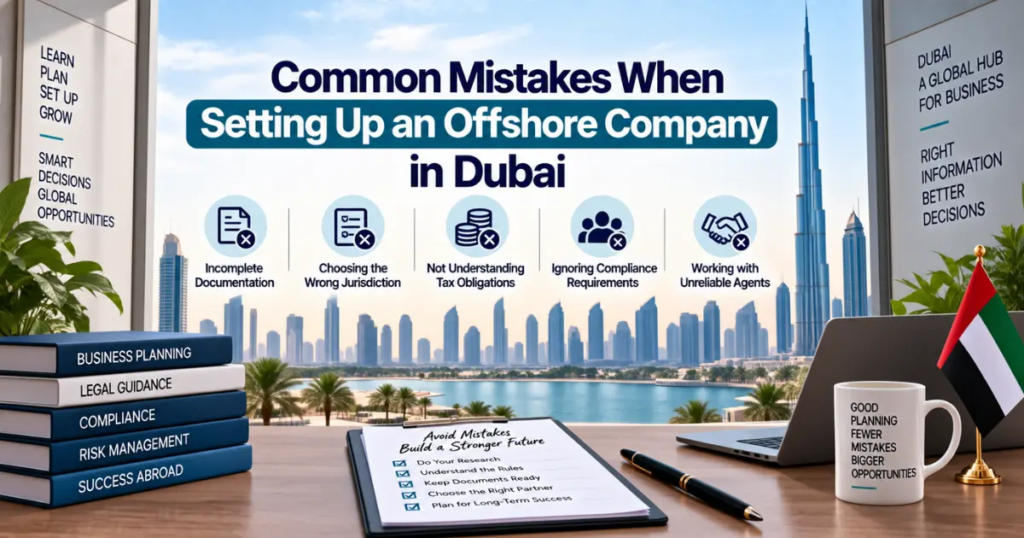
Common Mistakes When Setting Up an Offshore Company in Dubai
Choosing offshore because it sounds cheaper
The cheapest structure is not always the right structure.
A low registration fee means little if the business later needs another licence to operate.
Assuming offshore means tax free
The UAE Corporate Tax framework must be considered based on the company’s actual status and income.
Ignoring banking
Company incorporation and bank approval are different processes.
Using the wrong jurisdiction
A Dubai property investor may have a different requirement from an international holding company.
Assuming an offshore company can trade locally
JAFZA specifically restricts commercial activity with persons within the UAE.
Ignoring foreign taxes
A UAE company does not automatically remove tax obligations in another country.
Choosing an agent only because of price
The registered agent can play an important role in incorporation and ongoing administration.
Forgetting annual compliance
An offshore company needs ongoing maintenance.
How to Choose the Right Offshore Jurisdiction
A simple decision framework can help.
Choose JAFZA Offshore when:
Dubai is central to the structure
Dubai property ownership is relevant
A UAE corporate structure is required for international purposes
The JAFZA framework fits the intended activity
Consider RAK ICC when:
Wealth structuring is important
Holding companies are the main objective
International investments are involved
Asset holding is central to the structure
RAK ICC officially positions its structures around wealth preservation, asset protection, investments, holding companies, real estate and banking.
Consider Ajman Offshore when:
The intended structure fits its current offshore framework
The investor is comparing UAE offshore jurisdictions
Cost and structure are important factors
Because Ajman requirements and commercial offerings can change, applicants should verify the current rules directly before paying a formation provider.
Offshore Business Setup in Dubai: A Simple Decision Example
Consider two investors.
Investor A
Owns an international company and wants a UAE corporate entity to hold shares in other companies.
An offshore or holding structure may be worth exploring.
Investor B
Lives in Dubai and wants to start a digital marketing agency serving UAE companies.
An offshore company is probably not the first structure to consider.
A professional or commercial operating licence through a suitable mainland or free zone setup may be more appropriate.
The difference is the business activity and operating model, not simply the investor’s nationality.
2026 Updates That Matter for Offshore Company Formation in Dubai
The most important change for anyone researching an offshore business setup in Dubai is that older “tax free UAE offshore” advice should not be copied into a current guide.
The UAE Corporate Tax system is now established, and the FTA continues to update registration, compliance and tax guidance. The FTA’s Corporate Tax legislation page includes new 2026 decisions, including updated registration and compliance measures.
The FTA also confirms that UAE resident juridical persons subject to Corporate Tax must register, while tax treatment depends on the applicable rules.
JAFZA has also updated its offshore service documentation. Its current New Offshore Company service lists AED 10,000 registration, 5 to 7 working days processing, and specific document requirements.
This is why a 2026 offshore company guide should rely on current authority material rather than old claims about zero tax, guaranteed banking or automatic visas.
Is Offshore Business Setup in Dubai Right for You?
The answer depends on what the company needs to do.
Business goal
Likely structure to investigate
Hold certain Dubai property
JAFZA Offshore may be relevant
Hold shares in other companies
Offshore or holding structure
International investment holding
Offshore or corporate structuring vehicle
Run a Dubai consultancy
Mainland or suitable free zone
Open a Dubai retail shop
Mainland or appropriate operating licence
Hire UAE employees
Operating free zone or mainland company
Obtain normal UAE business visas
Operating company structure
Conduct international business
Offshore or free zone, depending on activity
Build a UAE operating business
Mainland or free zone
Family wealth planning
Offshore, foundation or other suitable structure
There is no single “best” UAE company structure.
The right choice comes from the purpose, activity, customers, assets, location, banking needs and tax position.
Frequently Asked Questions
Is offshore company formation legal in Dubai?
Yes. Offshore company formation is a legal structure under applicable UAE jurisdiction rules. JAFZA publishes specific offshore regulations and provides an official registration process through registered agents.
How much does offshore business setup in Dubai cost?
For a new JAFZA offshore company, the current official service guide lists AED 10,000 for registration, plus applicable specimen signature and other charges. Professional, agent, document and annual compliance costs can increase the total.
Can a foreigner open an offshore company in Dubai?
Yes. JAFZA regulations allow individuals and corporate entities to act as shareholders, subject to the required documents and compliance checks.
Can a non resident set up an offshore company in Dubai?
Yes, offshore structures can be used by international and non resident investors. However, company ownership does not automatically provide UAE residence or tax residency.
Can an offshore company open a bank account in Dubai?
Yes, JAFZA regulations permit an offshore company to hold a UAE bank account. However, the bank makes its own approval decision after KYC and AML checks.
Can an offshore company own property in Dubai?
Yes, a JAFZA offshore company can own property in designated freehold areas, subject to the applicable rules and registration requirements.
Can an offshore company do business in Dubai?
Not in the same way as a normal licensed Dubai operating company. JAFZA states that its offshore company is not issued a business licence and cannot conduct commercial activity with persons within the UAE.
Can an offshore company get a UAE residence visa?
An offshore company should not be treated as the normal route for UAE residence visas. Investors who need UAE residence should investigate an appropriate operating company structure and the applicable immigration rules.
Is an offshore company in Dubai tax free?
Not automatically. UAE Corporate Tax rules apply based on the entity’s tax status, income and other relevant facts. A blanket “zero tax” claim is not appropriate for a current 2026 guide.
Does an offshore company need a Corporate Tax registration?
A company should determine whether it is a taxable person and whether registration is required. The FTA states that juridical persons subject to Corporate Tax must register and obtain a Corporate Tax Registration Number.
Does an offshore company pay VAT in the UAE?
VAT depends on the company’s taxable supplies, imports and circumstances. The UAE standard VAT rate is 5%, and the FTA currently sets the mandatory registration threshold at AED 375,000 for applicable businesses.
How long does offshore company registration in Dubai take?
JAFZA currently states 5 to 7 working days for its New Offshore Company service, assuming the application meets the requirements.
Can an offshore company be registered without visiting Dubai?
The incorporation process can be handled through a registered agent, but banking and other verification processes may still require additional checks or personal participation.
What documents are required for offshore company setup in Dubai?
Typical documents include passport copies, founder details, specimen signatures, incorporation documents and registered agent documents. Corporate shareholders require additional documents such as incorporation certificates, constitutional documents, board resolutions and beneficial ownership information.
What is the difference between JAFZA Offshore and RAK ICC?
JAFZA Offshore is the Dubai based offshore structure associated with Jebel Ali Free Zone. RAK ICC is based in Ras Al Khaimah and focuses heavily on corporate and wealth structuring, including holding companies, investments, assets and real estate.
Does an offshore company need an office in Dubai?
It needs an appropriate registered office arrangement. JAFZA regulations allow the registered office to be maintained in the zone, at qualifying property owned by the company, or at the registered agent’s office in Dubai.
Can an offshore company own shares in a UAE company?
Yes. JAFZA regulations permit an offshore company to own a stake in another operating company in the UAE.
What is the biggest disadvantage of an offshore company in Dubai?
The biggest limitation is that it is not a normal UAE operating licence. Businesses that need local customers, employees, offices, retail operations or regular UAE commercial activity may need a mainland or free zone operating structure instead.
Conclusion
An offshore business setup in Dubai can be useful, but only when the structure matches the investor’s actual objective.
It can make sense for international holding structures, certain asset ownership arrangements, investments, corporate ownership and qualifying property structures. JAFZA’s framework specifically permits activities such as holding UAE company stakes, owning property in designated freehold areas and maintaining UAE bank accounts.
But offshore should not be confused with a normal Dubai business licence.
If the goal is to operate a business inside Dubai, serve UAE customers, employ staff, maintain an operating office or obtain the normal infrastructure of an active UAE company, a mainland or suitable free zone structure deserves closer attention.
The tax side also needs more care than older offshore guides suggest. UAE Corporate Tax is now part of the business environment, and the actual liability depends on the company’s status, income and applicable rules.
The safest decision process is therefore simple:
Define the business purpose → choose the right jurisdiction → check operating restrictions → calculate the full setup and annual cost → confirm banking requirements → review Corporate Tax and VAT → then register.
That approach is far more useful than choosing an offshore company simply because it is advertised as cheap, tax free or easy to establish.
Anees is a UAE-based content creator, writer, and SEO professional with over 12 years of experience. Since 2014, he has published research-backed guides on UAE visas, labour laws, jobs, traffic fines, and government services, all verified against official sources. He is certified in SEO by HubSpot Academy and Digital Marketing by Google Digital Garage.
12+ Years ExperienceHubSpot Academy — SEOGoogle Digital Garage
Disclaimer: This information is for general guidance only, based on publicly available UAE laws and regulations. It does not constitute legal advice. Always verify with official UAE government sources or a qualified legal professional.



Your email will not be published. Comments are reviewed before appearing.